Background
Frailty, a measure of health vulnerability, is a determinant of health outcomes among people with HIV (PWH), including mortality. Claims-based frailty indices (CFI) enable scalable assessment using electronic health records when performance-based assessments are unavailable. We adapted and applied a CFI to quantify frailty burden and its distribution in an adult HIV population.
Methods
Participants in the DC Cohort Longitudinal HIV Study (2011-2025) were eligible if aged ≥40 years and enrolled ≥24 months. The index date was the earliest point both criteria were met, with at least one HIV outpatient visit confirming active care. We applied the Harvard CFI using ICD-9/10 and CPT codes, a weighted claims-derived measure (range 0-1, higher scores indicating greater frailty). Characteristics were summarized across frailty groups. Cox proportional hazards models estimated hazard ratios (HRs) for all-cause mortality, adjusting for demographics, CD4, opportunistic infections [OI], antiretroviral therapy[ART] era, and behavioral comorbidities (smoking, intravenous drug use (IDU), alcohol abuse).
Results
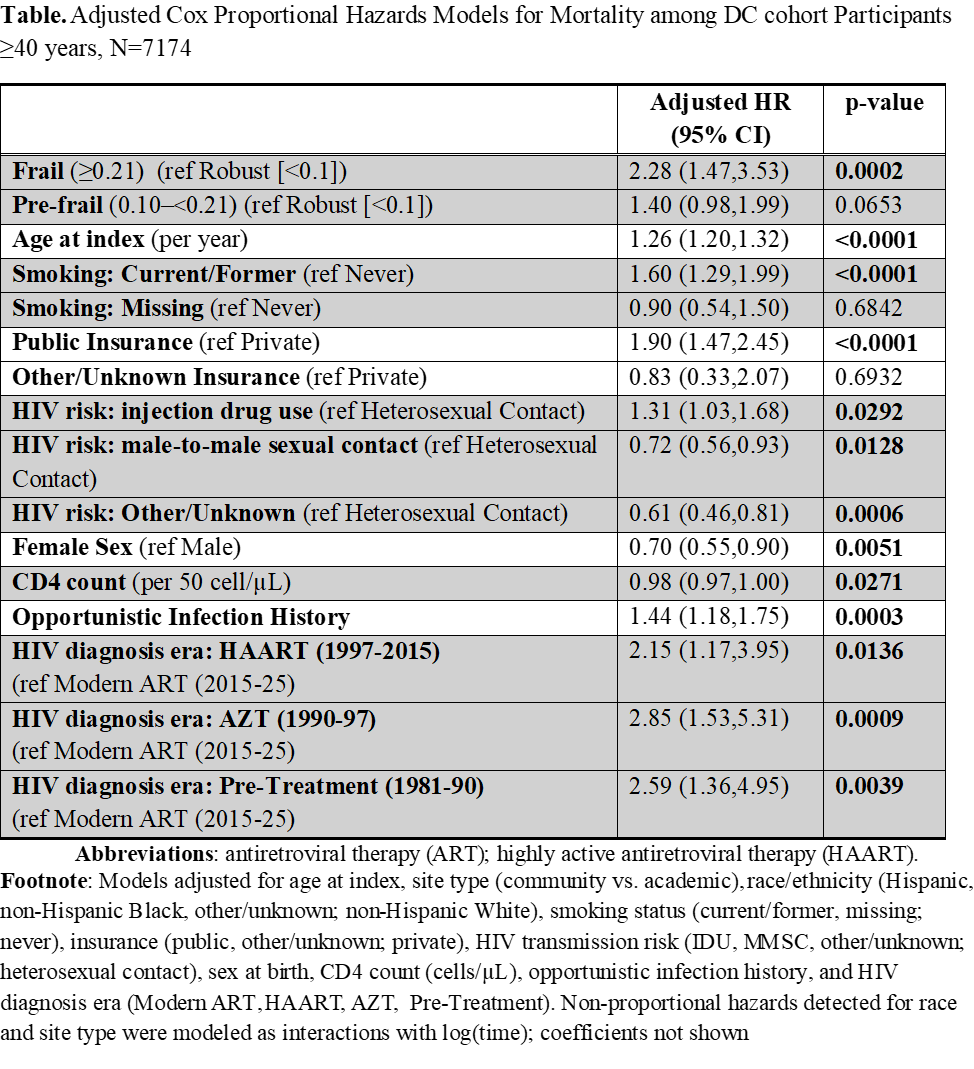
Among 7911 eligible participants (median age 52 years, 72% men, 77% Black), the mean CFI score was 0.12 (IQR: 0.11–0.15). Using conventional cutpoints, 14% were robust (CFI<0.1; lowest fraily), 83% prefrail (0.1-0.2), and 3% frail (≥0.21). Mortality increased by frailty group: robust (3.4%), prefrail (7.0%), frail (32.2%). Frailty scores increased with age and were higher among female and Black participants, those with behavioral comorbidities, public insurance, and prior OI. In adjusted models, frailty (aHR 4.2;2.8–6.5) was associated with higher mortality risk compared with robustness while pre-frailty showed a non-significant trend toward higher risk (aHR 1.4;0.98–2.0). Additional predictors of mortality were older age (aHR:1.3 per 5 years;1.2–1.3), public insurance (aHR:1.9;1.5–2.5). Lower CD4, prior OI, current/former smoking, and earlier ART eras were also associated with higher risk for mortality (Table). Female sex (aHR:0.6;0.5–0.8) and male-to-male sexual contact (aHR 0.7;0.6–0.9) were associated with lower mortality risk.
Conclusions
This CFI identified a large burden of prefrailty, which may be missed without performance-based assessments. Both prefrailty and frailty were independently associated with mortality. Incorporating frailty screening into HIV care may guide supportive services and reduce mortality risk by addressing functional vulnerability with a scalable, reproducible tool.
Table or Figure