Background
As people living with HIV continue to age in the US, healthcare systems for this population will face an increasing burden of age-related comorbidities. It remains unclear how demographic trends—and their corresponding impacts on healthcare systems—will impact the future of the HIV epidemic in US states with different population dynamics.
Methods
Using the Johns Hopkins Epidemiologic and Economic Model—a validated transmission model of HIV—we characterized the current and future age distribution of people with diagnosed HIV (PWDH) in 24 states comprising 86% of diagnosed prevalence in the US. We estimated the median age of PWDH and the percentage of PWDH age 55 or older, reporting 95% credible intervals across 1,000 simulations per state.
Results
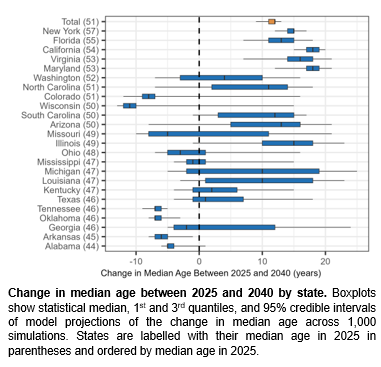
We projected the number of PWDH across all 24 states to rise from 917,000 (95% credible interval: 911,000 to 923,000) in 2025 to 1,002,000 (972,000 to 1,026,000) in 2040, with the number age 55+ growing from 417,000 (411,000 to 425,000) to 553,000 (534,000 to 576,000). Thus, the projected percentage of PWDH age 55+ rose from 45% (45 to 46%) in 2025 to 55% (53 to 58%) in 2040, with the median age of PWDH rising from 51 years (50 to 51) to 59 years (57 to 61). There were considerable differences at the state level, with two distinct groupings of HIV population dynamics emerging at the extremes (see Figure). Specifically, more populous and urban states with higher current median ages of PWDH were projected to experience even further aging of the population with diagnosed HIV in the coming 15 years. For example, California’s median age of PWDH was projected to rise from 53 [52 to 56] in 2025 to 71 [68 to 74] in 2040. By contrast, more rural and less populous states tended to have younger HIV epidemics that were not projected to age substantially over time. For example, Oklahoma’s median age of PWDH was projected to fall from 46 [45 to 48] in 2025 to 39 years [38 to 43] in 2040.
Conclusions
Taken as a whole, the population of persons diagnosed with HIV in the US is projected to age substantially. However, these effects will be felt differently across different states, resulting in even wider differences in median age of PWDH when comparing more populous, urban states to less populous, rural ones. In the coming years, resources should be allocated in a manner that can help healthcare systems adapt to changing state-level demographic patterns among PWDH.
Table or Figure