Background
The environment in which people with HIV (PWH) reside plays a complex and influential role in shaping outcomes along the HIV Care Continuum. In this study, we investigated the Area Deprivation Index (ADI)—a comprehensive metric of neighborhood-level disadvantage which ranks geographic areas based on cumulative socioeconomic adversity—as a potential determinant of retention-in-care (RiC) among PWH.
Methods
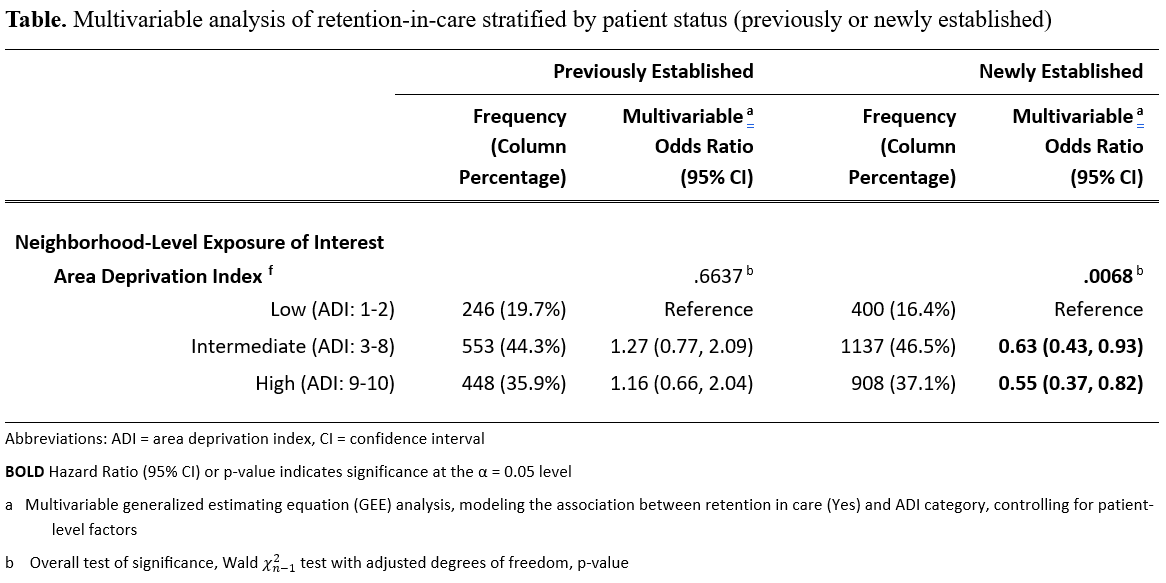
This study included an observational cohort of PWH who initiated HIV care between 2010 and 2022 at a university-affiliated clinic and resided within the Birmingham, Alabama Metropolitan Statistical Area (BMSA). Neighborhood disadvantage was assessed using the ADI, which ranks Alabama census block groups on a scale from 1 (least disadvantaged) to 10 (most disadvantaged), operationalized as tertiles (1-2 Low, 3-8 Intermediate, 9-10 High, area deprivation). The primary outcome, RiC, was defined as completing at least two HIV care visits, 90 days or more apart, within 12 months of their initial clinic visit. RiC was analyzed using generalized estimating equations, accounting for clustering at the census block group level. All analyses were stratified by patient status at initial clinic visit: previously established (virally suppressed, VL<200 copies/mL, at initial visit) or newly established (viremic at initial visit).
Results
Of the total cohort (N = 3,692), 33.8% (n = 1,247) were previously established in HIV care, and 66.2% (n = 2,445) were newly established in care. In total, 36.7% (n = 1,356) resided in highly disadvantaged neighborhoods. For previously established PWH, ADI was not significantly associated with RiC (p = .4103) [Table]. Among newly established PWH, ADI was significantly associated with RiC (p = .0068), and those in highly disadvantaged neighborhoods were significantly less likely to be retained in care, compared to Low ADI (aOR: 0.55; 95% CI: 0.37, 0.82).
Conclusions
Our findings highlight the detrimental impact of neighborhood-level disadvantage on RiC among newly established PWH. This underscores the importance of understanding the structural barriers that prevent sustained HIV care and can be used to inform local Ending the HIV Epidemic (EHE) initiatives. Further, routine assessment of neighborhood-level disadvantage among all newly-established PWH early in care has the potential to expedite referral to supportive services necessary to mitigate RiC challenges.
Table or Figure