Background
Recent WHO guidance states that individuals with low-level viremia (LLV, 200 – 1000 copies/mL) have “negligible” risk of HIV transmission, a modification of “undetectable = untransmittable” guidance. However, LLV is less stable than viral load (VL) that is undetectable, and no recent studies have rigorously quantified the resultant transmission risk. Here, we use updated data and statistical methods to quantify transmission risk associated with LLV and its implications in settings with infrequent viral load testing.
Methods
We used 2,100 person-years (PYs) of follow-up from 776 monogamous heterosexual HIV serodiscordant couples who participated in the Rakai Community Cohort Study in southern Uganda between 1994 and 2020 to quantify transmission rate as a function of VL. Three forms of the viral load vs. transmission rate relationship were compared, all of which accounted for extra-partner transmission and inter-observation VL variability. Based on prior findings that LLV does not always persist in individuals on treatment, we calibrated a model of adherence and viral control to 94 paired viral load measurements to quantify transmission risk following a single LLV VL measurement.
Results
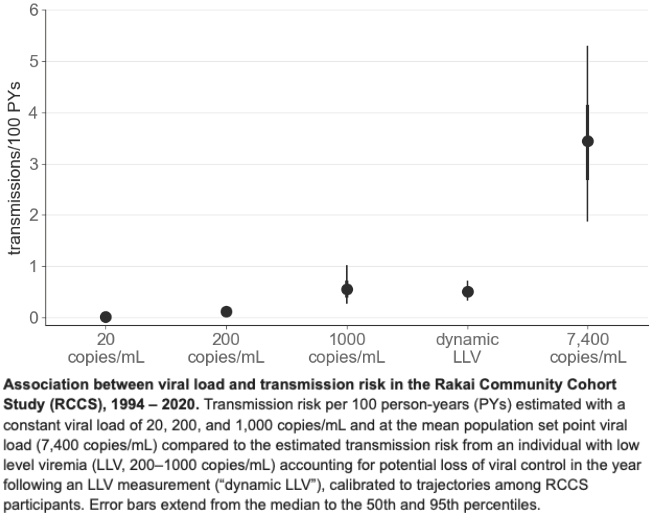
We observed a total 107 seroconversions that were used to calibrate our model of transmission rate as a function of viral load. Based on the best-fit model, we estimated the transmission risk attributable to heterosexual contact with an individual with a persistent VL of 200 and 1,000 copies/mL to be 0.11 [95%CI: 0.06,0.21] and 0.55 [0.28,1.00] transmissions/100 PYs, respectively (Figure). After accounting for the instability of a single LLV measurement, we estimated an average risk of 0.50 [0.35,0.70] transmissions/100 PYs between an initial LLV measurement and a subsequent test one year later, with 8.3% [6.7%, 10.1%] of individuals carrying 80% of the risk. Compared to an untreated individual at the population average set point VL (3.9 log10 copies/mL), the model-inferred average relative risk of transmission associated with potentially unstable LLV was 0.15 [0.08, 0.27], which could be reduced to 0.03 [0.02,0.07] with a 90 day test interval (vs.annually).
Conclusions
Our results suggest that transmission from low-level viremia is reduced but may be non-negligible, especially considering potential further loss of viral control between infrequent tests. These transmission risk estimates may allow for more evidence-based decision making by clinicians, policymakers, modelers, and people living with HIV.
Table or Figure