Background
Syphilis cases among cisgender (cis) women have been rising in jurisdictions across the United States (US), raising concerns about the potential for an increase in HIV. Using public health data, we summarize trends in the rate of HIV diagnosis and characteristics of newly diagnosed cis women in three large jurisdictions on the west coast.
Methods
This analysis included data from the National HIV Surveillance System and local partners services databases for King County, Washington; Los Angeles (LA) County, California; and San Francisco (SF) County, California from 2015-2024. Individuals were included if sex assigned at birth was “female”, current gender was “woman”, and the diagnosis was classified as new based on public health investigation. We calculated the annual incidence of new HIV diagnoses by jurisdiction and used descriptive statistics to summarize case characteristics at the time of diagnosis.
Results
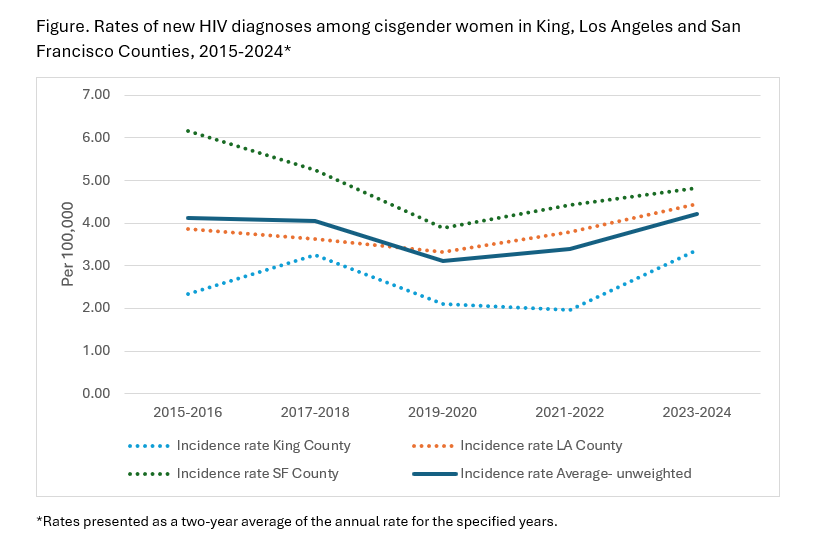
From 2015 to 2020, all three jurisdictions reported decreases in the rate of new HIV diagnoses among cis women (Figure). The rate started to increase in 2021, and in 2024, was 40%, 15% and 63% higher for King, LA and SF counties, respectively, compared to 2019 (pre-COVID). In 2024, reported history of injection drug use varied by county (King County 7%; LA County 12%; SF County 15%). In all three counties, the proportion of cis women who reported being homeless or unhoused at diagnosis in 2024 was higher than the proportion for the overall population of newly diagnosed individuals (King County 28% vs 20%; LA County 27% vs. 14%; SF County 39% vs 16%). There were significant and persistent racial/ethnic disparities, which varied by county. From 2015-2024, 1% of cis women across all three counties were diagnosed with syphilis in the 12 months prior to HIV diagnosis.
Conclusions
Across three urban jurisdictions, the rate of new HIV diagnoses among cis women increased over the past four years. The high proportion of homelessness/unstable housing at diagnosis highlights the significant marginalization of some cis women affected by this epidemic. While the rates new diagnoses were lower compared to cis men and similar to rates seen prior to COVID-19, these increases are concerning as they follow years of declining incidence (overall and among cis-women) and occur in the context of substantial increases in syphilis among a similarly marginalized population. Improved access to stigma-free HIV screening, prevention and treatment for cis women are important to reverse this trend.
Table or Figure