Background
Tracking HIV incidence is essential to understanding the shifting landscape of HIV transmission and responding to the needs of the most affected populations, such as female sex workers (FSW) and men who have sex with men (MSM). We conducted a cohort study to determine HIV incidence among vulnerable participants in western Kenya.
Methods
Between December 2021 and April 2023, we enrolled participants aged 14-55 years without HIV in Homa Bay and Kericho, Kenya. Eligible participants reported sexually transmitted infection, transactional sex, condomless sex, injection drug use, and/or anal sex during the 24 weeks prior to enrollment. Participants underwent clinic-based HIV testing every 12 weeks and home self-testing (Ora-quick) every four weeks for up to 72 weeks. HIV incidence rates were calculated per 100 person-years (PY). Incidence rate ratios (IRRs) and 95% confidence intervals (CIs) were calculated using Poisson regression with a log time offset. Among incident cases with HIV RNA >1000 copies/mL, drug resistance mutations were identified using Stanford HIVDB 9.8.
Results
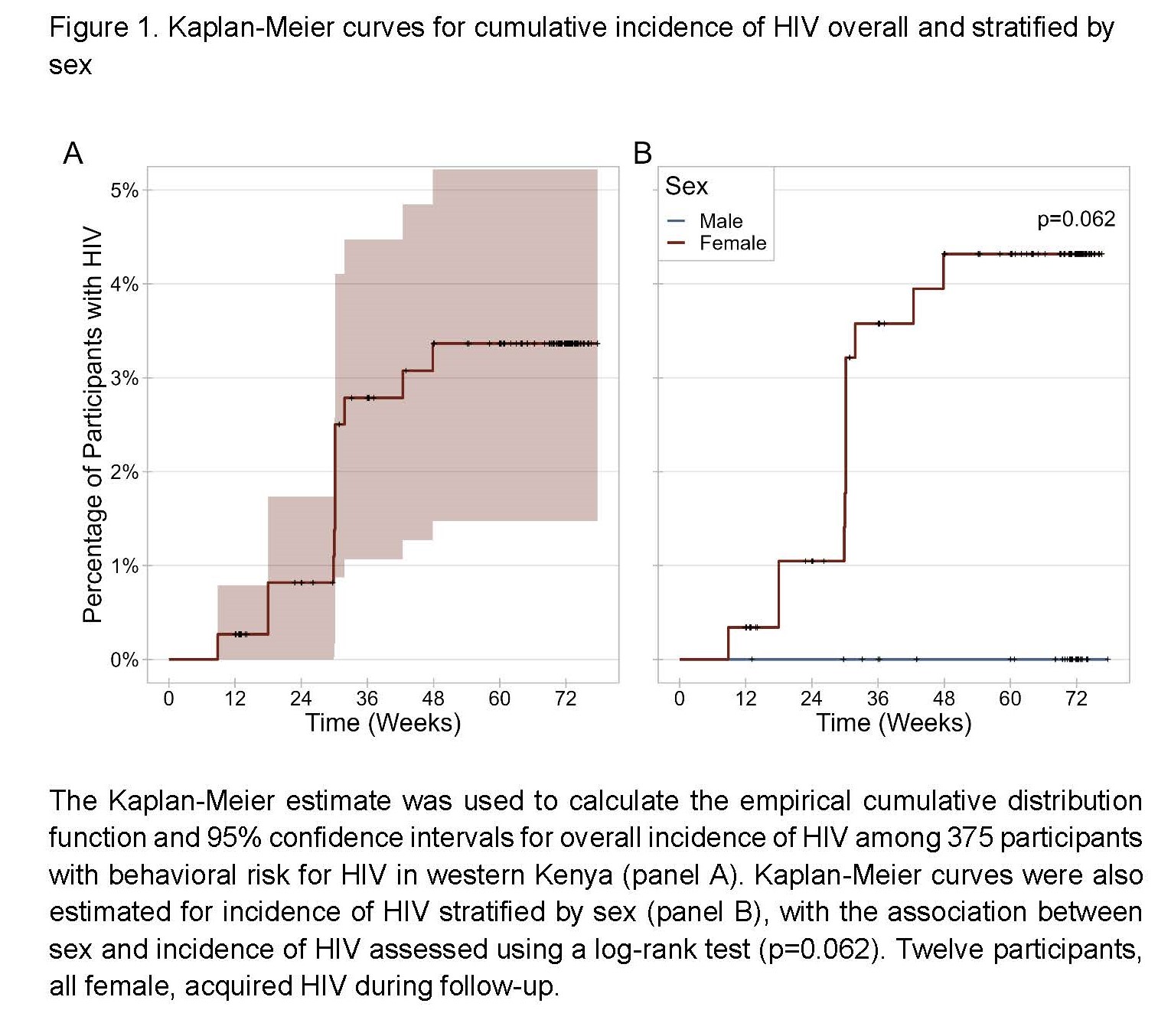
Among 407 enrolled participants, 375 (92.1%) had at least one follow-up visit and were included in HIV incidence analyses. Their median age was 22.0 years (IQR 19.0-24.0). Of 294 female participants, 259 (88.1%) reported transactional sex. Of 81 male participants, 42 (51.9%) reported being MSM and 30 (37.0%) reported transactional sex. Twelve incident HIV cases (six per site, all among female participants) were observed during 473.4 PY of observation (HIV incidence 2.54/100PY [95%CI 1.31-4.44]). HIV incidence among female participants was 3.27/100PY (95%CI 1.69-5.71). Incidence rates were similar by site (Homa Bay vs. Kericho IRR 0.69; [95%CI: 0.22-2.15], p=0.524). Among seven viremic participants with incident HIV, all viruses were subtype A1 and one (14.3%) had a nucleoside reverse transcriptase inhibitor mutation (S68N); no other drug resistance mutations were observed.
Conclusions
HIV incidence in this study was concentrated among female sex workers in western Kenya, underscoring their continued vulnerability to HIV acquisition. These findings highlight the urgent need to strengthen and expand targeted prevention strategies, including the development, evaluation, and scale-up of novel approaches such as long-acting injectable lenacapavir, to reduce HIV acquisition in this group.
Table or Figure