Background
Detecting recent and rapidly growing HIV transmission clusters is essential for timely public health intervention. Molecular epidemiology can detect people serving as network bridges, or connecting subclusters, who may be early indicators of cluster expansion. These connections often arise within slowly evolving, long-standing, genetically diverse clusters and may signal pathways of ongoing transmission.
Methods
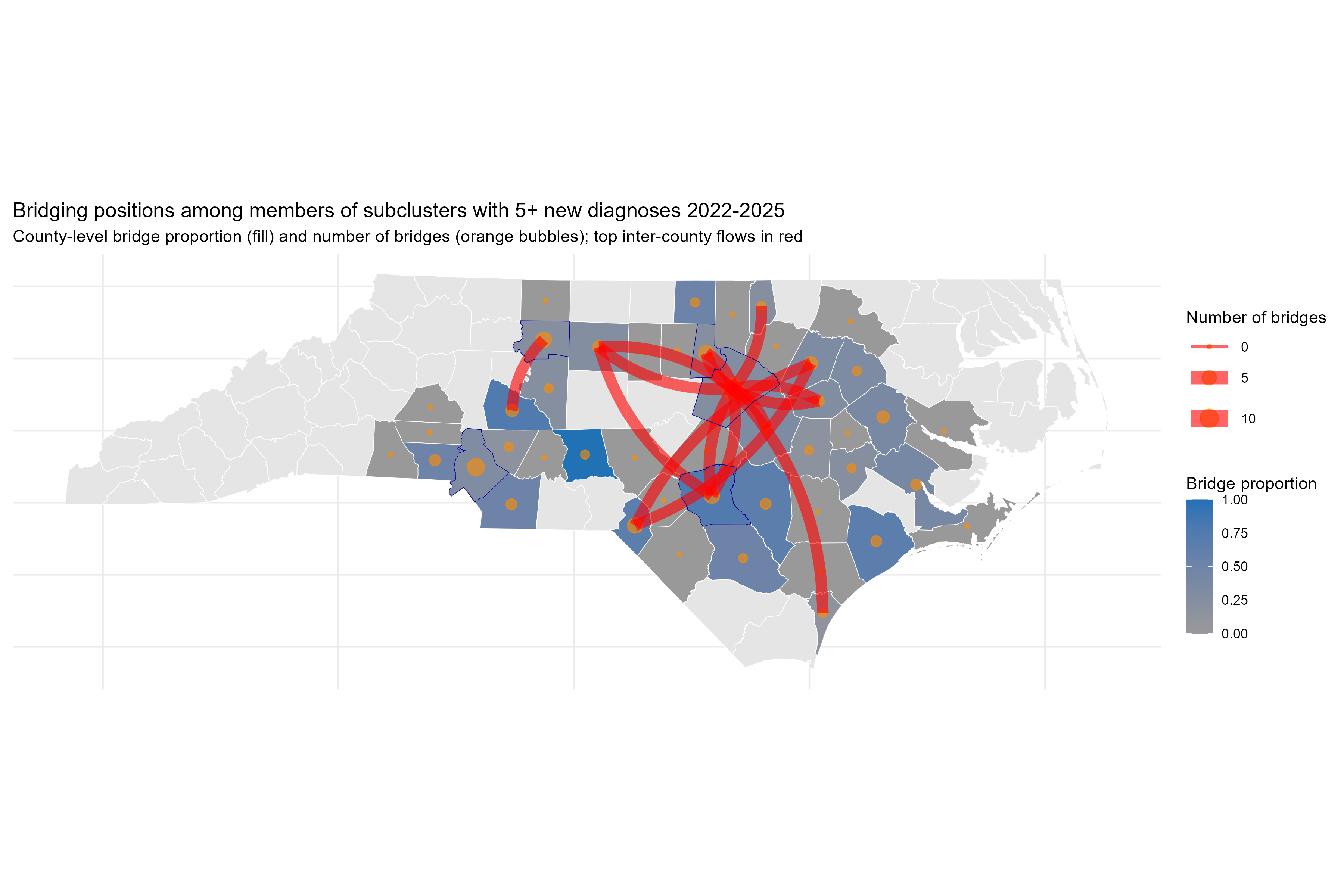
We analyzed HIV sequences collected from 25,174 persons and reported to North Carolina surveillance (2010–2025), using nextHIV2. Clusters were defined using a dual threshold approach: ≤1.5% TN93 distance for broader clusters and ≤0.05% for “recent and rapid” subclusters. Bridging individuals, defined as those linking across clusters and subclusters, were quantified at both individual and subcluster levels. Within growing clusters (≥1 new diagnosis during 2022–2025), we compared demographics and network metrics between bridge and non-bridge individuals with viremia. County-level bridge proportions and inter-county transmission flows were mapped to identify geographic hotspots.
Results
Of 5,205 individuals in growing clusters, 36% were newly diagnosed between 2022–2025. 2,004 were in 264 subclusters (≤0.05%), most were dyads. People in bridge positions with viremia were more likely to be previously diagnosed (75% vs. 60%) and Black (70% vs. 60%), and had higher network connectivity (median degree 9 vs. 5, betweenness 1 vs. 0, all p<0.001) compared other cluster members. Growing subclusters had more bridging members and higher mean viral loads than subclusters with no growth. Among 25 subclusters with ≥5 new diagnoses, most members were young MSM (median age 25–33 years), though several included women and heterosexual men. Bridges members with viremia were unevenly distributed across regions (p<0.001), with higher representation in Raleigh and eastern NC and lower representation in Charlotte. A minority of subclusters had few or no bridges, suggesting more localized transmission. Nearly all rapid growth clusters crossed multiple counties.
Conclusions
People in bridging positions, though less often new diagnoses, occupy highly connected positions that link recent infections into established clusters. Emerging clusters were characterized by high bridge density, highlighting viremic bridging positions as critical conduits of transmission and potential early warning markers for cluster growth. Interventions in bridge-heavy areas could reduce broader regional transmission.
Table or Figure