Background
HIV molecular epidemiology (HIV-ME) can support HIV cluster identification, tailor public health interventions, and conduct important research about HIV. Yet HIV-ME has vocal critics and concerns about the ethical, legal, and social implications (ELSI) of HIV-ME remain. We explored heterogeneity in community priorities for HIV-ME and assessed the reliability and validity of the results.
Methods
Adult cisgender men who have sex with men (MSM) were recruited from the 2023-2024 American Men’s Internet Survey. Eleven aspects of HIV-ME, identified using mixed methods, were assessed using best-worst scaling (BWS) to assess their importance. A conditional logit was used to estimate aggregate results, and heterogeneity was assessed using latent class analysis; all results were transformed onto a 100-point scale and differences in these scores compared across latent classes. Analysis of additional open and closed-ended responses were used to test the reliability and validity of the latent class results.
Results
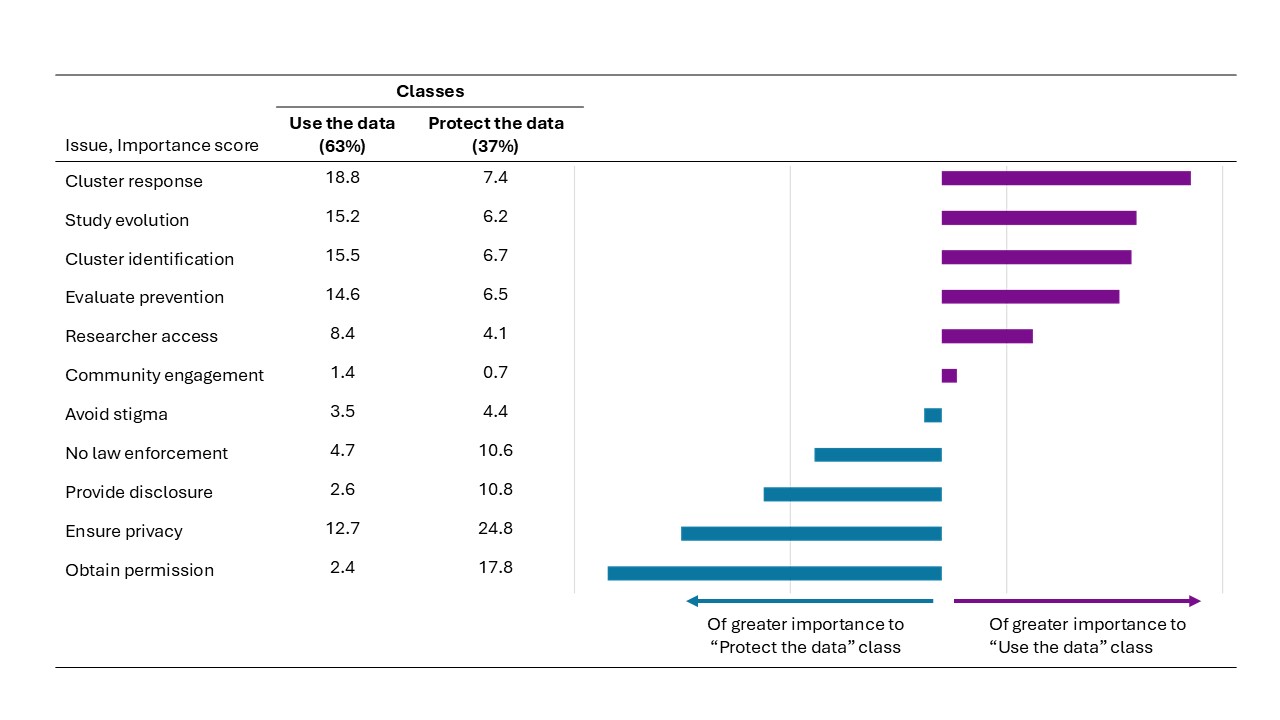
We had 747 people complete the survey, including 134 PLWH. PLWH were more likely to be aged 40 or over (p<0.01), have public insurance (p<0.01), have less than a college degree (p<0.01), and identify as non-Hispanic black (p<0.01). In aggregate BWS results, “ensuring privacy” was considered most important (17) and “community engagement” was considered least important (2). No major differences in priorities for HIV-ME issues were identified between people living with and not living with HIV, but latent class analysis revealed two groups with distinct perspectives on HIV-ME (Figure 1). The “Use the Data” group (63%) placed greater emphasis on the utility of the data for cluster detection and response, studying viral evolution, evaluating prevention strategies. The “Protect the Data” group (37%) placed greater emphasis on HIV-ME programs obtaining permission, ensuring privacy, providing disclosure, and ensuring no access to these data by law enforcement. All tests confirmed the validity and reliability of the latent class results (high correlation on split-sample analysis ( =0.99), with 3-point importance scores ( =0.78), and concordance with open-ended responses).
Conclusions
There is overwhelming support for HIV-ME when it provides benefit through cluster detection and response, study of viral evolution, and evaluation of prevention strategies. Those involved in the HIV-ME data ecosystem need to be responsive to concerns associated with ELSI of HIV-ME.
Table or Figure