Background
Adolescents and young adults living with HIV (ALWH) experience suboptimal outcomes along the HIV care cascade. Family support, including communication between youth and parents or guardians, may influence HIV testing and treatment uptake, and viral suppression. Using population-representative HIV surveys, we described the relationship of parental communication and HIV care cascade outcomes among ALWH.
Methods
We analyzed data from nine Population-based HIV Impact Assessments (2019–2023) in Eswatini, Malawi, Lesotho, Botswana, Tanzania, Uganda, Mozambique, Zambia, and Zimbabwe including ALWH aged 15–24 years who provided consent. Exposures were “ever discussed HIV with a parent/guardian” and “ever discussed sex with a parent/guardian” (yes/no). Outcomes reflected UNAIDS 95-95-95 indicators: HIV status awareness (self-report or ARV detected), current antiretroviral therapy (ART) use (self-report or ARV detected), and viral suppression (viral load <1000 copies/mL). Survey-weighted log-binomial regressions estimated adjusted prevalence ratios (aPRs) with 95% confidence intervals, adjusting for age, sex, urbanicity, and marital status, and accounting for the complex survey design with jackknife replicate weights. We report conditional (within-cascade) models.
Results
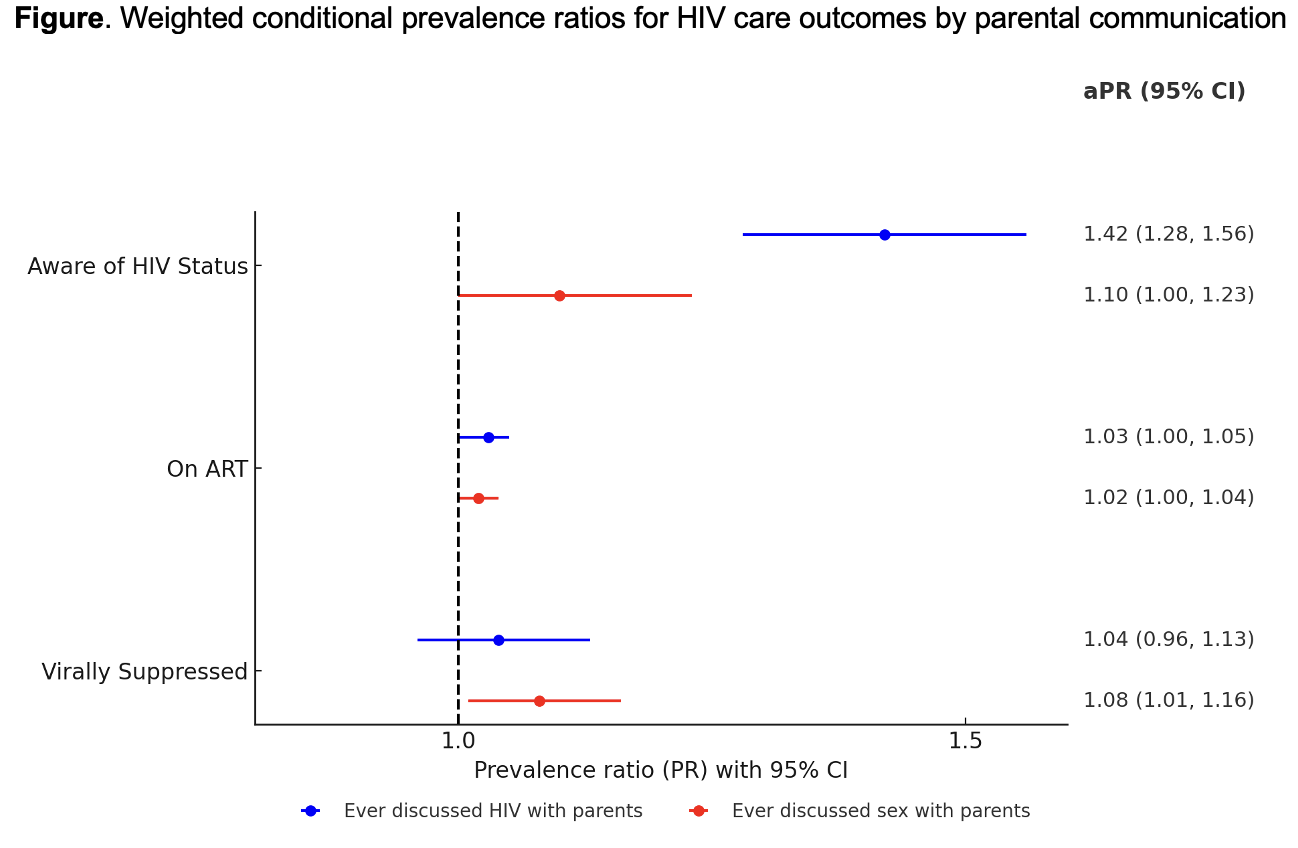
Among 1,822 ALWH, 40% (95% CI: 38–44) reported ever discussing HIV and 22% (95% CI: 19-24) reported ever discussing sex with a parent or guardian. In conditional analyses, ALWH who ever discussed HIV with a parent/guardian compared to those who didn’t, were associated with higher awareness of their HIV status (aPR=1.42, 1.28-1.56), and more likely to be on ART (aPR=1.03, 1.00-1.05). Parental communication about HIV had a positive point estimate with viral suppression among ALWH on ART (aPR=1.04, 0.96–1.13). Additionally, ever discussing sex with a parent/guardian was associated with higher awareness of HIV status (aPR=1.10, 1.00-1.23) among ALWH, higher ART use (aPR =1.02, 1.00-1.04) among those aware, and higher viral suppression (aPR=1.08, 1.01-1.16) among those on ART.
Conclusions
Parental and guardian communication on HIV and sex is associated with better HIV care cascade outcomes among ALWH in Southern and Eastern Africa. Caregiver–youth dialogue as a form of family support represent promising, scalable targets to enhance diagnosis, treatment success, and viral suppression, and merit evaluation in intervention studies.
Table or Figure