Background
Young people with HIV (YPWH) experience increased morbidity and mortality compared to uninfected peers. Adolescence is a critical developmental stage with unique challenges faced by YPWH related to peer groups, stigma, disclosure, and emerging mental disorders that can result in worse HIV and mental health (MH) outcomes. This abstract reports the primary outcomes of Sauti ya Vijana (SYV, Voice of Youth) intervention, a manualized, peer-led, group-based MH and life skills intervention in Tanzania.
Methods
An individually randomized group-treatment trial was conducted across four geographically distinct regions of Tanzania. YPWH aged 10–24 years who were fully aware of their HIV status, prescribed antiretroviral therapy (ART) for >= 6-months, and able to attend weekly SYV sessions were randomized to receive SYV or enhanced standard of care (eSOC). SOC was enhanced through MH screening and clinical referral for youth who reported moderate or severe symptoms of distress. SYV was delivered by trained peer group leaders age 23–29 years who live with HIV. SYV consists of ten group sessions and two individual sessions. The primary outcome was viral suppression (VS), HIV RNA <400 copies/mL at 6-months. ART adherence (self-report), MH (PHQ-9 for depression and GAD-7 for anxiety), coping/self-efficacy (CSE) (scale 0-130) and HIV knowledge (% correct) were also evaluated. Results were analyzed using modified Poisson generalized estimating equation (GEE) models for binary outcomes and Gaussian distribution GEE models for continuous outcomes.
Results
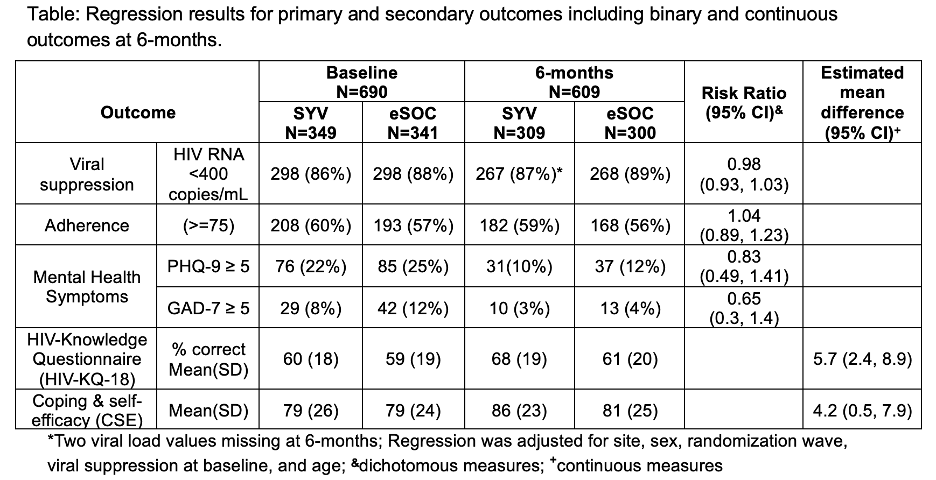
Of 690 participants, mean age was 17.5 years; 50% were female; 81% had perinatal HIV acquisition; 88% were receiving tenofovir, emtricitabine, dolutegravir (TLD) as ART; overall, 87% had VS at baseline and 88% were retained on study at 6-months.There was no significant difference between arms in VS (87% SYV; 89% eSOC) or adherence at 6-months (Table). There was a clinically meaningful reduction in depression and anxiety symptoms in both arms, though no significant difference between arms at 6-months. HIV knowledge and CSE were significantly higher in SYV compared to eSOC at 6-months.
Conclusions
There was no difference between arms in VS at 6-months. YPWH had high levels of VS at baseline. Reduced mental distress was demonstrated in both arms at 6-months, suggesting the importance of MH screening and referral. Positive effects on CSE and HIV Knowledge in SYV compared to eSOC suggest SYV can improve important aspects of HIV care for YPWH in Tanzania.
Table or Figure