Background
Patients with perinatally acquired HIV (PHIV) who age into adulthood may be at unique risk for the early development of specific non-AIDS associated comorbidities (NAC). It is unclear whether the early initiation of ART among PHIV may decrease risk for the development of specific NAC.
Methods
This retrospective study (N= 344) included a cohort of PHIV as well as an age range-matched cohort of people with non-perinatally acquired HIV (NPHIV). NAC outcomes were examined, including diabetes mellitus (DM), hypertension (HTN), chronic kidney disease (CKD, ≥stage 3), dyslipidemia, CAD/CHF, cancer, and asthma. Death was also examined as a discreet outcome. Descriptive statistics were used to characterize the study population. Univariate and multivariate logistic regression models were used to examine the association between potential immunologic, virologic, and demographic predictors and NAC. Log rank test was used to compare Kaplan-Meier curves for NAC outcomes. Finally, a logistic regression model was used to examine the association between time to ART initiation and the development of NAC among PHIV.
Results
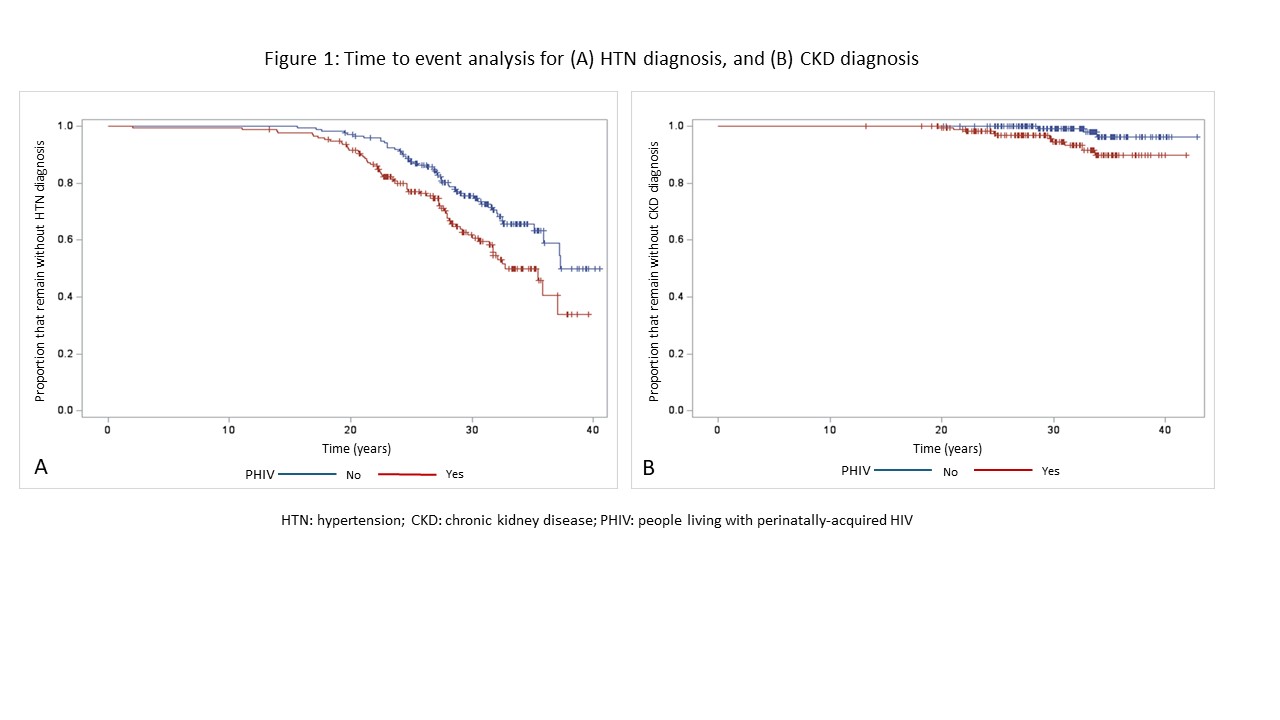
PHIV (N=171) significantly differed from NPHIV (N=173) on age (30.1 vs 31.8 yrs), sex at birth (females 60.2% vs. 40.5%), tobacco use (37.3 vs 60%), CD4 nadir (47.4% vs 16.8% with CD4 nadir <200 cells/mm3), and active HIV viral suppression (69% vs 82.7%). The cohorts did not differ on race (95.1% vs. 90.9% Black) and obesity (PHIV 33.9% vs, 39.3%). Both groups had high rates of HTN (PHIV 38.5%, NPHIV 29.5%), CKD (PHIV 5.9%, NPHIV 1.73%), dyslipidemia (PHIV 28.9%, NPHIV 28.2%), and active asthma (32.8%, 35.8%). 8.8% of the PHIV cohort died vs 0.6% of the NPHIV cohort. By multivariable analysis (inclusive of age, PHIV status, sex at birth, tobacco use, CD4 nadir, and viral suppression) PHIV demonstrated a higher likelihood of HTN (OR 1.87, 95% CI 1.1-3.2), CKD (OR 6.95, 95% CI 1.7-29.7), and a non-significant trend towards higher likelihood of death (OR 7.66, 95% CI 0.94-65.5). PHIV had significantly earlier acquisition of HTN (p=0.004), and CKD [(p=0.017), Figure 1]. Rates of NAC among patients within the PHIV cohort did not differ based on time to ART initiation (≤6 months vs >6 months after birth).
Conclusions
Compared to NPHIV of similar age, PHIV adults had higher rates of HTN and CKD and were more likely to acquire these diseases at a younger age than NPHIV. These findings may have long term implications for cardiovascular risk among aging PHIV.
Table or Figure