Background
Dolutegravir-based regimens (DBR) are currently the preferred first-line antiretroviral therapy (ART) for young children, but real-world data on outcomes remain limited. We evaluated virologic outcomes following DBR initiation or switch among children aged ≤5 years in Southern Africa.
Methods
We included children aged 0 to ≤5 years who initiated DBR or lopinavir/ritonavir(LPV/r)-based regimens, or switched from any previous regimen to DBR, between mid-2021 and end-2024 at selected public-sector IeDEA-SA sites in South Africa, Zambia, Zimbabwe, Malawi, Mozambique, and Lesotho. Children with a viral load (VL) result available at 6 months (3 to <9) or 12 months (9 to <18) after ART initiation or DBR switch were included in the analysis. Viral suppression (VS) was defined as VL≤1000 copies/ml. Adjusted odds ratios (aOR) for VS in children initiating DBR vs LPV/r were calculated using logistic regression, adjusted for age at ART start, sex, and country. Children who switched to DBR were analysed by VL at switch (VL≤1000, >1000, or unknown; within 6 months before to 2 weeks after switching).
Results
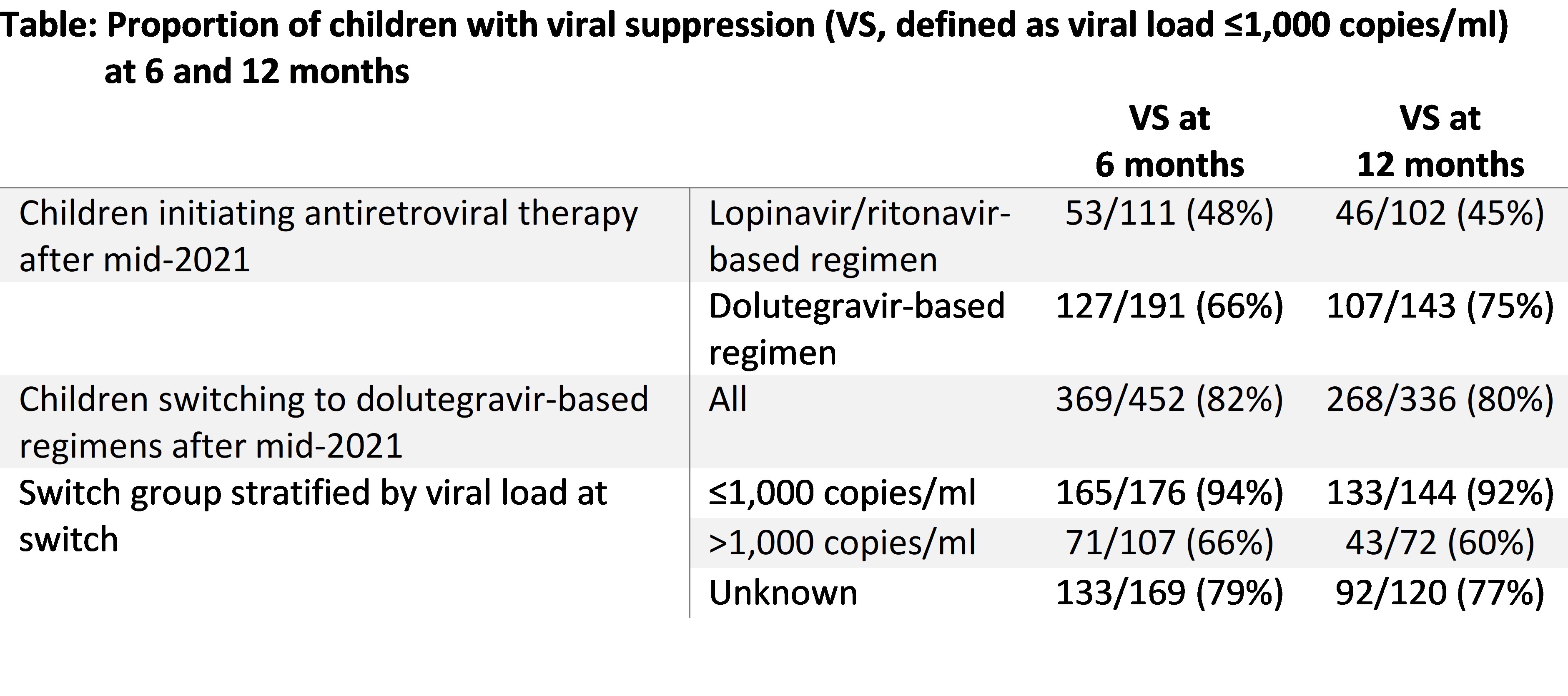
Of 894 children included (49% male), 424 initiated ART (224 on DBR, 200 on LPV/r) and 583 switched to DBR, of whom 565 (97%) received LPV/r prior to switch. Of the 200 children who initiated LPV/r from mid-2021, 113 later switched to DBR and were included in both groups. Among the ART initiators, median age at ART start was 20 months (interquartile range (IQR) 7-36) for DBR and 16 months (IQR 5-27) for LPR/r. VS was more likely after initiation with DBR vs LPV/r: 66% vs 48% at 6 months (aOR 2.8, 95% CI 1.3-6.3) and 75% vs 45% at 12 months (aOR 5.1, 95% CI 1.5-18.2). Among the 583 children who switched to DBR, median age at switch was 51 months (IQR 33-63). VS at 6 and 12 months was 82% and 80%. Compared to children with VL>1000 at DBR switch, those with VL≤1000 had higher odds of achieving VS at 6 months (aOR 7.5, 95% CI 3.5-16.1) and 12 months (aOR 6.8, 95% CI 3.1-15.2). Those with unknown VL at switch had intermediate odds of VS (aOR 1.8, 95% CI 0.9-3.3; aOR 2.4, 95% CI 1.2-4.7).
Conclusions
A higher proportion of young children initiating DBR achieved VS compared to those starting LPV/r. Among children who switched to DBR, VS was less likely when VL at switch was >1000, highlighting the need for close monitoring and support in this group. These findings provide real-world evidence supporting DBR use in young children in Southern Africa.
Table or Figure