Background
People with perinatally acquired HIV (PWPHIV) are often exposed to a wide range of antiretroviral therapy (ART). Co-formulated bictegravir/emtricitabine/tenofovir alafenamide (B/F/TAF) is a single tablet, once daily regimen licensed from a weight of 14kg, however real-world data on 2nd line use is limited. We assessed efficacy, tolerability and safety of 2nd line B/F/TAF use in a PHIV cohort.
Methods
A retrospective cohort study was conducted of PWPHIV attending a tertiary service who had ever received B/F/TAF as subsequent line therapy up to 31.08.25. Only PWPHIV with prior virological failure (confirmed viral load (VL) >200 c/mL) on a previous regimen prompting ART switch were included. Two groups were identified at B/F/TAF switch: those suppressed (<200c/ml) and those with detectable viraemia (VF). Past ART, VL & CD4 count, side effects and drug resistance mutations (DRMs) were recorded pre- and post-B/F/TAF switch.
Results
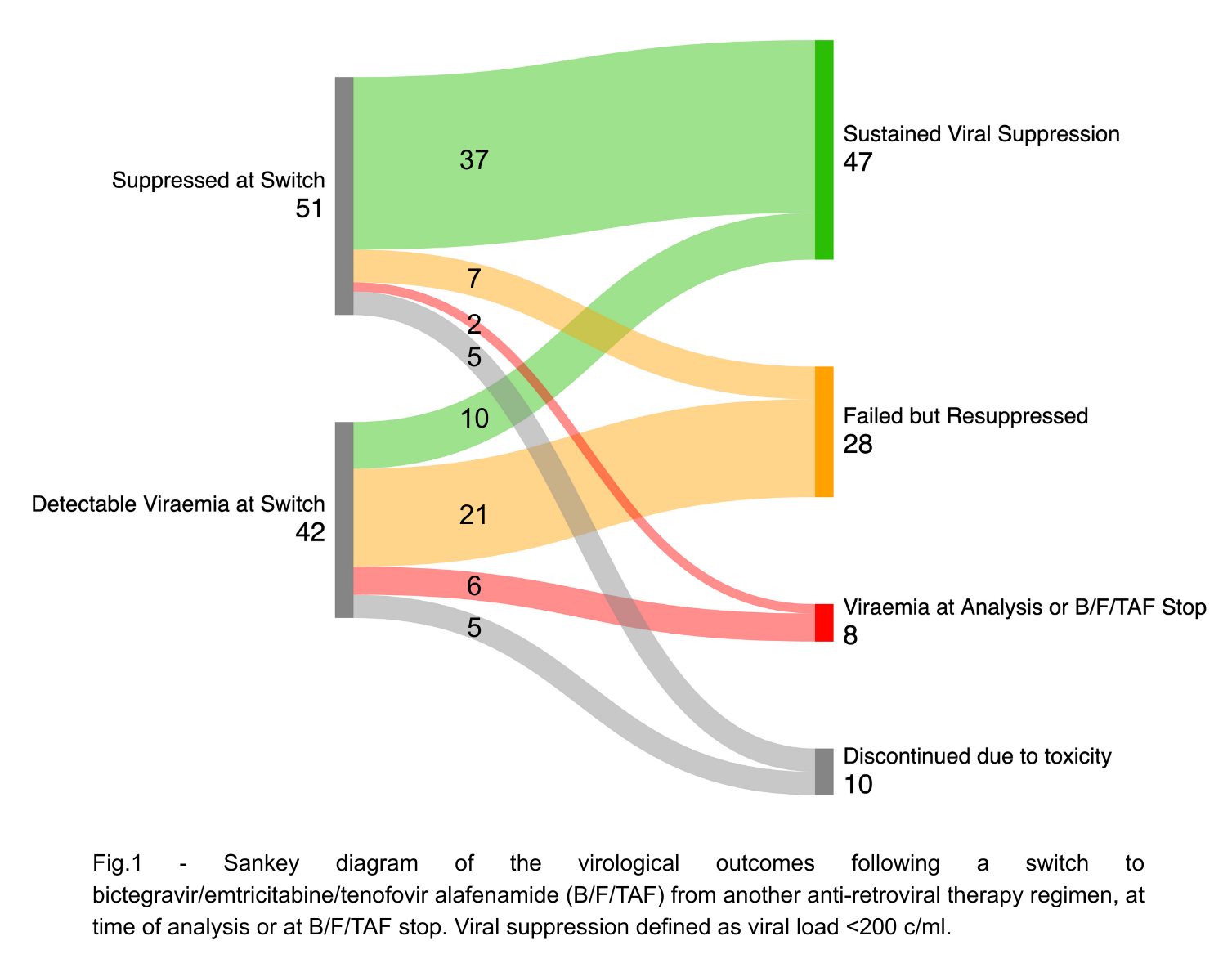
Of 93 eligible individuals, 55 (59%) were female, 80 (86%) were of Black ethnicity and median age was 26 years (IQR 22-30, range 5-36). Of the 51 (55%) suppressed at switch, median number of past ART regimens was 5 (IQR 3-6) and 34 (67%) had past DRMs (21 dual class, no integrase/protease DRMs). Median duration on B/F/TAF was 35 months (IQR 17-40); 37/51(72%) sustained suppression (Fig. 1), 7 (14%) experienced VF but resuppressed, and 2 (4%) had VF at analysis or at B/F/TAF stop with no emergent DRMs. Of the 42 with VF at switch, median VL was 19900 c/ml (IQR 1180-71350), median number of past ART regimens was 4 (IQR 3-5) and 27 (64%) had past DRMs (7 dual class, 3 triple class). Median duration on B/F/TAF was 34 months (IQR 20-49); 10 (24%) achieved sustained suppression, 21 (50%) suppressed then had VF but resuppressed, and 6 (14%) never achieved suppression/had viraemia at analysis or at B/F/TAF stop. 5 individuals had emergent DRMs: 1 integrase, 1 integrase + nucleoside reverse transcriptase (NRTI), 3 NRTI only. 3 discontinued B/F/TAF due to resistance, and 2 switched to long acting injectables. Overall, 10 (11%) discontinued due to side effects; mood/sleep disturbance, weight gain, rash, tinnitus, migraine, vomiting; median duration on B/F/TAF was 5 months (IQR 1-18).
Conclusions
Despite extensive prior DRMs in this highly treatment-experienced PHIV cohort, switching to B/F/TAF demonstrated high efficacy as 2nd line therapy, with 81% achieving/sustaining virological suppression. Emergent DRMs (5%) were rare although 11% discontinued for toxicity.
Table or Figure