Background
Treatment options for children with HIV are limited. Bictegravir/emtricitabine/tenofovir alafenamide (B/F/TAF) is a well-tolerated antiretroviral therapy (ART) with a high barrier to resistance approved in the US for children weighing ≥14 kg and in other countries for children ≥25 kg. However, data on its use in younger children are limited. We present efficacy and safety outcomes for B/F/TAF through Week 24 in infants and children weighing 3-<25 kg.
Methods
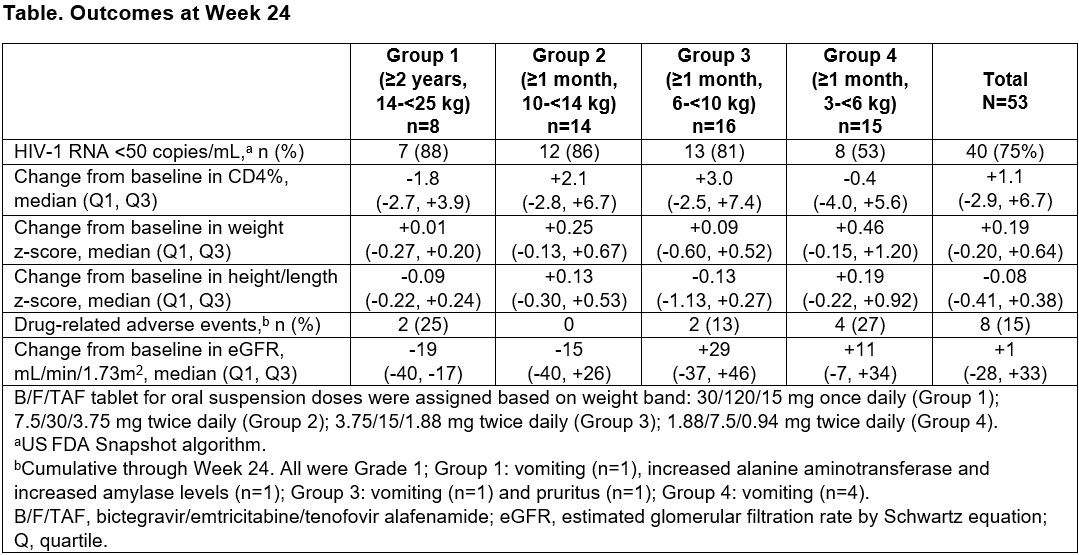
Data from participants enrolled in Cohort 4 of the Phase 2/3 trial evaluating B/F/TAF in infants and children with HIV-1 (NCT02881320) were analyzed. Participants were grouped by age and weight band: ≥2 years and weighing 14-<25 kg (group [G] 1); ≥1 month and 10-<14 kg (G2); ≥1 month and 6-<10 kg (G3); ≥1 month and 3-<6 kg (G4). Children in G1 had virologic suppression (VS; defined as HIV-1 RNA <50 copies/mL) on ART at screening; those in G2-4 were treatment-naïve or on ART. B/F/TAF tablet for oral suspension (TOS) doses were: 30/120/15 mg once daily (G1); 7.5/30/3.75 mg twice daily (BID; G2); 3.75/15/1.88 mg BID (G3), and 1.88/7.5/0.94 mg BID (G4). CD4%, VS, safety, acceptability, and palatability were assessed.
Results
Overall, 53 participants were treated (G1: n=8; G2: n=14; G3: n=16; G4: n=15). At baseline (BL), median (range) age in G1-4 was 4.0 (2.0-7.0) years, 2.0 (1.7-4.0) years, 8 (2-19) months, and 4 (2-16) months, respectively. Median (quartile [Q] 1, Q3) weight at BL in G1-4 was 15.9 (14.6, 17.0), 11.3 (11.0, 13.0), 8.0 (6.8, 8.8), and 5.4 (5.3, 5.8) kg, respectively. Overall, 58% of participants were female, 94% were Black, 45% had VS at BL, and median (Q1, Q3) CD4% was 34% (29, 38). Week 24 outcomes are shown in the Table. Overall, at Week 24, CD4% was similar to that at BL, and the VS rate was 75% (40/53; by US FDA Snapshot algorithm); in the missing=excluded analysis, the VS rate was 79% (41/52). Grade 3/4 laboratory abnormalities occurred in 32% of participants (17/53), and drug-related adverse events (AEs) in 15% (8/53; all Grade 1). One child in G1 discontinued B/F/TAF due to an AE (pulmonary tuberculosis), and there was one death in G4 (pneumonia); neither was considered to be related to the study drug. Caregivers perceived B/F/TAF TOS as easy to prepare, with neutral/favorable acceptability and palatability.
Conclusions
Overall, through 24 weeks, B/F/TAF showed favorable efficacy, safety, and acceptability in infants and children, supporting its potential as a treatment option in this population.
Table or Figure