Background
Broadly neutralizing antibodies (bNAbs) are being investigated as part of HIV remission strategies in children. We examined baseline bNAb neutralization profiles in participants from the Tatelo Plus (IMPAACT 2042) study, which is evaluating VRC07-523LS, PGDM1400LS, and PGT121.414.LS among early-treated children in Botswana.
Methods
Twelve virally suppressed children who initiated antiretroviral treatment <7 days of life participated in the safety and pharmacokinetic phase of the study at 1.5-9.5 years of age. Nine children had exposure to 10-1074 and VRC01LS in the prior Tatelo Study. Intact virus for baseline testing was obtained from stored plasma near birth (N=11) or at failure in the Tatelo Study (N=1) and tested by PhenoSense Monoclonal Antibody Assay (Labcorp-Monogram Biosciences). Each bNAb was classified as: full susceptibility (inhibitory concentration [IC] 90 ≤1.0 µg/mL and maximum percent inhibition [MPI] ≥98%), partial susceptibility (IC90 >1.0 µg/mL but ≤10 µg/mL and MPI ≥98%), partial resistance (either IC90 >1.0 µg/mL but ≤10 µg/mL with MPI <98%, or IC90 >10 µg/mL but ≤20 µg/mL with MPI ≥98%), and resistance (IC90 >20 µg/mL regardless of MPI).
Results
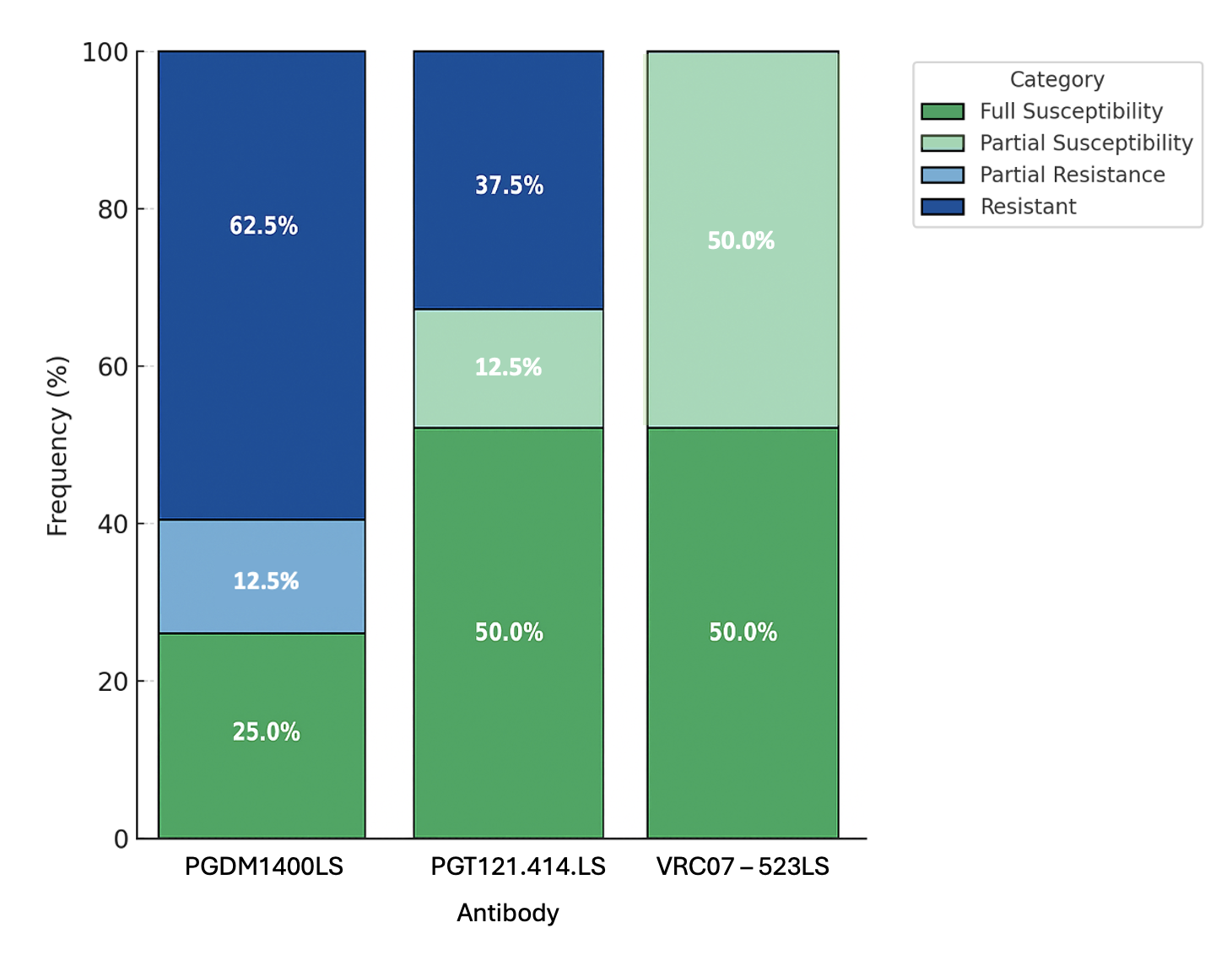
Stored samples were available from all 12 participants (3 male, 9 female), median sampling time was at 3 days of life (range 2 days, 212 weeks). Eight (66.7%) participants had successful bNAb phenotypes (Figure 1). For VRC07-523LS, 4 (50%) were fully susceptible and 4 (50%) were partially susceptible. For PGDM1400LS, 2 (25%) were fully susceptible, 1 (12.5%) was partially resistant, and 5 (62.5%) were fully resistant. For PGT121.414.LS, 4 (50%) were fully susceptible, 1 (12.5%) was partially susceptible, and 3 (37.5%) were fully resistant. One participant was fully susceptible to all three bNAbs, and two were resistant to both PGDM1400LS and PGT121.414.LS. The one child sampled at Tatelo virologic failure (rather than birth) was partially susceptible to VRC07-523LS and PGDM1400LS. In total, 6 (75%) of 8 participants with results were fully or partially susceptible to ≥2 bNAbs, allowing entry into the bNAb-only phase of the study.
Conclusions
In early-treated children sampled primarily near birth in Botswana, all samples were fully or partially susceptible to VRC07-523LS, with more variable susceptibility patterns for PGDM1400LS and PGT121.414.LS. Susceptibility testing to bNAbs in children remains an important component of current research trials, even with combination therapy and broadly acting agents.
Table or Figure