Background
Females often present with lower plasma viral loads and higher CD4 counts early in infection yet may experience greater HIV-related morbidity and mortality. In contrast, evidence among infants living with HIV (ILHIV) remains limited and sometimes conflicting, particularly regarding viral dynamics, immune reconstitution, and reservoir size. This gap hampers understanding of sex-related differences in early infection and their implications for treatment outcomes.
Methods
Data from the African pediatric EARTH-EPIICAL cohort were analyzed, including 159 of 215 early treated ILHIV who started ART within the first 3 months of life and had available longitudinal measurements of HIV-1 DNA in PBMCs. Sex effects on reservoir over time were estimated with a multivariable Bayesian Gaussian model. Severe immunosuppression (reaching 25% CD4) was assessed with a multivariable Bayesian Weibull survival model and reported as hazard ratios (HR). Baseline plasma samples were analyzed using a targeted proteomic approach; sex differences were tested with Bayesian two-sample t tests, reporting log2 fold change and Bayes factor (BF₁₀). Results are summarized as posterior medians with 95% credible intervals (CrI) and a posterior probability (PP%-the probability that the effect is in the stated direction).
Results
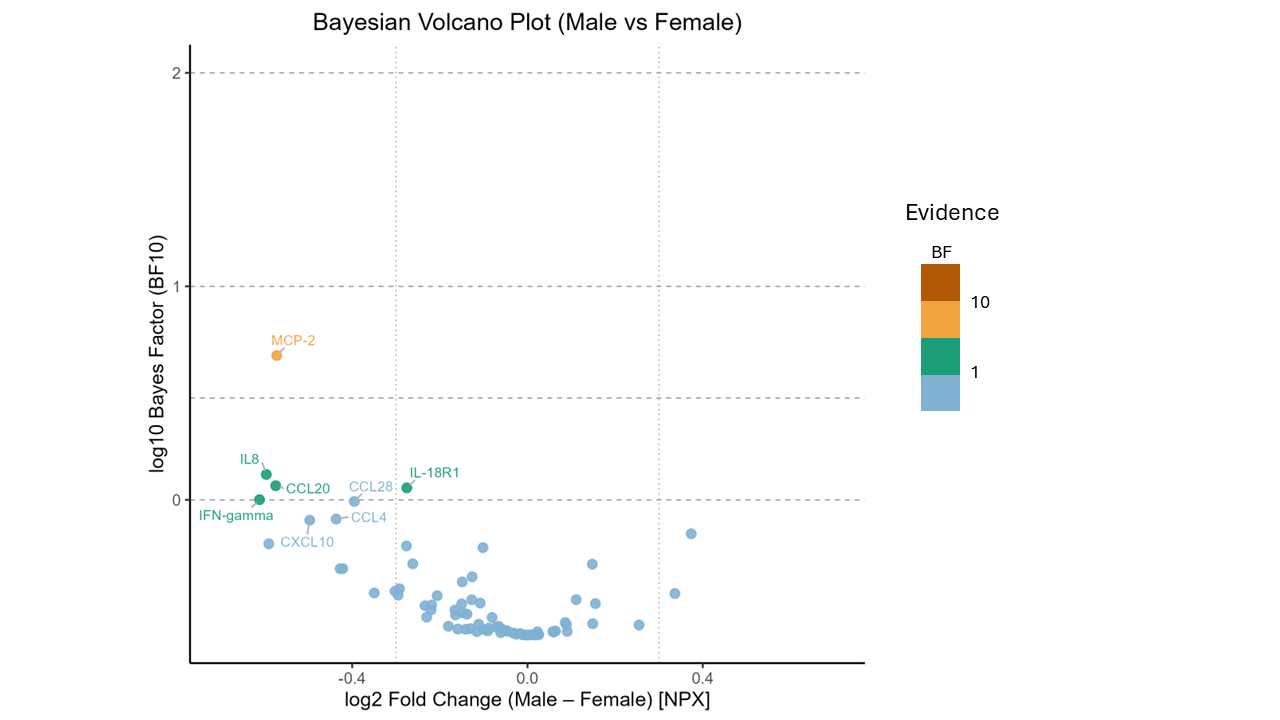
For each year of follow-up, females showed a steeper decline in reservoir size compared to males (–0.005; 95% CrI: –0.012 to 0.003), with a PP of 87%. Females had a 38% lower hazard of severe immunosuppression (HR: 0.62 [0.29;1.24]; PP=91%). Proteomic data suggested higher innate signaling and a more pro-inflammatory response in females. Notably, MCP-2, an inflammatory chemokine, was elevated with substantial evidence (BF₁₀=4.7; PP=91%), while IL-8, IL-18R1, CCL20, and IFN-γ showed moderate evidence of higher levels (BF₁₀≈1.0–1.4; PP≈95–97%), supporting a sex-specific inflammatory profile.
Conclusions
Females tended to show a more pronounced decline in reservoir size and a lower hazard of severe immunosuppression. Proteomic data suggested higher innate signaling and an enhanced pro-inflammatory response in females, with MCP-2 emerging as a candidate marker of sex-specific biology and IL-8, IL-18R1, CCL20, and IFN-γ indicating potentially attenuated but persistent inflammatory signaling. These findings suggest that sexual dimorphism may contribute to pediatric HIV pathogenesis and be considered in trial design and treatment strategies.
Table or Figure