Background
Metabolic perturbations have been observed in infants with perinatal HIV and antiretroviral exposure who are uninfected (HEU). Data is sparse on body composition among HEU infants.
Methods
The ORCHID study enrolled women with HIV (WWH) and HIV-seronegative women >16 years old and <18 weeks (wks) gestational age (GA) during pregnancy in South Africa. All WWH received tenofovir+lamivudine+dolutegravir. For this analysis, we included singleton liveborn infants with available body composition or anthropometric data. Repeated measures of infant adiposity during the 1st year included: 1) fat mass and body fat% via air displacement plethysmography (PEAPOD), 2) sum of caliper-measured triceps, subscapular, and suprailiac skinfolds (SSF). Mixed models were fit to assess the association of HEU status with outcomes over time. Infants >8 kg were excluded from fat mass and body fat% analyses due to PEAPOD system weight specifications. Subgroup analyses in HEU infants were performed to assess the association of maternal CD4 and viral load (VL) at enrollment with outcomes.
Results
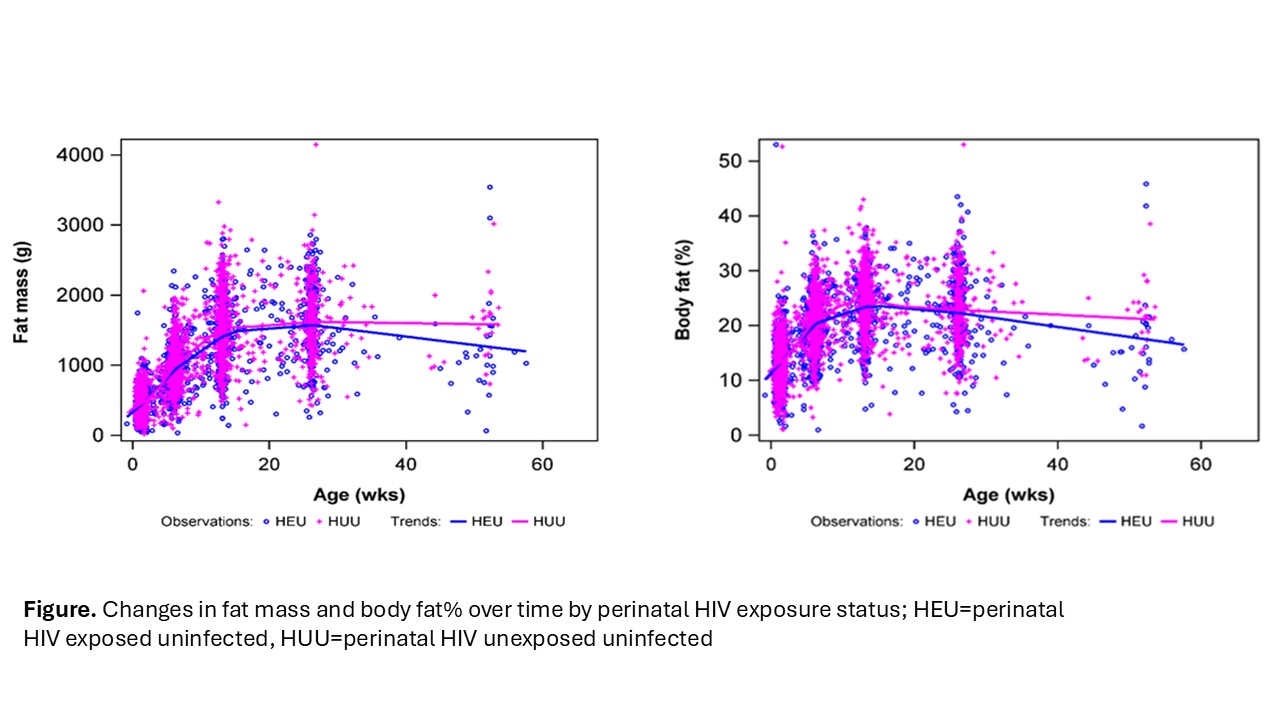
Of 1414 infants (715 female), 610 were HEU. Maternal age (30 vs 26 years) and multiparity (37 vs 22%) were higher, and breastfeeding duration was lower (19.3 vs 39.3 wks) among HEU vs infants without HIV exposure (HUU). Maternal education, BMI, body fat%, gestational diabetes (GDM) at enrollment, as well as infant GA, weight, and length at birth, were similar between groups. Among HEU infants, 52% of mothers had CD4>500 cells/mm3 and 77% had VL<50 c/mL. Fat mass (413 vs 425g), body fat% (13.1 vs 12.9%) and SSF (15.5 vs 15.8mm) at 2 wks were similar between groups.On average, mean infant fat mass and body fat% were similar between groups while SSF was 0.5mm lower (p=0.02) in HEU vs. HUU over time after adjusting for maternal age, BMI, GDM, gestational weight gain, body fat%, substance use, as well as infant sex, GA at birth, and breastfeeding duration. (Figure) Trajectories of fat mass (estimate: -7.0 g/wk, p<0.01) and body fat% (estimate: -0.07 body fat%/wk, p<0.01) were somewhat dampened in HEU vs. HUU over time. Among HEU infants, maternal CD4 and VL were not associated with infant fat mass or body fat%.
Conclusions
In the largest study of body composition comparing HEU and HUU infants, there were no clinically relevant differences in adiposity in the 1st year of life; long-term follow-up is needed. Maternal CD4 and VL were not associated with infant adiposity among HEU infants.
Table or Figure