Background
Prematurity and low birth weight (LBW) are leading risk factors for morbidity among HIV-exposed uninfected (HEU) neonates. The IMPAACT PROMISE 1077BF trial found high rates of adverse pregnancy outcomes among women living with HIV (WLHIV) randomized to triple antiretroviral treatment compared to zidovudine alone. We sought to elucidate the possible role of TORCH infections and other factors associated with preterm delivery (PTD) and LBW among WLHIV on ART.
Methods
We conducted a nested case-control study using stored PROMISE 1077BF specimens from mother/infant pairs enrolled in Uganda. All eligible mother/infant pairs with PTD (< 37 weeks) and/or LBW infant (< 2500g) were selected as cases. For every case, up to two 1077BF mother/infant controls with term delivery (≥37 weeks) and non-low birthweight infant (≥ 2500g) of similar maternal age, parity, and infant specimen availability were randomly selected. Generic PCR testing for cytomegalovirus (CMV) and toxoplasmosis (TOXO); and syphilis testing (RPR and Treponema test if RPR was positive) were done for all maternal samples. Infant testing was performed if the maternal sample was positive; otherwise, the infant was presumed TORCH-negative. Weighted estimates of prevalence were calculated for each TORCH infection. Multivariable weighted Poisson models were fit to assess the association between maternal TORCH infections and adverse pregnancy outcomes. Weights were based on the inverse probability of being sampled.
Results
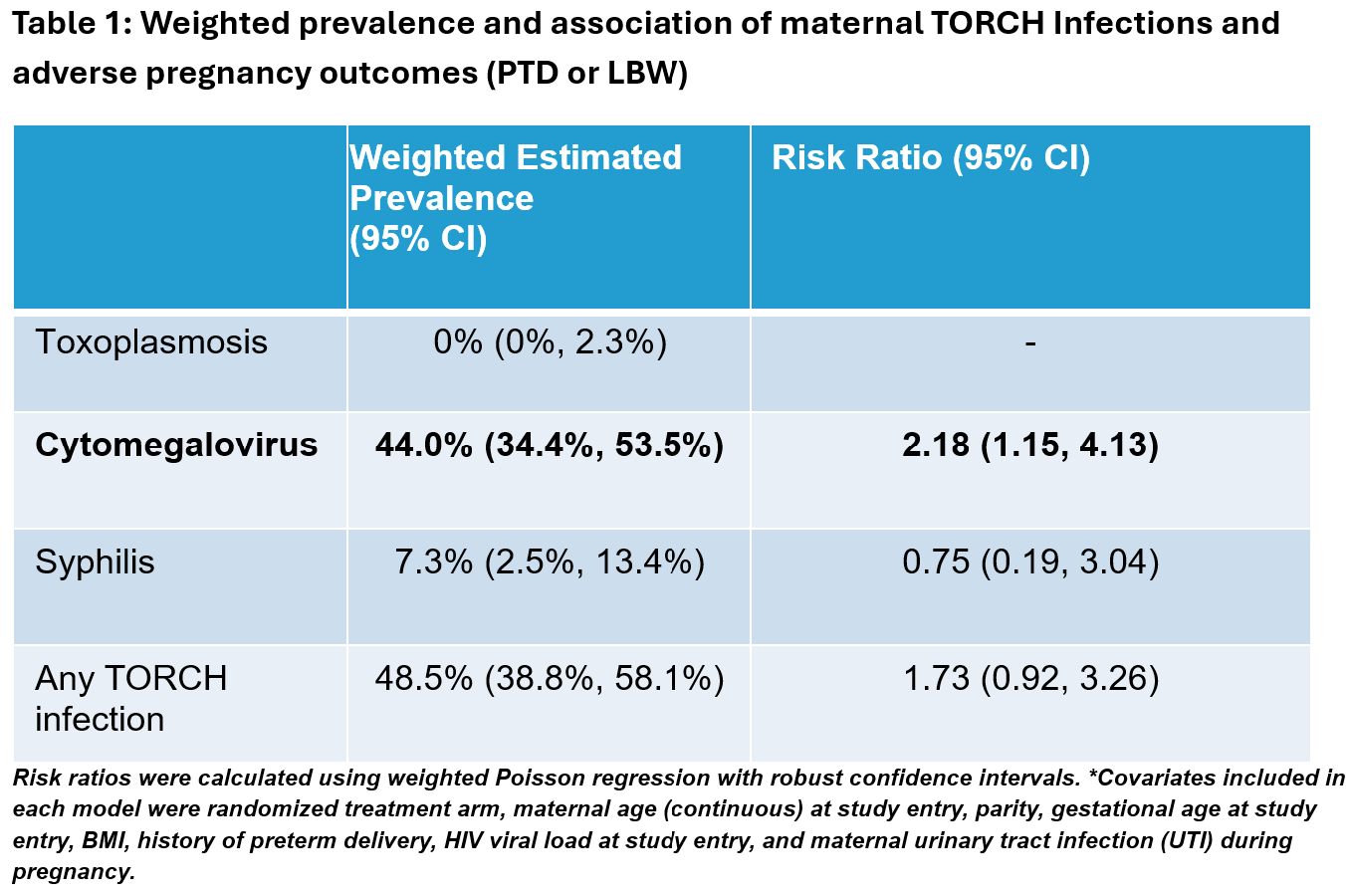
Among 158 women with live singleton births, median maternal and gestational age at study entry was 26 years (IQR 23-30) and 27.5 weeks (IQR 23.0-36.1), median baseline HIV-1 RNA was 4.1 log10 copies/ml (IQR 3.4-4.6), and 96% were WHO clinical stage I. The estimated weighted prevalence (95% CI) of any maternal TORCH infection was 49% (39%, 58%). Weighted prevalence estimates for maternal CMV, syphilis, and TOXO were 44%, 7%, and 0%, respectively. Infant weighted prevalence was 7% and 2% for CMV and syphilis, respectively. CMV was associated with an increased risk of PTD and/or LBW; Risk Ratio (95% CI): 2.2 (1.2, 4.1). Maternal syphilis was not associated with an increased risk of PTD or LBW.
Conclusions
About one in two pregnant WLHIV in Uganda had evidence of a TORCH infection. Mothers with CMV had twice the risk of PTD or LBW compared to CMV-negative mothers. Prenatal CMV screening should be prioritized among WLHIV, as well as subsequent testing of their exposed uninfected children for WLHIV who are CMV-PCR positive.
Table or Figure