Background
Despite virologic suppression with ART, pregnant people living with HIV (PLWH) experience a disparate risk of chronic non-AIDS-related morbidities (NAMs) during pregnancy compared to people without HIV infection including preterm labor and small for gestational age. Many studies postulate that NAMs reflect immunological dysfunction from underlying continuous inflammation. Extracellular vesicles (EV) are fundamental to both HIV immune pathogenesis and maternal-placental-fetal systemic intercellular networking. Circular RNAs (CircRNA) are enriched within EVs and are readily transmissible with disease-specific functional outcomes in recipient cell populations. However, there is limited research addressing the intersection of EV circRNA and HIV during pregnancy.
Methods
Plasma-derived EV small RNA (smRNA) cargo from pregnant PLWH (n=8) was compared to pregnant people living without HIV (PLWoH, n=10) using low-input RNA sequencing (Illumina PE150). Differential EV circRNA profiles were used to construct EV circRNA-miRNA-gene regulatory maps and EV circRNA-protein interactions (circInteractome and miRTarbase). Gene set enrichment analysis (GSEA) using Reactome on the predicted genes from the interactome networks, provided insights into the regulatory roles of the differentially expressed EV circRNAs.
Results
Differential expression analysis identified 27 significantly upregulated EV circRNAs for pregnant PLWH as compared to pregnant PLWoH. GSEA revealed physiological pathways influential to HIV reservoir establishment, latency, replication, immune activation, immunosenescence, as well as maternal-placental-fetal immune cross talk. FUS, AGO2, and EIF4A3 were the top EV circRNA binding proteins and are involved in scaffolding for circRNA biogenesis, EV sorting, and miRNA sponging. High-density miRNA-binding EV circRNAs highlighted circRNA-mediated suppression of HIV inhibitory mechanisms including extensive binding of hsa-miR-326 and hsa-miR-548c-3p.
Conclusions
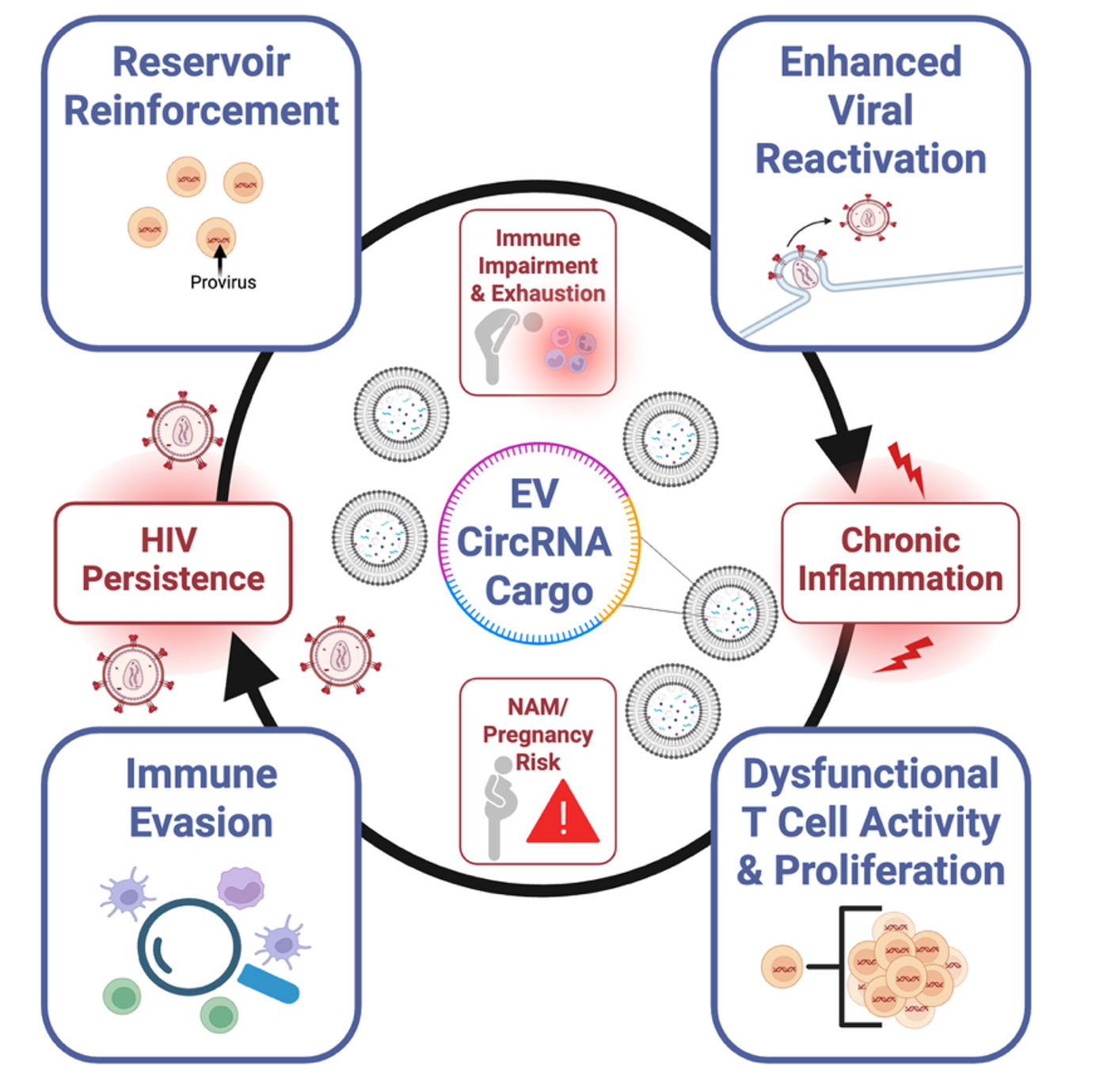
While many studies have compared plasma RNA profiles for PLWH compared to PLWoH, few have conducted this analysis for EVs, and we were unable to find a study specific to the unique combination of exploring EV RNA cargo in PLWH during pregnancy. This study aims to address the knowledge gap for NAMs in pregnancy by investigating EV-based intercellular communication. The results imply that novel EV circRNA-mediated regulatory mechanisms may contribute to HIV persistence, inflammation, and immune modulation in pregnancy.
Table or Figure