Background
Low vaginal bacterial diversity in pregnancy, with Lactobacilli (L) species dominance, is immune protective. Transition to less stable, high diversity community state type (CST) IV (bacterial vaginosis) is linked with inflammation driven preterm birth(PTB). Women living with HIV have high prevalence of non-optimal CSTs and rates of PTB. We hypothesised initiation of antiretroviral therapy(ART) impacts vaginal bacterial diversity, CST stability and differs by regimen.
Methods
In this DolPHIN-2 substudy we examined the impact of dolutegravir(DTG) and efavirenz(EFV) -based ART initiated in late pregnancy on the vaginal microbiota of South African women. Paired cervicovaginal fluid (CVF) samples at baseline (~29weeks) and 28 days (~33weeks) were available (EFV n=17, DTG n=18). Bacterial composition (alpha(a)diversity/CST by VALENCIA) was determined by near full-length 16S rRNA gene sequencing. CVF inflammatory cytokines were measured at baseline by immunoassay. Multivariate adjusted logistic models assessed additive and interacting effects of ART, time, cytokines, CD4, HIV load, on a diversity change, CST IV transition, and gestational age(GA) at delivery using R.
Results
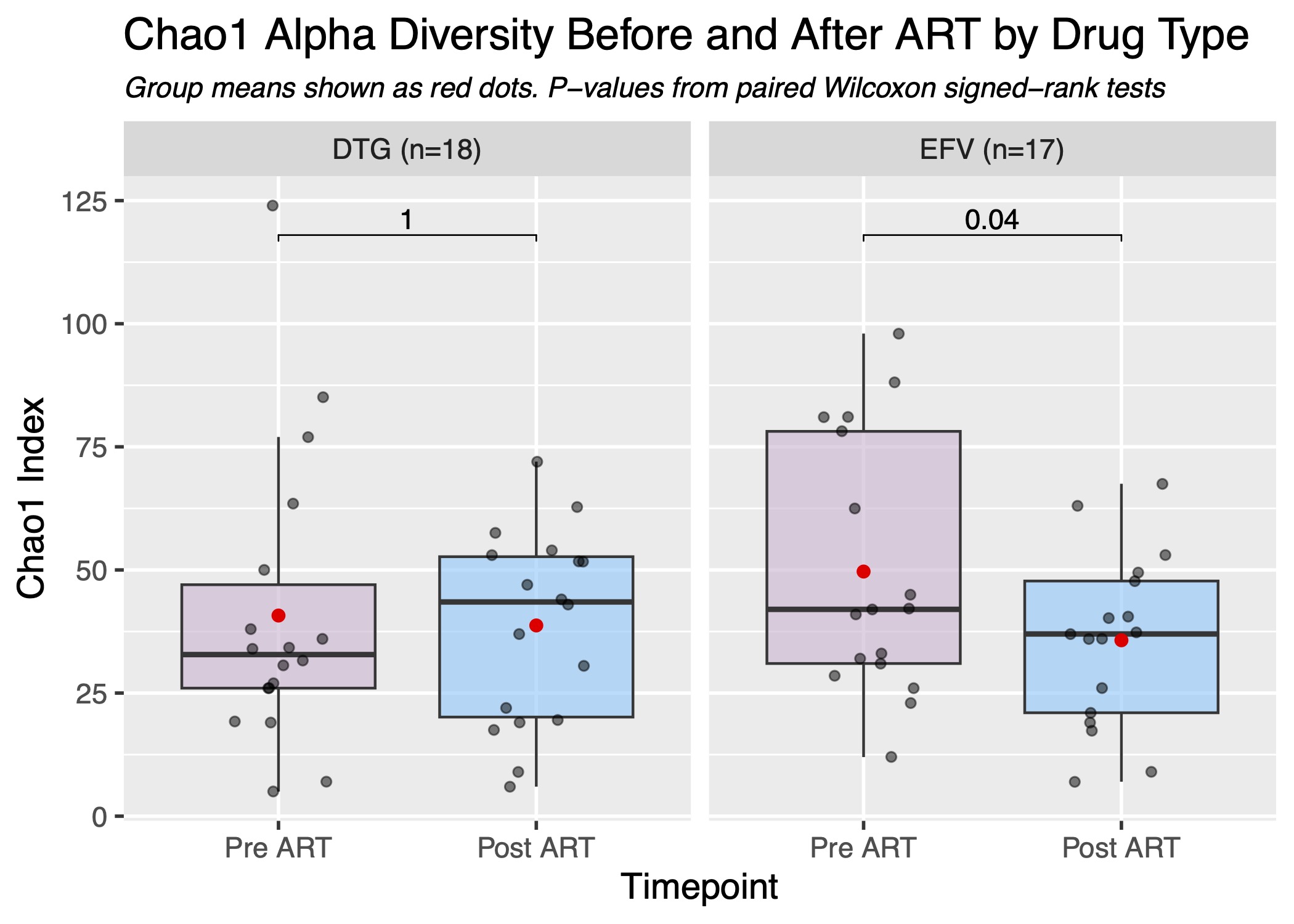
Baseline a diversity, CST and cytokines did not differ by ART or immune status. 43% of women were CST IV, 49% CST III (L.iners dominant), with 1 PTB in each arm. Alpha diversity decreased in both arms, reaching significance with EFV(p=0.04) but not DTG, see figure. With EFV, higher baseline IL-1β trended toward increased a diversity (p=0.10), not seen with DTG. With DTG there was a significant interaction of ART×days between samples on a diversity, with more days between samples associated with lower diversity(p=0.03), not seen with EFV. Women on EFV trended toward higher odds of transitioning to CST IV (p=0.07), and there was a significant ART×IL-1β interaction, with higher IL-1β increasing likelihood of CST IV transition (interaction OR≈25, p=0.03). No associations were observed between a diversity change, shift to CST IV, IL-1β and GA at delivery.
Conclusions
We found a high prevalence of non-optimal CSTs in late pregnancy. Alpha diversity reduced in the 3rd trimester and significantly in the EFV arm. We observed different drivers of diversity change within each arm (time/inflammation), however in our regression models a drug specific effect was not significant. The role of ART regimen and inflammation on vaginal microbiota stability in pregnancy warrants modelling in larger cohorts to understand the impact on PTB risk.
Table or Figure