Background
While significant progress has been made in prevention of vertical transmission (VT) of HIV, globally, an estimated 120,000 children acquired HIV in 2024. Sustained antiretroviral treatment (ART) for pregnant and breastfeeding women (PBFW) is critical for HIV viral suppression and reduced risk of VT; however, continuity of ART engagement among PBFW is not widely understood. We characterized ART continuity to inform programmatic and research priorities for PBFW.
Methods
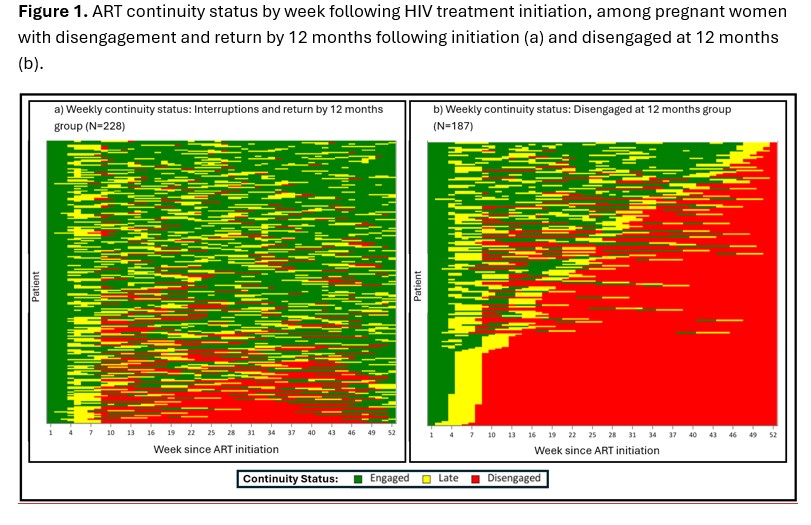
We assessed continuity of ART engagement using routinely collected electronic medical record data for HIV-positive pregnant women (PW) initiating ART between 2017-22 at 42 health facilities in Côte d’Ivoire. PW with at least 12 months of observable follow-up time were included. Using documented appointment and clinic visit dates, we classified periods of noncontinuity as: 1) late, inclusive of up to 28 days past an appointment date; and 2) disengaged, inclusive of any period beyond 28 days without a visit. We used disengagement classifications to categorize PW into three groups: no disengagement, disengaged and returned by 12 months, and disengaged at 12 months. We generated heat maps to visualize continuity pattens by disengagement group and descriptive statistics to summarize total numbers of days of noncontinuity.
Results
Among the 679 PW initiating ART, 187 (27%) were disengaged from treatment at 12 months after initiation, 228 (34%), had disengaged and returned, and 264 (39%) had no periods of disengagement. PW with no disengagement had a median of 18 total days (IQR: 8-33) of noncontinuity in the first 12 months of ART; women who disengaged and returned had a median of 105 total days (IQR: 75-154), while women disengaged at 12 months had a median of 279 days (IQR: 201-334) of noncontinuity. Heat maps show that both groups of PW with disengagement often experienced short intervals of lateness, returning to care before the 28 day mark (Fig 1). The substantial number of total days late among the disengaged and returned group was primarily due to these frequent late returns along with brief periods of disengagement.
Conclusions
Almost two-thirds of PW disengaged from ART in the 12 months following initiation; even the women who returned to care accumulated a median of over three months of noncontinuity of ART, increasing risks of morbidity and vertical transmission. Interventions such as person-centered, differentiated ART models for PW are needed to improve continuity.
Table or Figure