Background
Efavirenz (EFV) pharmacokinetics (PK) may be influenced by both pregnancy-related physiological changes and concurrent treatment for drug-sensitive tuberculosis (DS-TB) in pregnant women living with HIV (PWLHIV) with TB disease. As EFV might be preferred over dolutegravir to avoid double dosing during DS-TB treatment, more EFV PK data in PWLHIV on DS-TB treatment are needed, as only limited sparse sampling data are currently available.
Methods
The IMPAACT P1026s study evaluated EFV PK in a prospective observational cohort of PWLHIV receiving EFV-based antiretroviral therapy alongside first-line TB medications rifampicin and isoniazid, with or without ethambutol and pyrazinamide. PK outcomes were compared to a previously published P1026s cohort of PWLHIV without TB and evaluated against protocol-defined minimum therapeutic targets (AUC0-24 40 µg·h/mL (10th percentile of non-pregnant historical controls) and Cmin 1 µg/mL). Participants received WHO-recommended daily EFV and first-line TB medications, followed by intensive 24-hour PK sampling during the second trimester (2T), third trimester (3T), and 2–8 weeks postpartum (PP). PK parameters were characterized using noncompartmental analysis and comparisons across pregnancy stages and between treatment groups were made using geometric mean ratios (GMRs) with 90% confidence intervals (CIs).
Results
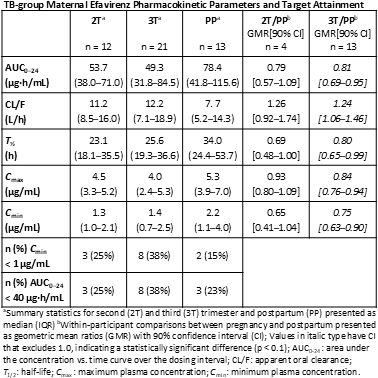
Of 22 participants, PK data were available for 12, 21 and 13 participants in 2T, 3T and PP, respectively. In 3T, EFV exposure was lower compared to PP: AUC0-24 was 19% lower, Cmax 16% lower, Cmin 25% lower, and apparent oral clearance (CL/F) 24% higher (CIs exclude 1.0). In 2T, these parameters and the GMRs were similar to those in 3T but the CIs included 1.0. Although median EFV concentrations remained above therapeutic thresholds, 38% of participants did not meet target AUC0-24 and Cmin levels. In contrast, in the non-TB-group, the EFV AUC0-24 and Cmax were similar in pregnancy and postpartum, but Cmin was 28% lower in 3T with 27% of participants not meeting target AUC0-24 and Cmin levels. In the TB-group only 64% of participants had a viral load ≤ 50 copies/mL at delivery, while 85% were suppressed in the non-TB-group, but no infants had acquired HIV during the follow up period.
Conclusions
These findings suggest that late pregnancy combined with DS-TB treatment is associated with lower EFV exposure. Further investigation is warranted to determine the clinical significance of lower EFV exposure in PWLHIV on first-line TB treatment.
Table or Figure