Background
Long-acting cabotegravir and rilpivirine (LA CAB/RPV) provides an alternative to daily oral antiretroviral therapy and has shown high effectiveness and acceptability in non-pregnant populations. During pregnancy, physiologic changes can reduce antiretroviral (ARV) drug concentrations. Pharmacokinetic (PK) modeling indicates that adequate CAB exposure is maintained with monthly dosing; however, there is concern that RPV concentrations fall below the protein-adjusted 95% effective concentration leading to recommendations for monthly dosing. We describe the first multi-center case series of pregnant persons maintained on bi-monthly LA CAB/RPV throughout pregnancy.
Methods
We conducted a multi-center retrospective chart review of persons with HIV who were prescribed LA-CAB/RPV at any point during pregnancy between January 2021 and September 2025 (n=42). For this analysis, we included anyone who conceived while receiving bi-monthly LA-CAB/RPV and continued this dosing schedule throughout pregnancy and delivery, without receiving any other ARV therapy. Data collected included maternal demographics, longitudinal HIV RNA measurements during pregnancy, and perinatal and neonatal outcomes such as gestational age at delivery, birth weight, and viral suppression at delivery.
Results
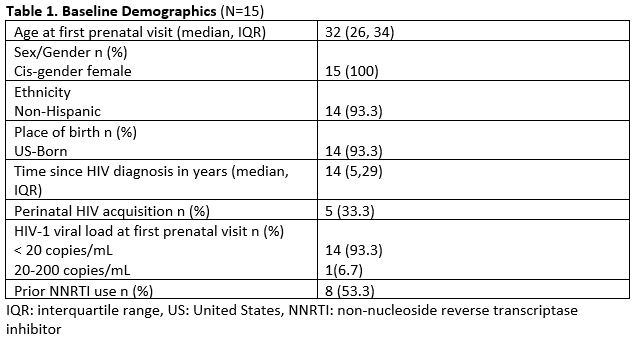
Fifteen pregnant cis-gender women receiving bi-monthly LA CAB/RPV prior to pregnancy met inclusion criteria and are included in this analysis. Baseline demographics are included in Table 1. All but one entered prenatal care with a viral load that was less than 50 copies/mL. The median number of HIV-1 RNA levels checked during pregnancy was 3 (IQR: 3,5) and all participants maintained virologic suppression (< 20 copies/mL) throughout the pregnancy and delivery with no blips or virologic failure. The majority had vaginal deliveries; caesarean deliveries were performed for obstetrical reasons. Median gestational age at delivery was 37 weeks (IQR: 25,38) with a median birth weight of 2,330 grams (IQR: 767, 2,750). There was one spontaneous abortion. There were no cases of perinatal HIV transmission.
Conclusions
In this multi-center cohort study of pregnant persons maintained on bi-monthly LA CAB/RPV, sustained virologic suppression with favorable perinatal outcomes and no perinatal transmissions were achieved on bi-monthly dosing. These findings underscore the urgent need for dedicated PK and safety studies to determine whether bi-monthly LA CVAB/RPV can be considered a viable option during pregnancy.
Table or Figure