Background
Studies have shown people with HIV (PWH) are 2-4x more likely to develop long COVID than people without HIV (PWOH), potentially due to persistent immune dysregulation. We evaluated post-COVID symptoms in PWH versus PWOH to assess differences in symptom prevalence and/or immune biomarkers of long COVID.
Methods
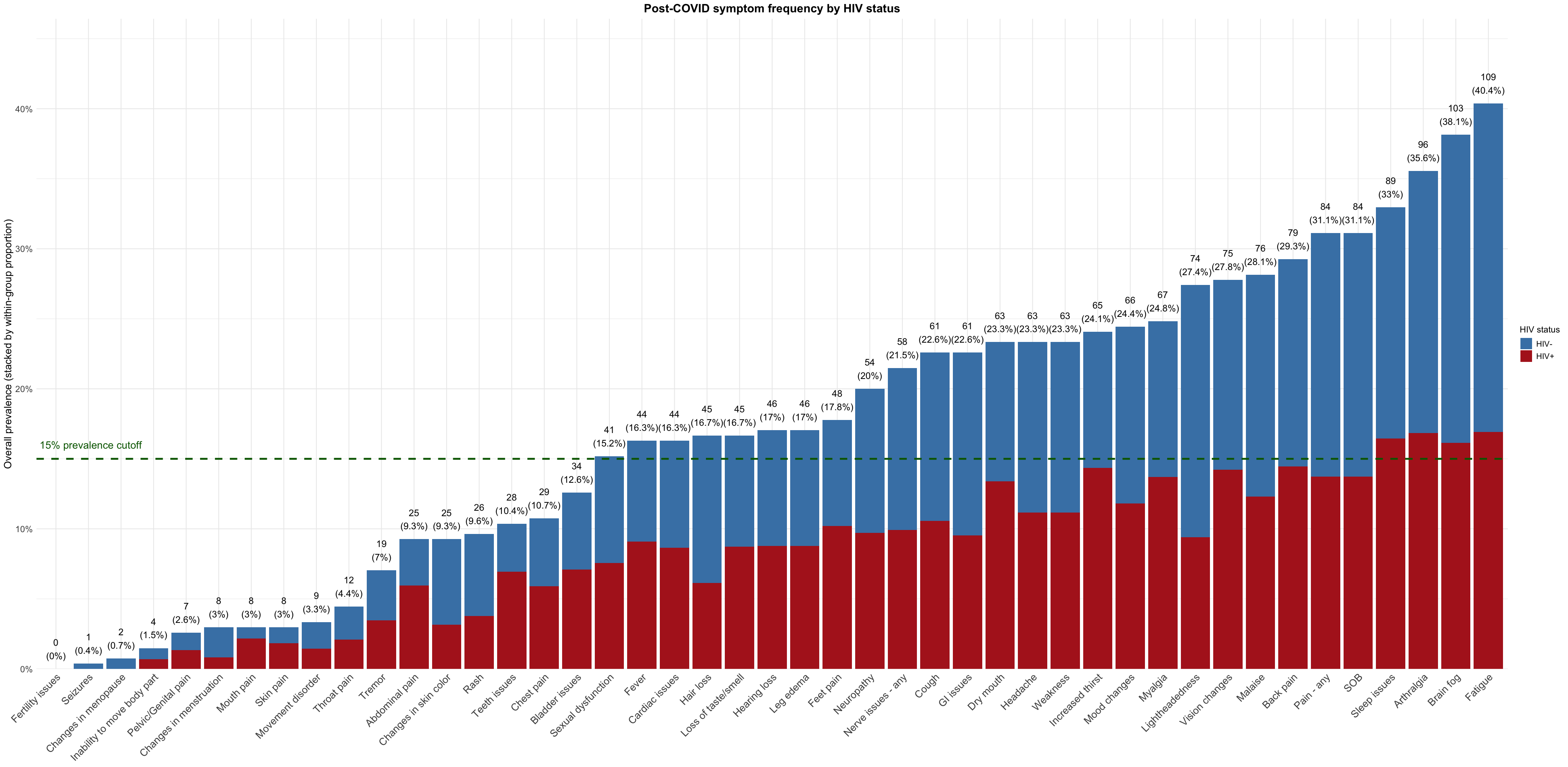
Surveys and blood samples were collected from PWH (n=73) and PWOH (n=197) an average of 890 days [range 606-1174] after initial COVID-19 infection. Long COVID was defined as reporting ³ 1 new symptom post-COVID plus one of the following: 1) moderate-extreme symptom interference in the last month, 2) RECOVER2024 index met, or 3) long COVID diagnostic code. We performed flow cytometric analyses on peripheral blood mononuclear cells from PWH with (n=34) and without (n=34) long COVID and PWOH with (n=66) and without (n=51) long COVID. Cells were stained for T cell activation/exhaustion and monocyte subsets. Of 45 reported symptoms, the 28 occurring in ≥15% of participants were analyzed. Logistic regression adjusted for race, sex, and acute COVID severity was used to evaluate demographic and immune features associated with post-COVID symptoms (false discovery rate 5%).
Results
The top three most reported symptoms were fatigue (40%), brain fog (38%), and arthralgia (36%). Despite similar post-COVID symptoms, moderate-extreme symptom interference was reported by 18% of PWH and 42% of PWOH (p=0.003). Although 71% of PWH and 74% of PWOH reported ³ 1 new symptom post-COVID, only 10% of PWH and 37% of PWOH had a long COVID diagnostic code (p<0.0001), highlighting potential limitations in clinical diagnosis. Older age was linked to arthralgia (OR 1.05, CI 1.02–1.07) and obesity to dyspnea (OR 2.8, CI 1.5–5.4). Elevated CD16+ monocytes were linked to higher odds of malaise (OR 1.14, CI 1.05–1.24), whereas elevated CD4+PDL1+ T cells were linked to lower odds (OR 0.6, CI 0.4–0.8; OR 0.9, CI 0.85–0.96). Symptom associations did not differ by HIV status. PWH had increased CD16+ monocytes (p=0.008) and decreased PDL1 expression on both CD4+ (p<0.0001) and CD8+ T cells (p<0.01) compared to PWOH, regardless of long COVID status.
Conclusions
Post-COVID symptoms were not driven by HIV status. However, malaise in both PWH and PWOH was associated with immune shifts observed in chronic HIV, suggesting the possibility of overlapping mechanisms. Immune signatures may help identify individuals at risk for long COVID and inform interventions for symptoms such as malaise.
Table or Figure