Background
The co-circulation of SARS-CoV-2 with other respiratory viruses raised concerns that coinfections may increase pediatric COVID-19 severity. Evidence mainly derives from critically ill patients, where testing likely underestimated milder cases. We assessed the epidemiology, clinical features, and outcomes of SARS-CoV-2 coinfections versus monoinfections in hospitalized children, accounting for hospital testing practices.
Methods
We analyzed national surveillance data from the Canadian Pediatric Surveillance Program and the Canadian Immunization Monitoring Program, ACTive (IMPACT). Children <17 years hospitalized for PCR-confirmed COVID-19 during Delta and Omicron waves (July 2021–Dec 2022) were included. Coinfection was defined as SARS-CoV-2 plus ≥1 other respiratory virus. Analyses were first conducted pooling all IMPACT hospitals, irrespective of testing policies, and then stratified by testing strategy: (i) systematic influenza/RSV testing, (ii) systematic multiplex PCR in all admissions. Multivariable Poisson regression estimated adjusted risk ratios (aRR) for severe disease (intensive care unit [ICU] admission, ventilation, organ complications, or death), adjusted for demographics, comorbidities, SARS-CoV-2 lineage, and vaccination.
Results
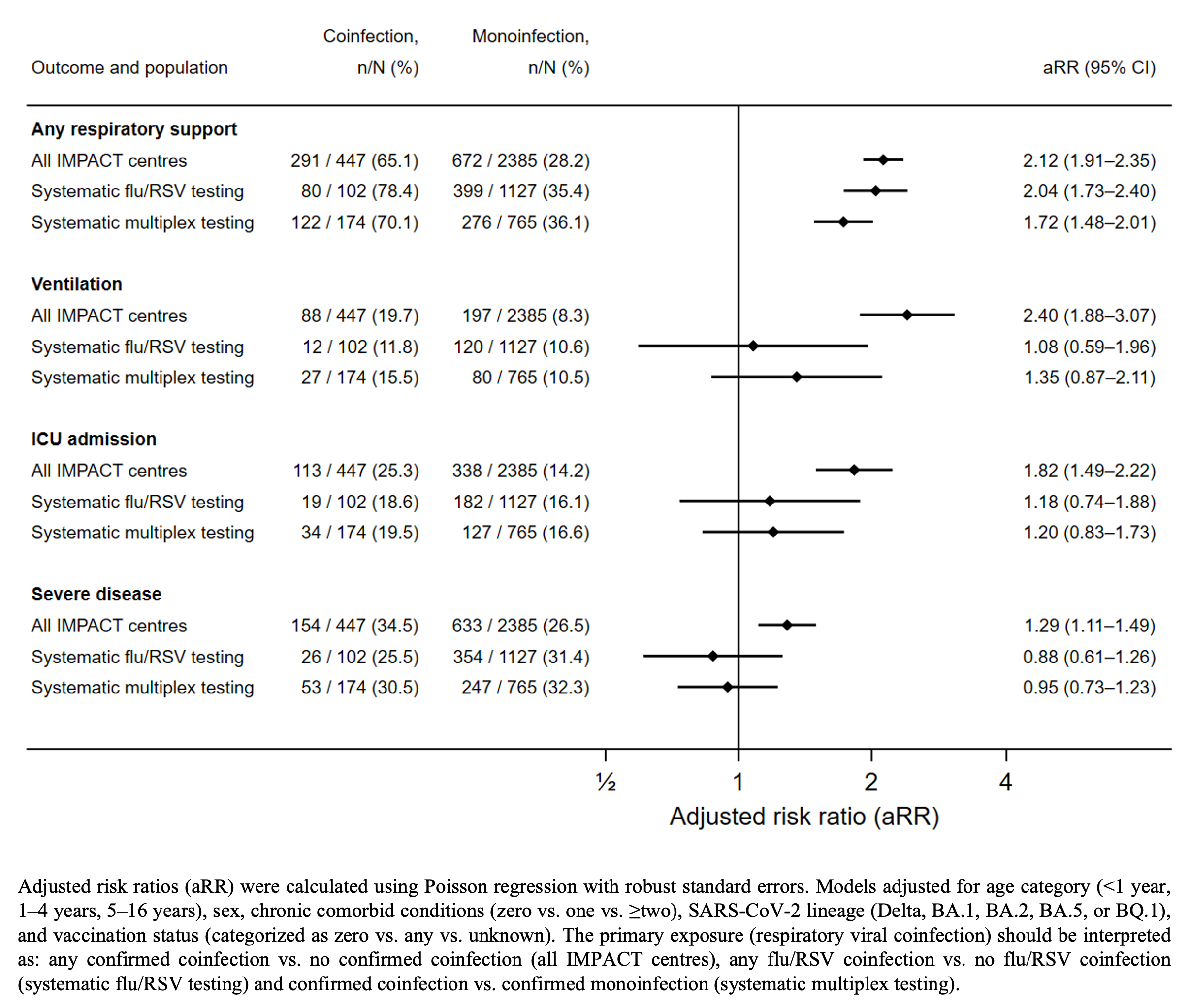
Among 2832 hospitalizations, 447 (15.8%) had coinfections, mostly with one other virus (87.0%). Coinfected cases were younger (median 1.1 [IQR:0.3-3.3] vs 1.5 [IQR:0.3-6.2] years, p=0.01) and less often COVID-19 vaccinated (17.5% vs 35.2% among vaccine-eligible cases, p<0.001). RSV (183/447, 40.9%) and enterovirus/rhinovirus (160/447, 35.8%) were the most frequent coinfections. In overall analyses pooling all IMPACT hospitals, children with coinfections had a higher risk of severe outcomes compared to monoinfections. When stratified by systematic influenza/RSV or multiplex testing, no differences in severe outcomes were observed. Coinfections, however, remained associated with higher noninvasive respiratory support (Figure). Among RSV coinfections, 55.1% had bronchiolitis, 88.4% respiratory distress, and 85.5% required noninvasive support, but only 10.1% ventilation and 21.7% severe disease.
Conclusions
After adjusting for testing practices, SARS-CoV-2 coinfections overall were not linked to greater severity, suggesting the apparent excess risk mainly reflected selective testing of critically ill children. RSV coinfections showed higher respiratory morbidity, with more frequent distress and noninvasive support, though without increased severity.
Table or Figure