Background
Sarcopenia is an age-related condition characterized by progressive loss of muscle mass, strength, and function. We evaluated the efficacy of a 48-week home-based physical activity program on sarcopenia-related parameters in persons with HIV (PWH) ≥50 years and elderly without HIV (ELD) ≥60 years, all with sarcopenia.
Methods
Participants (n=196; 98 PWH, 98 ELD) were randomized 1:1 to either perform (EXE group) or not perform (non-EXE group) the program, consisting of 4 weekly 40-minute sessions of exercises targeting major limb muscle groups and balance control, supported by a smartphone app with video tutorials and remote training monitoring. Sarcopenia was defined as appendicular skeletal muscle mass index (ASMMI) ≤7.0 (men) or ≤5.5 kg/m² (women), or skeletal muscle mass index (SMI) ≤10.75 (men) or ≤6.75 (women) kg/m², assessed by bioelectrical impedance analysis (BIA). Percent changes from baseline were compared between EXE and non-EXE groups by nonparametric tests, at weeks 12 and 48 (W12, W48) for strength and functional performance (handgrip [HG], knee extension, 30-second chair-stand test [CST], 6-minute walking test, mini-BESTest), muscle mass by BIA (fat and lean mass, SMI, ASSMI), and lipid profile.
Results
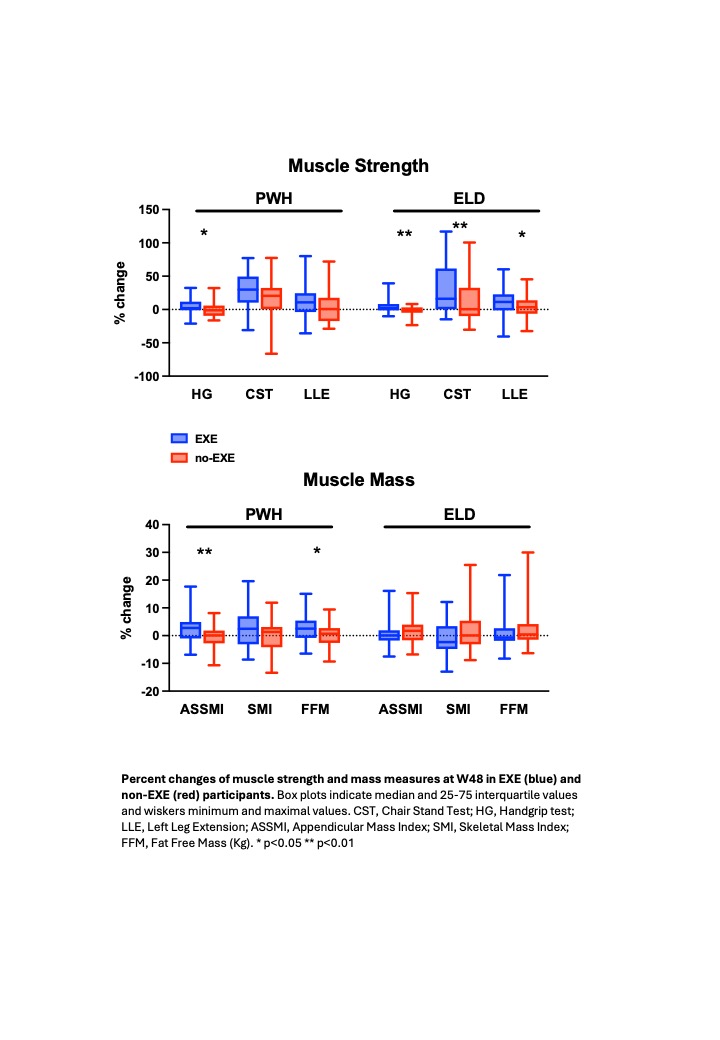
Of the 196 participants, 142 (72.4%) completed the study, including 69 PWH (median age 62 years [25th-57thIQR 57-67]; 74% males, nadir CD4 271/µL [148-348], current CD4 773/µL [220-1027], 95.7% undetectable VL) and 73 ELD (median age 69 years [65-74], 45% males). Among PWH, EXE participants (n=36) showed significantly larger improvements than non-EXE (n=33) in CST at W12 and in HG at W48; in SMI and ASSMI and total lean mass at W12 and W48. Among ELD, EXE participants (n=37) showed significantly larger improvements, compared to non-EXE (n=36), in CST at W12 and W48, and in HG and left and right leg extensors at W48, but not in muscle mass measures (Figure). No significant differences between EXE and non-EXE participants were observed for the other variables. Among EXE participants, PWH showed significantly larger improvements at W48 in ASSMI, SMI, and lean mass than ELD; ASSMI and lean mass changes correlated inversely with age. All other measures did not change significantly in PWH vs ELD, females vs males, or in relation to age.
Conclusions
This 48-week home-based physical activity program was feasible and effective in improving muscle strength and mass in PWH ≥50 years, and muscle strength in elderly without HIV ≥60 years with sarcopenia.
Table or Figure