Background
Data on frailty prevalence and associated factors among Kenyan women living with HIV (WLWH), and broadly, in sub-Saharan Africa, are limited, and few studies have validated the use of frailty measures in this population. This study examined the prevalence and factors associated with frailty and the agreement between the Fried Frailty Phenotype (FFP) criteria and Clinical Frailty Scale (CFS).
Methods
We conducted a cross-sectional study among WLWH aged ≥50 years, on antiretroviral therapy (ART) for ≥6 months at Kenyatta National Hospital in Nairobi, Kenya (September 2024-June 2025). Frailty was assessed using the CFS and FFP criteria, defined as a clinical syndrome with ≥3 of the following: unintentional weight loss, self-reported exhaustion, grip strength weakness, slow walking, limited vigorous physical activity. We assessed participant characteristics with frailty as a binary outcome (robust versus pre-frail/frail) using bivariate tests and multivariable Poisson regression with robust standard errors. Prevalence ratios (PRs) with 95% confidence intervals (CIs) were reported. Agreement between FFP and CFS was assessed using weighted Cohen’s kappa (Kw).
Results
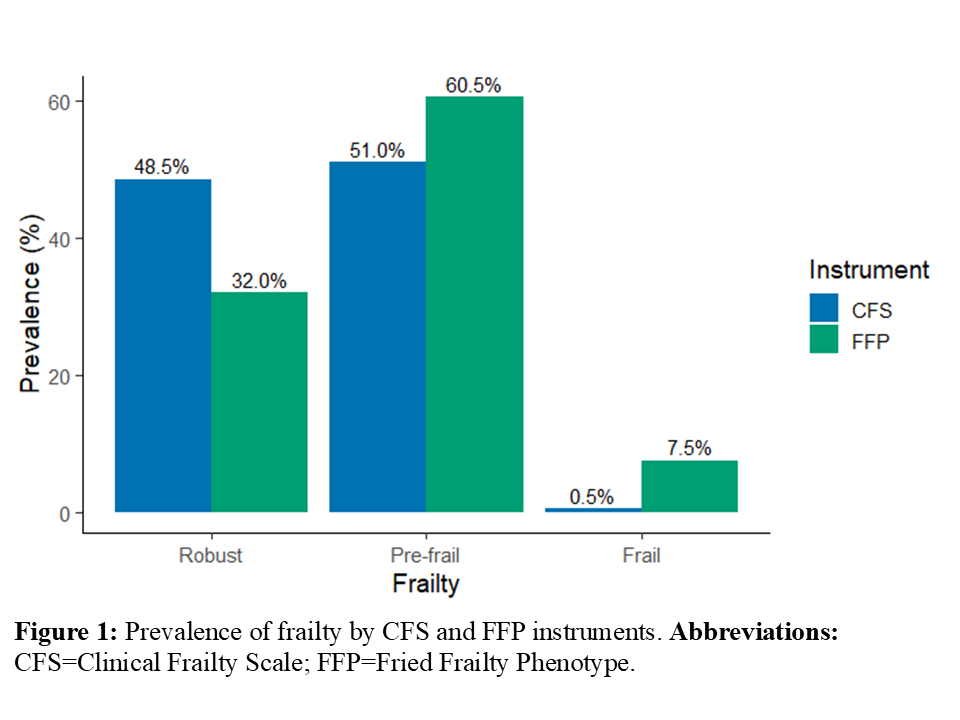
We enrolled 200 WLWH with a median age of 58.1 years (interquartile range [IQR]: 53.8, 62.8), 27% were married, and 49.5% had a primary education or lower. Median ART duration was 12.3 years (IQR: 9.5, 12.3), and 91.9% were virally suppressed (<50 copies/mL). Most women were overweight or obese (BMI ≥25 kg/m²: 77.0%). Frailty and prefrailty prevalence via FFP were 7.5% and 60.5%, but lower with the CFS, 0.5% and 51% (Figure 1). Slow gait (58.5%) and exhaustion (12.5%) were the most common phenotypes. Agreement between FFP and CFS was poor (Kw <20). In multivariable analysis, frailty/pre-frailty prevalence was 1.23 times greater (95% CI: 1.00, 1.52) among women reporting falls in the past year compared to those who did not. Longer Timed Up and Go (TUG) duration, higher BMI, longer duration on ART, and higher PHQ-9 scores were also significantly associated with increased prevalence of frailty/pre-frailty.
Conclusions
In this virally suppressed cohort of WLWH, frailty prevalence was low. However, 60% were pre-frail, highlighting those at risk for progressing to clinical frailty and presenting a window for early intervention. Frailty was significantly associated with functional impairments (falls, TUG). CFS underestimated frailty compared with FFP. Reliance on CFS alone may miss a significant proportion of at-risk women.
Table or Figure