Background
People with HIV have increased cardiovascular disease (CVD) risk, partly driven by persistent inflammation. We assessed associations of inflammatory biomarkers with current CVD burden and 10-year risk in the Pharmacokinetic and clinical Observations in PeoPle over fiftY (POPPY) study.
Methods
In POPPY participants with HIV, a CVD pattern was identified using principal component analysis (PCA). Comorbidities (PCA loading) correlated with this pattern included: coronary artery bypass grafting/percutaneous transluminal coronary angioplasty (0.68), heart failure (0.62), hypertension (0.70), ischaemic heart disease (0.72), myocardial infarction (0.69), peripheral vascular disease (0.46) and renal problems (0.40). Participant burden z-scores were calculated using PCA loadings and the presence/absence of these current comorbidities, with scores >0 reflecting higher CVD comorbidity than the mean. Five biomarkers (IL-6, IL-10, TNF-α, CCL2/MCP-1, CXCL1) previously linked to CVD pathogenesis were selected (OLINK platform) and are reported as normalised protein expression (NPX) values (arbitrary unit on a log2 scale). Ten-year CVD risk was estimated in participants >40 years without prior myocardial infarction/stroke using Systematic Coronary Risk Evaluation 2 (SCORE2). Linear regression assessed associations, adjusted for age, sex, ethnicity, body mass index (BMI), smoking, nadir CD4+, years since HIV diagnosis and prior AIDS event.
Results
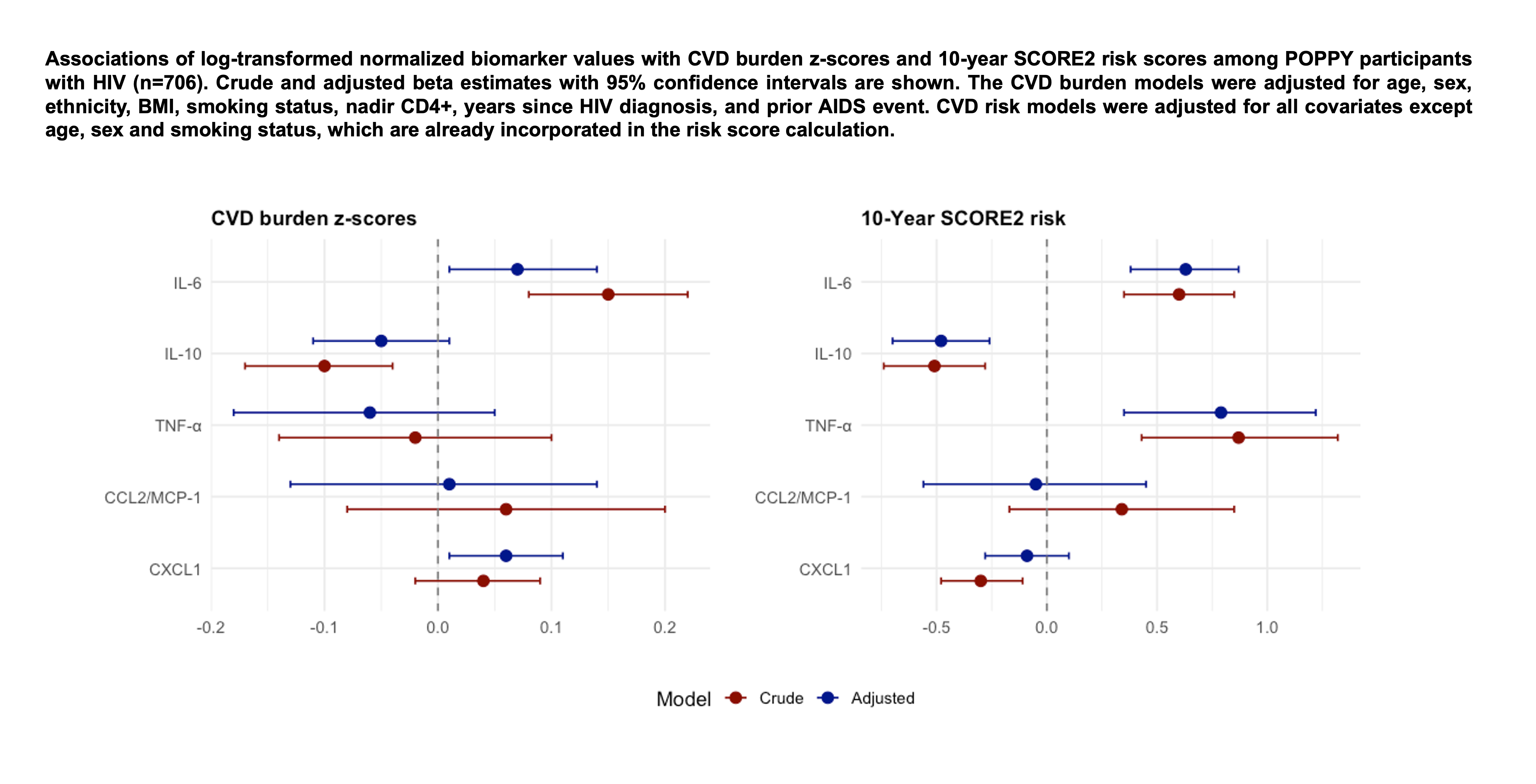
The 682 eligible participants with HIV (median [interquartile range; IQR] age 52 [47-58] years; 86% male; 85% white) had median [IQR] CVD z-score and SCORE2 of -0.62 (-0.62, 0.56) and 2.70 (1.27,4.58), respectively. Median [IQR] NPX values of each biomarker were: IL-6 -0.01 [-0.47,0.62]; IL-10 0.00 [-0.35,0.50]; TNF-α 0.00 [-0.28,0.36]; CCL2/MCP-1 0.01 [-0.29,0.34]; CXCL1: 0.07 [-0.77,0.73]. After adjustment, higher values of IL-6 were associated with higher baseline CVD burden z-scores (β=0.07, 95% confidence interval [CI] 0.01,0.14) and higher SCORE2 (β=0.68 [0.42,0.94]), whereas IL-10 showed inverse associations with SCORE2 (β=-0.37 [-0.60,-0.13]). CCL2/MCP-1 and CXCL1 demonstrated weak associations with CVD burden and SCORE2 after adjustment.
Conclusions
Inflammatory markers were differentially associated with CVD outcomes in people with HIV. Associations were stronger with calculated risk scores than with current CVD burden, partly reflecting that lifestyle/demographics (e.g. age, smoking) may act as proxy measures for overall CVD risk in these models.
Table or Figure