Background
Lipoprotein(a) [Lp(a)] is a genetically determined lipoprotein associated with atherosclerotic cardiovascular disease (ASCVD). Current guidelines recommend a once-in-a-lifetime measurement, assuming stability over time. However, chronic inflammation in people living with HIV (PLWH) may influence Lp(a) trajectories. Data on long-term Lp(a) stability in aging PLWH on suppressive ART remain limited.
Methods
We analyzed participants from the HIV-NAT 006 cohort, aged ≥50 years, with stored serum at baseline (2016–2017) and follow-up (2023–2024). Lp(a) was measured by isoform-dependent immunoturbidometric assay and classified by baseline quartiles and increased cardiovascular risk-cutpoint (>30 and >50 mg/dL). Agreement of Lp(a) across two time points was assessed using Bland–Altman plots. Quartile persistence and reclassification rates were assessed by Stuart–Maxwell test. Subgroup analyses compared participants with elevated baseline interleukin-6 (IL-6 >6 ng/dL) versus normal IL-6.
Results
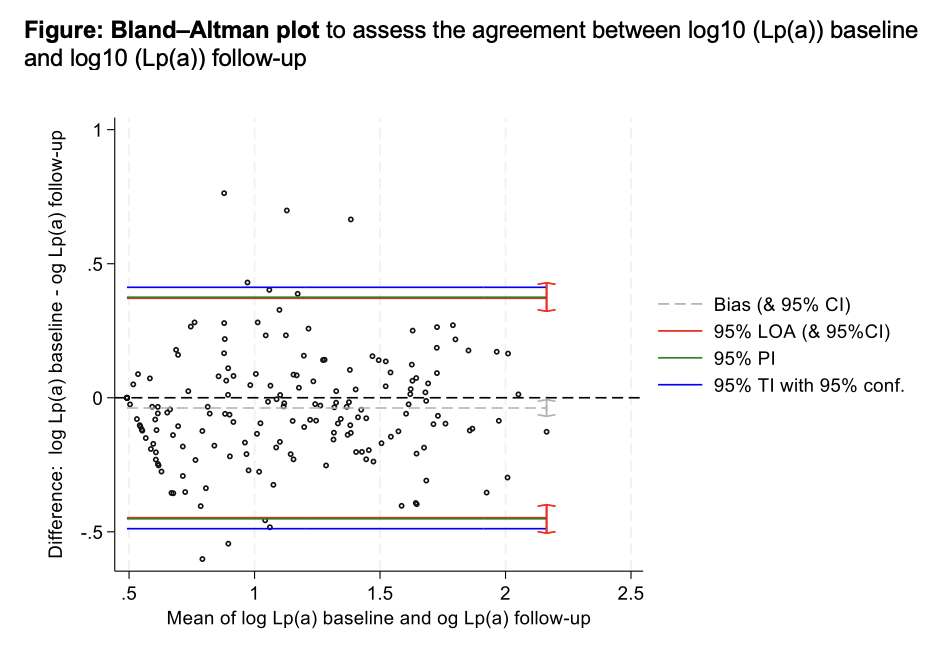
Among 176 participants (53% male, median age 54.5 years), the median follow-up interval was 7.3 years. Median Lp(a) was 14.1 mg/dL (IQR 4.9–26.7) at baseline and 13.2 mg/dL (6.1–31.5) at follow-up (p=0.019). At baseline, 22.7% had Lp(a)>30 and 10.8% >50 mg/dL, compared with 26.1% and 10.8% at follow-up, respectively. Bland–Altman analysis showed minimal bias overall and narrow limits of agreement between log(baseline Lp(a)) and log(follow-up Lp(a)), indicating stability of Lp(a) levels over time. Quartile analyses indicated strong persistence in highest quartiles (89% remained Q4:>26.7 mg/dL), with greater reclassification in others [56.8% in Q3 (14-26.69 mg/dL), 31.8% in Q2 (4.91-14.05 mg.dL), and 38.6% in Q1 (<4.9 mg/dL); (p=0.011)]. Using guidelines Lp(a) cutoffs, 91.9% of participants remained concordant at the ≤30 mg/dL (p=0.21) and 94.9% at ≤50 mg/dL (p>0.99). Participants with elevated baseline IL-6 showed decrease in Lp(a) Q4 persistence and wider Bland–Altman limits, though subgroup analyses were limited by small sample sizes.
Conclusions
In aging PLWH on long-term ART, Lp(a) levels remain stable over 7 years, with strongest persistence in extreme quartiles and those with Lp(a) below guideline cut points (<30 or <50 mg/dL). However, variability was observed in intermediate quartiles and among participants with higher baseline IL-6. A single lifetime test may suffice for most aging PLWH, but repeat testing could be considered in those with inflammation or borderline levels.
Table or Figure