Background
The REPRIEVE trial showed pitavastatin reduces major adverse cardiovascular events (MACE) by 36% in people living with HIV (PWH) at low-to-moderate 10-year CVD risk based on the Pooled Cohort Equations (PCE; median 4%, Q1-Q3 2-7%). US guidelines now recommend statins for PWH with PCE ≥5% and counselling with PCE <5%. To help inform prevention strategies among PWH with PCE <5%, we performed an exploratory analysis to identify drivers of heterogeneous statin benefit among this subgroup in REPRIEVE.
Methods
A causal survival forest fit using the full sample predicted each participant’s absolute 6-year MACE risk reduction (individual treatment effect, ITE) with pitavastatin versus placebo, conditional on baseline demographics and risk factors. Among participants with PCE <5%, local heterogeneity was evaluated using coefficient tests produced by best linear projection (BLP). Acknowledging the PCE ≥5% risk group influences full-sample predictions, sensitivity analysis refit the causal forest using only participants with PCE <5%.
Results
Of 7,769 REPRIEVE participants, 7,490 had complete demographics and risk factors. The median age was 50 years, 31% were female, 0.5% had diabetes, 39% had low eGFR (<90 mL/min/1.73m3), and 54% had PCE <5%. The median follow-up was 5.6 years, and 227 MACE occurred by 6 years: 71 among PCE <5% and 156 among PCE ≥5%.
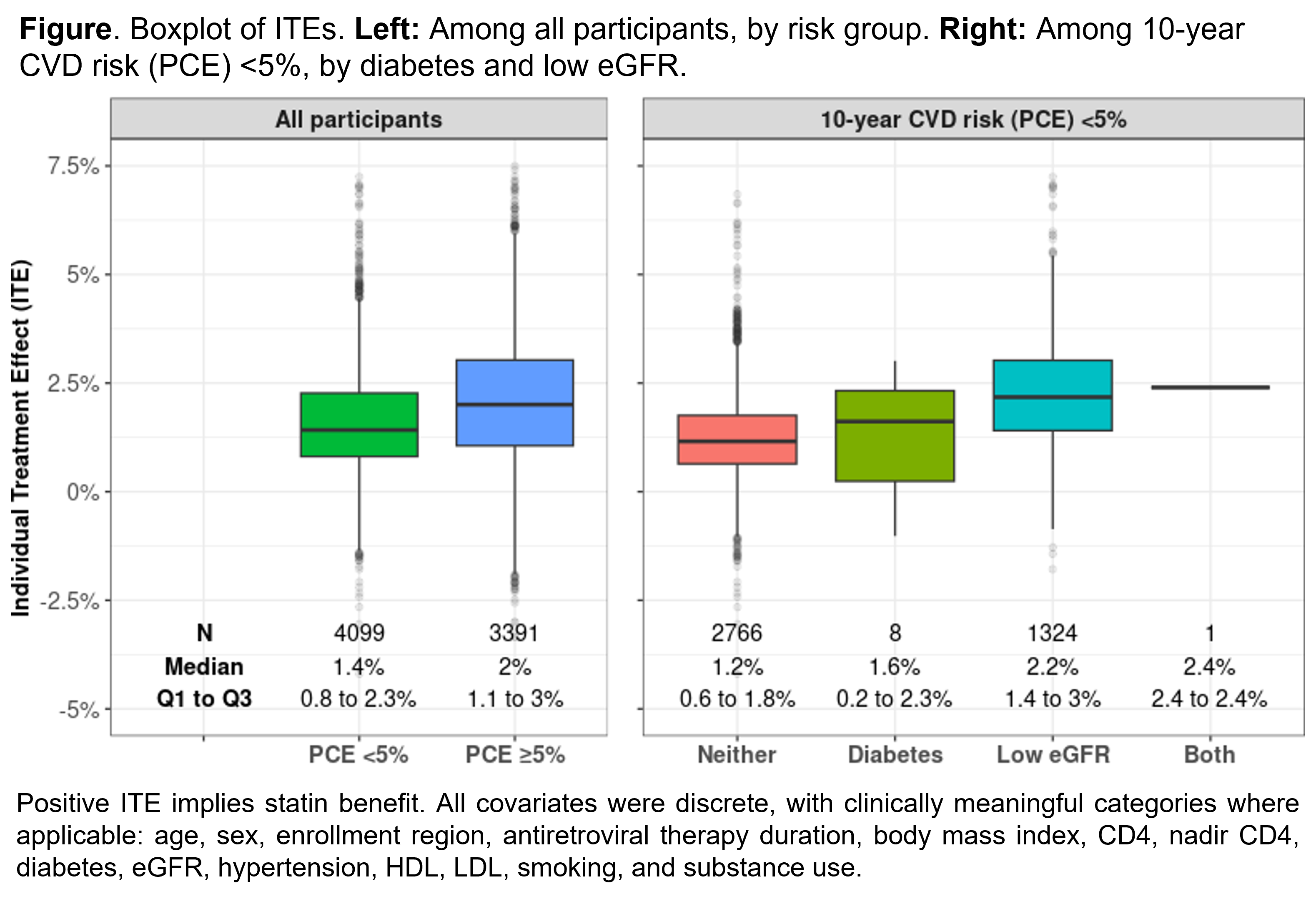
Ninety-three percent of all participants had a positive ITE, indicating predicted statin benefit. The median (10-90%tile) ITE was 1.4% (0.3-3.2%) among PCE <5% versus 2% (0.3-4%) among those with PCE ≥5% (Figure; rank-sum P<0.0001).
Among participants with PCE <5%, BLP suggested that those with low eGFR (P=0.036) or diabetes (P=0.001) had higher ITEs compared to those without (Figure). Differences were not apparent by other risk factors (P>0.05).
Sensitivity analysis estimating ITEs within only participants with PCE <5% yielded consistent effects. Low eGFR remained significant at the 5% level (P=0.037), but diabetes did not (P=0.078).
Conclusions
Statin benefit was predicted in 93% of REPRIEVE participants by 6 years of follow-up. Findings suggest reduced kidney function and, to a lesser degree, diabetes may increase statin benefit among PWH with 10-year CVD risk <5%, suggesting low-risk subgroups for targeted prevention. Findings are considered exploratory due to low sample sizes for some risk factors and no adjustment for multiple comparisons, but align with higher CVD risk with comorbid diabetes and kidney disease.
Table or Figure