Background
People living with HIV (PLWH) face a two-fold increased lifetime risk of cardiovascular (CDV) diseases compared to those without. This trend that has become more evident as ART has extended life expectancy. Nearly two-thirds of PLWH live in Sub-Saharan Africa, where evidence on long-term CDV outcomes remains limited. We conducted a prospective study within the Anti-Retroviral Long Term (ALT) cohort, which enrolled Ugandan adults on ART for at least 10 years, to characterize CDV risk factors.
Methods
The ALT cohort, from 2015 to 2025, enrolled and followed up annually 1000 Ugandan ART-experienced adults. At each visit, data were collected on medical history, opportunistic infections (OIs), CDV events (stroke, myocardial infarction, heart failure and other CDV conditions), ART adherence, CD4 count, and HIV-VL. Bivariate analyses were used to select variables for the multivariable regression. Predictors were: CD4+ count <200 cells/μL, HIV-RNA >50 copies/mL, hypertension, age, BMI>30, and current treatment type (INSTI vs non-INSTI based regimens). A Cox proportional hazards regression was performed. Analyses were conducted using Stata.
Results
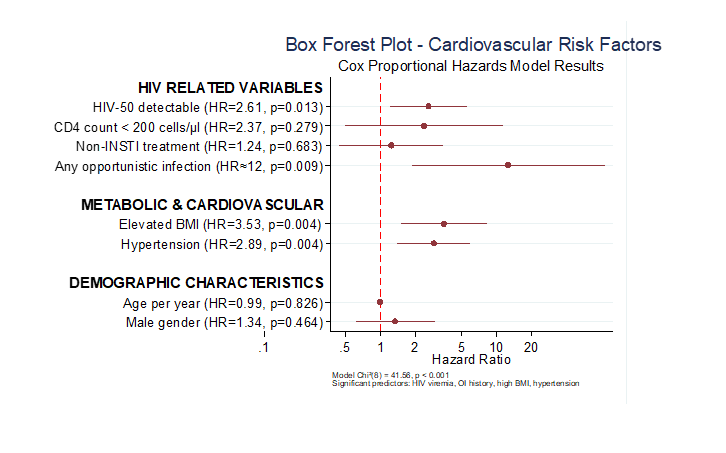
Of 1,000 participants 62% were women and 37% were men. At baseline: median CD4 count was 539 cells/μL, 88% had HIV-VL <50 cp/mL, 18% was on 2nd-line ART. Over a median follow-up period of 8,7 years (IQR 0.72 y), we observed 33 CDV events, resulting in an incidence rate of 43.2 per 1,000 person-years (annual CDV risk of 4.32%). A multivariable Cox regression revealed that a history of opportunistic infections was associated with the highest risk (HR=12.65, 95% CI: 1.88-85.21, p=0.009), HIV detectable viremia before the CDV event was also associated with a higher risk of CDV events (HR=2.61, 95% CI: 1.22-5.59, p=0.013). About traditional CDV risk factors: higher BMI significantly increased cardiovascular risk (HR=3.53, 95% CI: 1.51-8.24, p=0.004), so did hypertension (HR=2.89, 95% CI: 1.40-5.94, p=0.004). Age, male gender, type of ART and CD4+ cells count were not significantly associated with CDV outcomes. The overall model was highly significant (Wald χ²=41.56, p<0.001).
Conclusions
Our findings in this Ugandan cohort suggest that preventing CDV events and their long-term complications in PLWH requires a combined approach: an early start of ART to reduce the risk of OIs (a likely marker of low CD4+ nadir) and ensuring sustained viral suppression, while also addressing traditional risk factors such as hypertension and elevated BMI.
Table or Figure