Background
People with HIV have an increased risk of cardiovascular disease (CVD), but the pathogenesis is not fully elucidated. Co-infection with cytomegalovirus (CMV) is associated with CVD, but whether this is explained by traditional CVD risk factors is incompletely understood. We determined associations of CMV IgG seropositivity and concentrations with the burden of traditional CVD risk factors and assessed whether HIV status modifies any associations seen.
Methods
Analyses included participants with and without HIV from the POPPY Study with similar demographics/lifestyles, and who were aged >50 years without prior myocardial infarction/stroke. CMV IgG concentrations and seropositivity were measured on plasma at study entry using the DiaSorin LIAISON CMV IgG II assay. Ten-year risk of CVD was assessed using the Systematic COronary Risk Evaluation 2 score (SCORE2). Associations of participant characteristics with CMV IgG serostatus and concentration were described using χ2, Fisher’s and Mann-Whitney U-tests, and multivariable linear regression assessed associations with SCORE2 before and after adjusting for confounders.
Results
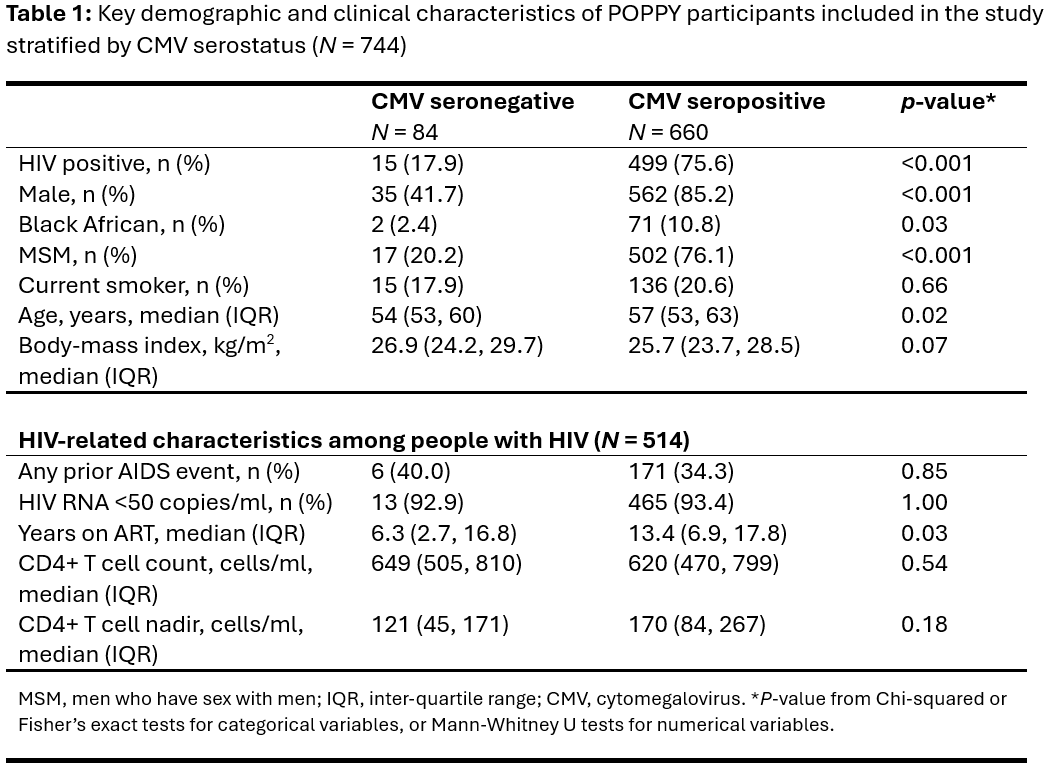
In 514 people with and 230 people without HIV (Table 1), the CMV seropositivity was 97% and 70%, respectively (P<0.001), with median CMV IgG concentrations of 165 and 91 U/mL (P<0.001). Median CMV IgG concentrations were higher in men than women (P<0.001) and in MSM (P<0.001). Among those with HIV, lower current and nadir CD4 counts were associated with higher CMV IgG concentrations (P<0.001 for each). The median SCORE2 was 4.6% (inter-quartile range: 3.2-6.7), and CMV seropositivity was associated with 1.10% higher SCORE2 (95% CI: 0.32, 1.87, P<0.01) after adjustment for HIV status, but the association did not remain after further adjustment for sex, age, and ethnicity (-0.46% [-0.97, 0.05], P=0.08). A doubling of CMV IgG concentrations was associated with higher SCORE2 before (0.18% [0.07, 0.29], P<0.01) and after (0.20% [0.08, 0.32], P<0.01) adjustment for HIV status, but not after further adjustment for sex, age, and ethnicity (-0.02% [-0.10, 0.06], P=0.55). HIV status did not modify the associations of CMV IgG concentrations and SCORE2 (Pint=0.48).
Conclusions
Whilst CMV seropositivity and higher CMV IgG concentrations in people with and without HIV aged >50 were associated with a higher estimated CVD risk, the associations were not independent of sex, age, and ethnicity, suggesting that the associations may be explained by confounding from demographic factors.
Table or Figure