Background
Though prostate cancer risk is lower in males with HIV (MWH) versus without, MWH are diagnosed with more advanced stage cancer and have poorer prognoses. It is unclear if prostate-specific antigen (PSA) testing among MWH has been impacted by changing PSA policies (USPSTF 2012 guidelines [against PSA screening] and 2018 [advocating shared decision making]), or the inception of treat-all HIV policies, which has implications for health status at entry into care, and increasing integration of primary care into HIV care. We examined age-specific PSA testing over time and if these trends differed by when MWH initiated ART.
Methods
We estimated annual PSA rates among adult males (≥18yo) with HIV with no prior prostate cancer and known ART initiation dates in the NA-ACCORD 11 US clinical cohorts contributing PSA data. We followed MWH from the latest of: enrollment, cohort inception, PSA/cancer data collection initiation, or 1/1/2006, to the first of: cohort close, end of PSA/cancer data collection, prostate cancer diagnosis, or 12/31/2020. MWH could contribute one PSA per year. Age-specific annual PSA rates per 100 person-years (PYs) with 95% confidence intervals from 2006-2020 were estimated among MWH initiating ART before (<2012) vs. during treat-all (2012+).
Results
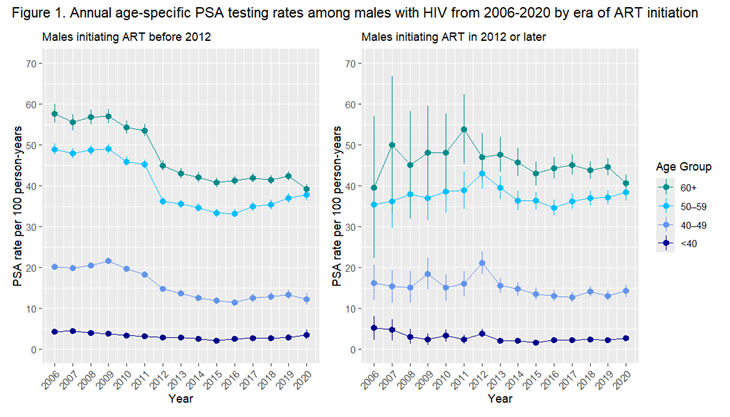
We observed 75,780 MWH (627,759 PYs) from 2006-2020; 39% were non-Hispanic Black, 43% were non-Hispanic white, and 12% were Hispanic. Median entry age was 46 (IQR: 37, 55) years, and 56% ever had a PSA. Annual PSA rates (per 100 PYs) among MWH initiating ART before treat-all declined (males 60+yo: 58 to 39 tests; 50-59yo: 50 to 38 tests; and 40-49yo: 20 to 12 tests). PSA rates were low among MWH <40yo. PSA rates in MWH initiating ART during treat-all era were stable, with modest spikes in 2012 for all age groups except males 60+yo (spike occurs in 2011). By 2020, age-specific PSA rates were similar in MWH initiating ART before vs. during treat-all.
Conclusions
PSA rates were stable from 2006-2010 but dropped substantially in 2011 among MWH who initiated ART prior to 2012, coinciding with PSA guideline reforms. A warehousing effect of increased PSA testing among those initiating ART at the onset of the treat-all era (2012) was observed. Age-specific PSA rates were similar from 2013-2020 regardless of initiating ART before or during the treat-all era, and remained stable. Our findings indicate temporal PSA trends may be informed by changing clinical guidelines for PSA testing and HIV, but stagnate from 2012 onward.
Table or Figure