Background
The ANCHOR study demonstrated that aggressive anal cancer screening and treatment can prevent cancer progression. High Resolution Anoscopy (HRA), however, is invasive and resource-intensive, and risk is not evenly distributed among people living with HIV (PLWH). Individuals with poor immune recovery remain at highest cancer risk.
Methods
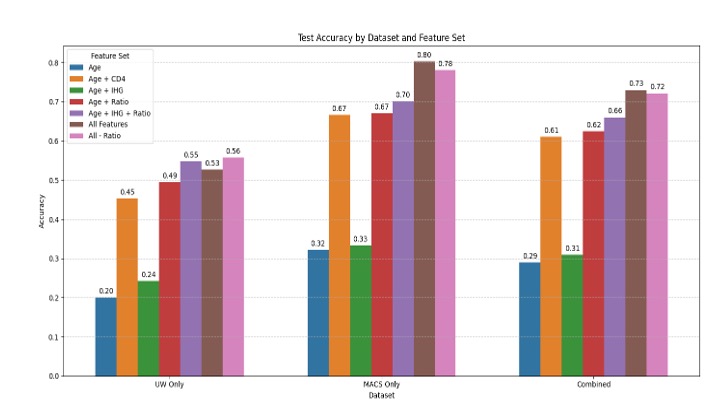
We analyzed 400 PLWH from the UW clinic (2000–2020) and 1,200 participants from the Multicenter AIDS Cohort Study (MACS, 1984–2025). All had anal cancer screening results (cytology or biopsy) with concurrent immune measures: CD4, CD8, CD4/CD8 ratio, and Immune Health Grades (IHG), integrating CD4 and CD4/CD8 ratio. Outcomes were categorized as no disease, LSIL, HSIL, or anal cancer. Supervised classifiers were trained on 80% of the data (stratified by outcome) and tested on 20%, with an additional 10-fold cross-validation. Feature sets were incrementally expanded: age + CD4, age + CD4/CD8 ratio, age + IHG, and all immune parameters. Performance was assessed for accuracy, sensitivity, specificity, balanced accuracy, and multiclass AUC. Model comparisons used McNemar’s test and bootstrap resampling to generate 95% confidence intervals. Confusion matrices were reviewed to characterize misclassification, with emphasis on differentiating LSIL/HSIL from normal and cancer.
Results
Predictive accuracy improved with additional immune features. In the combined dataset, age + CD4 achieved 0.61 accuracy (95% CI: 0.58–0.64), while the classifier with all parameters reached 0.73 (95% CI: 0.70–0.76; p<0.01). Cross-validation confirmed stability, and bootstrap analysis supported significance. Normal cytology and invasive cancer were identified with highest accuracy, while LSIL and HSIL were more frequently misclassified, largely with each other. Cohort-specific analyses showed accuracy gains from 0.41 to 0.52 in UW and from 0.69 to 0.80 in MACS.
Conclusions
Immune parameters measured at the time of anal cancer screening significantly improve prediction of anal disease in PLWH beyond CD4 alone. Multivariable models consistently outperformed standard approaches, particularly for distinguishing lowest- and highest-risk individuals. These findings support immune-based risk stratification as a strategy to refine screening intensity and reduce unnecessary HRA. Ongoing work will integrate additional clinical predictors and translate these models into a web-based tool for personalized, less invasive and costly screening.
Table or Figure