Background
Immunotherapy has revolutionized lung cancer management. However, people with HIV (PWH) are often excluded from immunotherapy trials, which limit real-world evidence on effectiveness of immunotherapy among these patients. Thus, our objective was to assess the effect of immunotherapy on overall survival among lung cancer patients, stratified by HIV status.
Methods
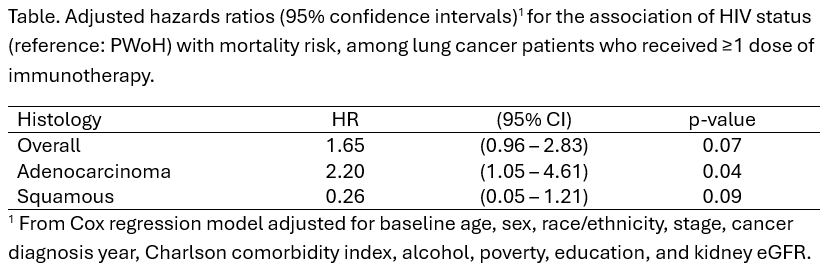
We conducted a retrospective cohort study including non-small cell lung cancer patients (adenocarcinoma and squamous carcinoma) from the US Veterans’ Affairs between 2008-2020, who received ≥1 dose of immunotherapy. This immunotherapy cohort was a subset of an overall cohort of lung cancer PWH who matched (1:1) to people without HIV (PWoH) on age (±1 years), gender, race/ethnicity, cancer stage, and year of diagnosis (±1 years), but not on treatment. We compared patients’ demographics, cancer-related treatment, and other clinical characteristics by HIV status. Hazard ratios (HR) for HIV status associated with overall survival, stratified by histological subtype, were obtained from Cox models adjusting for baseline factors (Table footnote).
Results
In a total of 477 PWH and 477 PWoH diagnosed and treated for Squamous cancers and Adenocarcinomas (39% and 61%, respectively), we identified 45 (9.4%) PWH and 50 (10.5%) PWoH receiving immunotherapy. Among the 95 immunotherapy recipients, adenocarcinoma remained the most common histological subtype with 33 (73.3%) of PWH and 29 (58%) of PWoH. There were no significant differences between groups for demographic and clinical variables. Among PWH,73.3% cases had CD4 counts >350 cells/mm3. The median duration of immunotherapy treatment was 46 vs. 70 days for PWH vs. PWoH (p=0.57), respectively, and the distribution of total immunotherapy dosages was 231 for PWH vs. 296 doses for PWoH (p = 0.09). The median follow-up was 1.46 years for PWH vs. 1.98 years for PWoH (p = 0.36). In adjusted Cox models, however, PWH had a non-significant higher risk of death than PWoH, and then stratified by histological subtypes, PWH with adenocarcinoma had significantly worse survival while PWH with squamous carcinoma had non-significant better survival (See Table).
Conclusions
Among PWH receiving immunotherapy, differential survival for squamous carcinoma versus adenocarcinoma might suggest underlying genetic differences in tumor mutation burden or tumor microenvironment. Future studies should confirm these findings in larger cohorts, focusing on histology-specific analyses for non-small cell lung cancers.
Table or Figure