Background
Kaposi Sarcoma (KS) is a significant cause of morbidity and mortality in PLWH. While cutaneous involvement is common, visceral only or cutaneous+visceral disease confer poor prognosis. The utility of human herpesvirus-8 (HHV-8) viral load (VL) as a predictor of visceral involvement remains poorly characterized. In this study, we aimed to determine the clinical diagnostic utility of HHV-8 VL as a predictor of cutaneous+visceral KS.
Methods
We conducted a cross-sectional retrospective study of 99 participants with HIV and KS, categorized as cutaneous-only (n = 43), visceral-only (n = 28), or cutaneous+visceral (n =37). HHV-8 VL was measured by quantitative PCR. We performed receiver operating characteristic (ROC) analysis to calculate optimal cutoff points. Multivariate logistic regression was adjusted for age, gender, HIV, Epstein-Barr virus and Cytomegalovirus VL, and CD4 count. Model performance was validated using the train/test method (70/30%).
Results
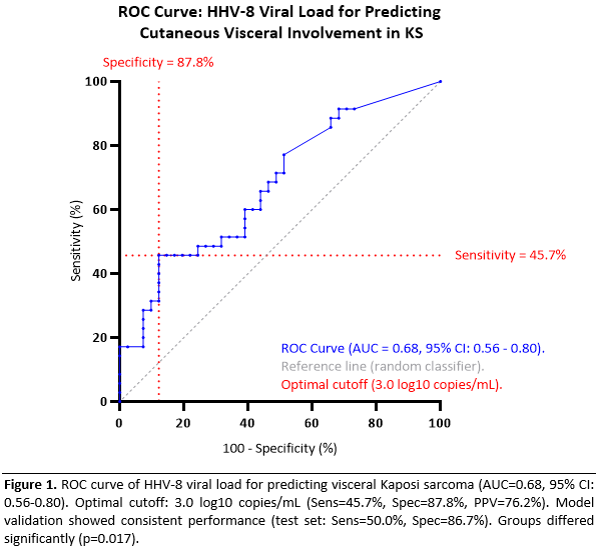
HHV-8 VL was significantly higher in participants with cutaneous+visceral involvement (p = 0.02). ROC analysis showed an area under the curve (AUC) of 0.68 (95% CI: 0.56-0.80) for discriminating cutaneous+visceral disease. Optimal cutoff was established at 3.0 log10 copies/mL with 45.7% sensitivity, 87.8% specificity (Figure 1), 76.2% positive predictive value, and 3.75 positive likelihood ratio. Multivariate analysis confirmed HHV-8 >3.0 log10 as an independent predictor of cutaneous+visceral involvement (adjusted OR 4.53, 95% CI: 1.21-19.47, p = 0.03), along with CD4 count (OR 1.02, 95% CI: 1.00-1.04, p = 0.03). The multivariate model showed excellent discrimination (AUC 0.79) and good fit (Hosmer-Lameshow p = 0.41). Validation demonstrated consistent performance (sensitivity 50%, specificity 87%).
Conclusions
HHV-8 VL >3.0 log10 copies/mL is an independent predictor of cutaneous+visceral involvement in KS, with high specificity and positive predictive value. Multivariate analysis demonstrated that together HHV-8 and CD4 count provided good discrimination. These findings support the clinical utility of HHV-8 monitoring for risk assessment and early detection of visceral involvement in people with HIV and KS.
Table or Figure