Background
Kaposi sarcoma (KS) remains an important AIDS-defining malignancy in the antiretroviral therapy (ART) era, yet its contemporary epidemiology and outcomes are not well characterized.
Methods
Population-based cohort study in Catalonia, Spain, including all adult with HIV (PWH) in the PISCIS Cohort (1998–2023) without prior KS. We estimated KS incidence rates (IR), and all-cause mortality rates (MR) after KS diagnosis and assessed risk and prognostic factors using multivariable Poisson regression.
Results
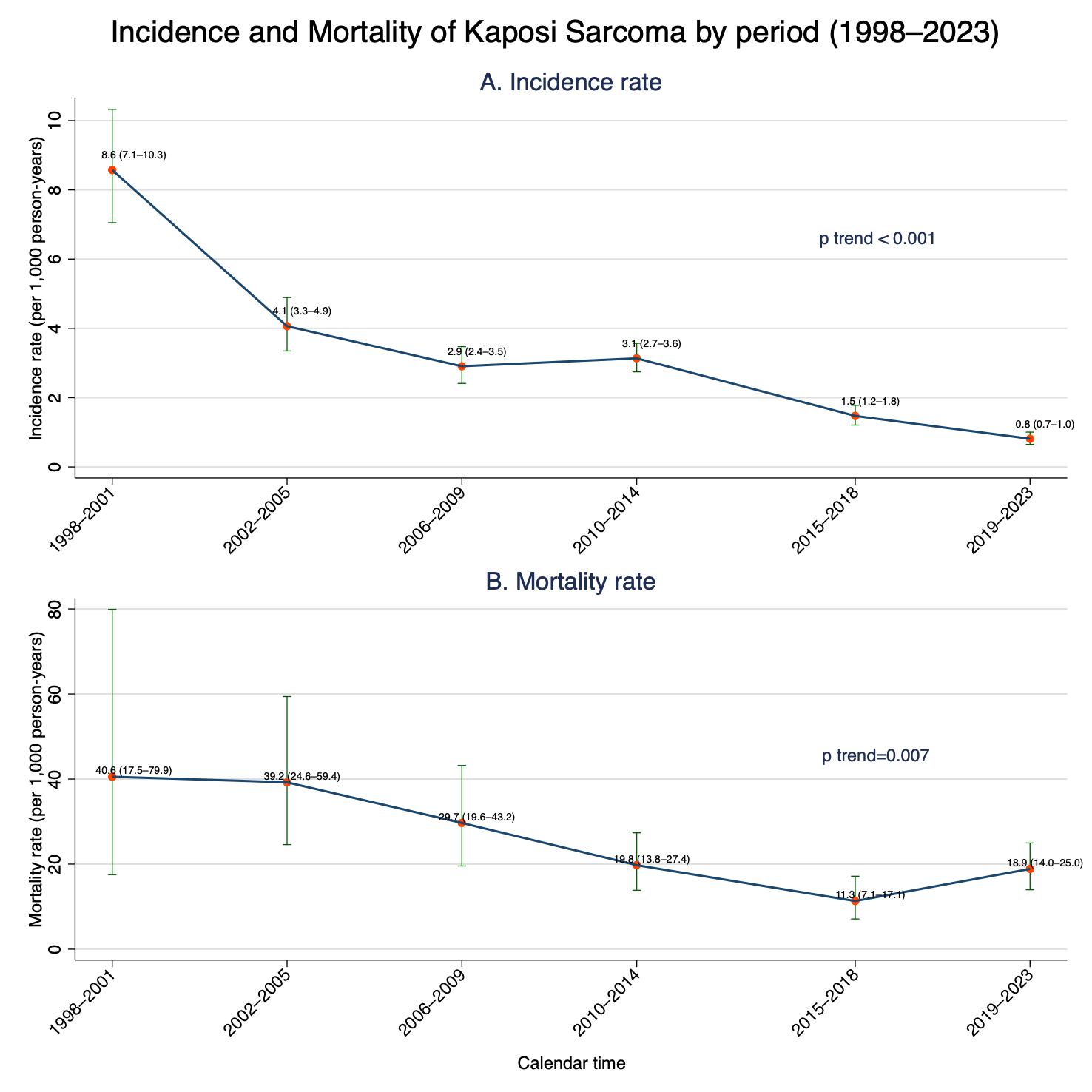
Among 32,498 PWH contributing 334,485.2 person-years (PY) of follow-up (median 10.1 years [IQR 4.6-16.4]), we identified 768 KS events (IR 2.3/1,000 PY (95%CI: 2.1–2.5). While absolute KS cases persisted, IR declined steadily over time, from IR 8.6/1,000 PY (7.1-10.3) (1998–2001) to 0.8/1,000 PY (0.7-1.0) (2019-2024) (p<0.001) (Fig. 1).
In multivariable models, KS risk was higher in MSM (aIRR 4.96, [3.35–7.33]), those with comorbidity (Charlson score (CCS) 1-2: 23.9 [16.9-34.0]; 3-4: 46.4 [21.5-100.1]; ≥5: 52.3 [15.5-175.8]), lower baseline CD4 counts (<100 cells/µL: aIRR 4.31 [3.13-5.94]; 100-199 cells/µL: 2.84 [2.02-3.99]; 200-349 cells/µL: 1.62 [1.21-2.18]), and high cumulative viraemia (≥5 log10 copy-years: aIRR 4.29 [3.40-5.41]). Associations were consistent across periods (pre- vs post-2015). Viral coinfections (HBV, HCV, CMV) were inversely associated with KS (aIRR 0.17 [0.11-0.25]; 0.08 [0.05-0.12] and 0.26 [0.20-0.33], respectively), though residual confounding cannot be excluded.
KS cases showed good immunological recovery, with median CD4 counts rising from 159 (IQR 59-399) at KS diagnosis to 406 (IQR 265-603) two years after. Over 8,542.7 PY, 164 deaths occurred (MR 19.2/1,000 PY [16.5–22.4]), declining over time (p=0.007) (Fig. 1). MR was higher in earlier periods, with low CD4 counts at KS diagnosis (<200 cells/µL, aMRR 1.48 [1.01-2.19]), severe comorbidity (CCS ≥5: aMRR 3.32 [1.49-7.40]), HCV (aMRR 2.44 [1.34-4.46]), and prior TB (aMRR 1.90 [1.02-3.56]). MSM had lower mortality than heterosexual men (aMRR 0.55 [0.34–0.87]).
Conclusions
KS incidence declined over time, yet it remains a persistent malignancy in the modern ART era. Risk was highest among MSM, and in those with greater comorbidity, immunosuppression, and uncontrolled viremia. Although mortality decreased over time, it remained higher in those with severe comorbidity and low CD4 counts. Early ART, sustained viral suppression, and optimal comorbidity management should be prioritized to further reduce the KS burden.
Table or Figure