Background
Coordinating treatment for people with HIV (PWH) who have cancer in Zimbabwe is complicated by siloed HIV and cancer service delivery. Information on viral suppression (VL), CD4 count, and antiretroviral regimen (ART) informs cancer treatment planning but may not be available to oncology providers.
Methods
We enrolled a cohort of 150 PWH initiating cancer treatment at Parirenyatwa Hospital Radiotherapy Centre (RTC) in Harare, November 2024 – August 2025. Participants were >18 years with new cancer diagnosis and confirmed HIV. We administered questionnaires on sociodemographic information and data on HIV care engagement and reviewed cancer center records to collect HIV and cancer clinical data at cohort entry. We used robust Poisson regression to estimate associations between clinical and sociodemographic characteristics and completeness of HIV clinical information at RTC patient registration.
Results
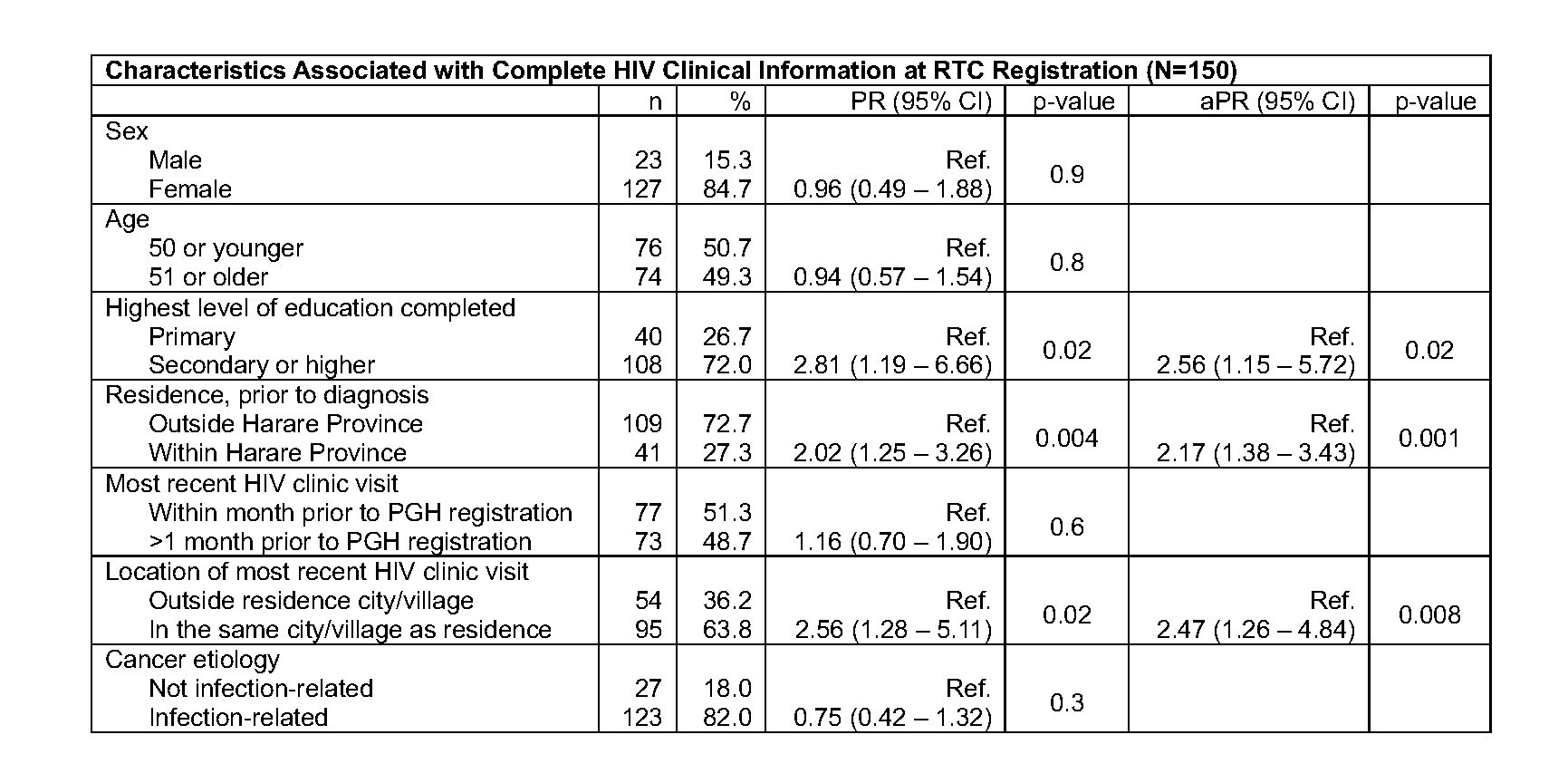
Participants’ median age was 50, 85% were female, and 72% had completed secondary education. Prior to cancer diagnosis, 73% resided outside Harare (Table). Most (87%) were diagnosed with HIV >5 years prior to cancer diagnosis and 95.3% had an HIV visit within 6 months prior to RTC registration, 48.7% within the month prior. Most (82%) had infection-related cancers (77% HPV-related). Only 29% had complete HIV clinical information (CD4 count, HIV VL, ART regimen) at RTC registration; 55% were missing CD4 and 52% were missing HIV VL. Those with secondary education were over twice as likely to have complete HIV data (adjusted prevalence ratio [aPR]: 2.6, 95% confidence interval [CI]: 1.2-5.7). PWH who lived in Harare prior to cancer diagnosis were more likely to have complete HIV data (aPR: 2.2, 95% CI: 1.4-3.4) compared to those living outside Harare, as were PWH whose most recent HIV clinic visit was near their residence (aPR 2.5, 95% CI: 1.3-4.8) compared to those visiting HIV clinics further from home. Age, sex, recency of HIV clinic visit, recent change of residence, and cancer etiology were not associated with availability of HIV data in RTC record.
Conclusions
Despite a high proportion of HPV-related cancers strongly associated with HIV, most PWH initiate cancer care without full HIV clinical data available to treating oncology teams. PWH may face delayed cancer treatment decision-making do to lack of information on immune status. This study highlights gaps in communication of key HIV-related information needed for optimal and timely cancer care.
Table or Figure