Background
People with HIV (PWH) have an increased cancer risk compared to the general population. Cancer is a leading cause of morbidity and mortality among PWH. An enhanced understanding of cancer incidence and contributing risk factors, particularly among those well -treated on ART, may guide concomitant individual- and population-level preventive interventions.
Methods
Analyses were performed among REPRIEVE participants free of cancer at baseline who were followed until the first occurrence of any reported cancer, and subtypes: AIDS-defining cancers (ADCs), infection related non-AIDS-defining cancers (NADCs), and non-infection-related NADCs. Incidence rates were computed for all cancers, each cancer type, and the most common cancer by Global Burden of Disease (GBD) region and sex. We assessed associations between cancers and sex, age, GBD region, CD4, nadir CD4, BMI, and smoking status using cause-specific Cox proportional hazards models and report adjusted hazard ratios (aHRs) with 95% confidence intervals (CIs).
Results
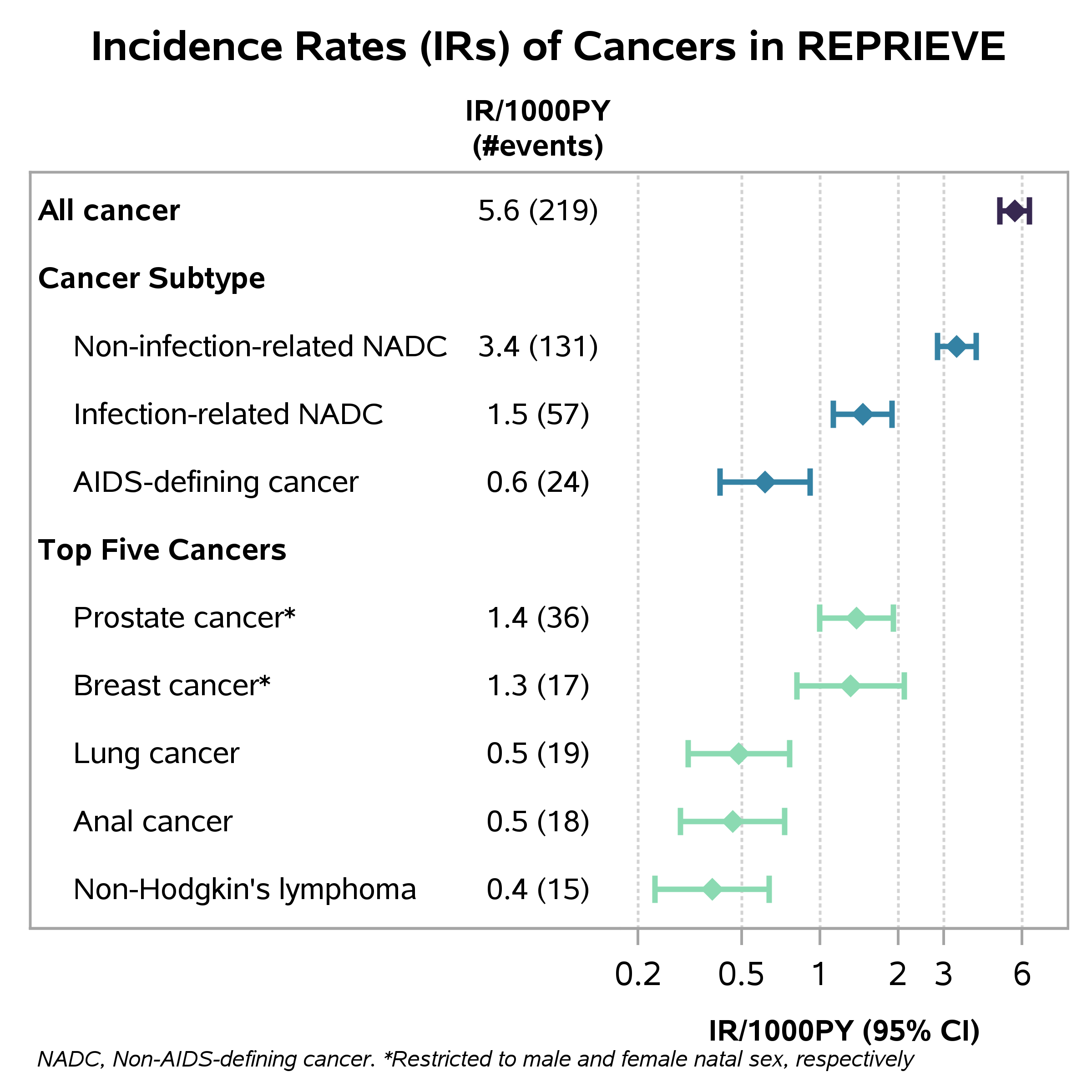
Analyses include 7,507 participants (2,362 [31%] women) with 39,011.8 person-years (PY) of follow-up. Of these, 219 reported incident cancer (incidence rate: 5.6 per 1,000 PY, 95% CI 4.9-6.4), including 24 with ADC (0.6 per 1,000 PY, 95% CI 0.4-0.9), 57 with infection-related NADCs (1.5 per 1,000 PY, 95% CI 1.1-1.9), 131 with non-infection-related NADCs (3.4 per 1,000 PY, 95% CI 2.8-4.0). Among those with cancer, 160 were male (incidence 6.1 per 1,000 PY) and 59 were female (4.5 per 1,000 PY). The most common cancer among participants born female was breast cancer (n=17 [28.8%] cases), and the most common cancer among male participants was prostate cancer (n=36 [22.5%] cases). High income GBD region had the highest cancer incidence (n=152, 7.6 per 1,000 PY). Higher age (50-59 vs 40-49, aHR 1.5, 95% CI 1.1-2.1; ≥60 vs 40-49, aHR 3.0, 95% CI 2.0-4.5), and smoking (former/current vs non-smoker, aHR 1.3, 95% CI 1.0-1.8) were associated with higher rates of cancer, and GBD regions of Latin America and Caribbean (aHR 0.6, 95% CI 0.3-0.8), South Asia (aHR 0.3, 95% CI 0.1-0.8), and Sub-Saharan Africa (aHR 0.4, 95% CI 0.2-0.7) were associated with lower risk of cancer, compared to high income region.
Conclusions
Among a global cohort of PWH on effective ART treatment, we report cancer incidence rates and identify key risk factors associated with the first occurrence of cancer, including advancing age, GBD region, and the modifiable risk of cigarette smoking.
Table or Figure