Background
We previously described intramuscular (IM) preclinical pharmacokinetics (PK) of a long-acting injectable (LAI) formulation of glecaprevir (G) and pibrentasvir (P) as a potential one-shot cure for HCV. Longer terminal half-life extension for G and higher overall exposure of P was observed when both drugs were administered as a fixed dose combination (FDC) compared to single-component formulations given in separate thighs. The current study investigated half-life and exposure benefits for co-formulation within individual particles of the suspension, versus a mixture of single-component particle suspensions. PK was also assessed following subcutaneous (SQ) administration.
Methods
Male Sprague Dawley rats (n=4 per group, 225-250g) received G and P via IM or SC administration into the thighs or scapular region, respectively. Formulations comprised 80wt% drug content and 20wt% excipient and a ratio of 2:1 for G:P. Three groups were included: 1) G and P co-formulated into individual particles of the suspension (FDC); 2) G and P formulated into separate suspensions and mixed (MD); 3) separate injections of G and P (SI). Safety was assessed by Draize score, clinical observation and histological assessment of the depot.
Results
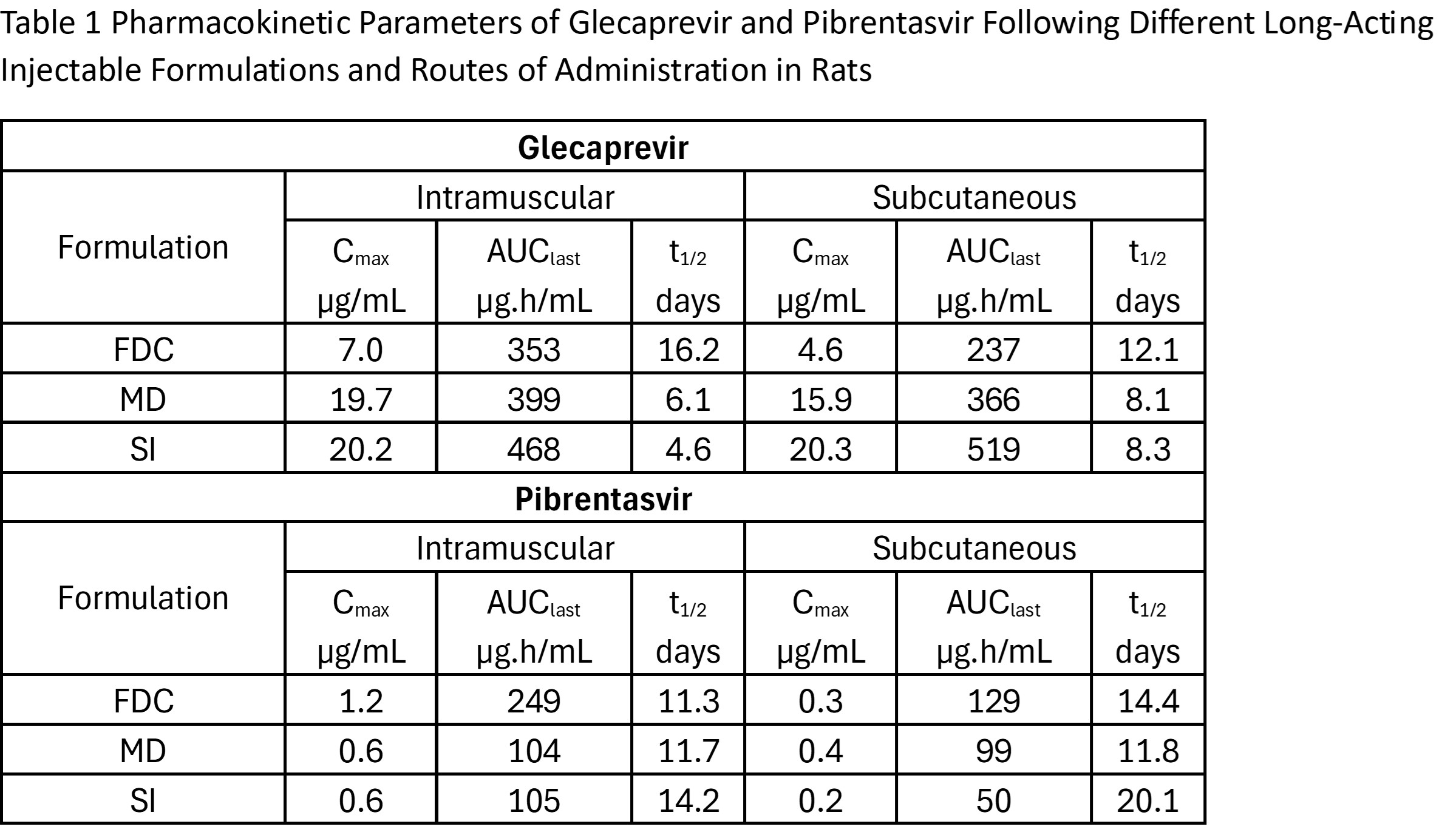
Following both IM and SQ dosing, a longer terminal half-life of G and a higher exposure of P were observed for the FDC than either the MD or SI groups (Table 1). For the FDC but not the MD or SI groups, therapeutic concentrations defined by approved dosing to humans were maintained for the full 8-week study duration. Differences in PK were observed between IM and SQ dosing, with higher exposures following SQ administration. No overt toxicity issues were encountered.
Conclusions
These data demonstrate that optimal performance of the G/P LAI is achieved when both drugs are co-formulated into each particle of the formulation. The absence of benefit within the MD group suggests that a biological mechanism (e.g. transporter or enzyme inhibition) does not underpin this positive interaction. The current hypothesis is that low solubility P confers restricted dissolution rate of G in the FDC, thus prolonging the G half-life by slowing absorption. Conversely, the higher solubility of G might increase the P dissolution rate leading to higher overall exposure of P. The co-formulation of molecules with different solubilities may have broader application to optimise LAI performance for other indications.
Table or Figure