Background
Vitamin D insufficiency and metabolic dysfunction-associated steatotic liver disease (MASLD) are highly prevalent in people with HIV (PWH). Evidence suggests vitamin D may modulate hepatic fat accumulation, but data in HIV are limited. We assessed the relationship between serum 25-hydroxyvitamin D [25(OH)D] and hepatic steatosis severity in a prospective cohort with paired transient elastography (TE) and vitamin D measurements.
Methods
We included all clinical observations from the Modena HIV Metabolic Clinic, Italy, where TE (liver stiffness measurement [LSM] and controlled attenuation parameter [CAP]) and serum 25(OH)D were measured concurrently. Demographic, anthropometric, metabolic, and HIV-related data were collected at the same visit. Steatosis was graded by CAP (S0: <248 dB/m, S1: 248–268, S2: 269–279, S3: ≥280). Multivariable mixed-effects linear regression was applied with CAP as the dependent variable, adjusting for age, sex, BMI, waist circumference, diabetes, CD4 count, HIV suppression, and ART class, with patient ID as a random intercept to account for repeated measures.
Results
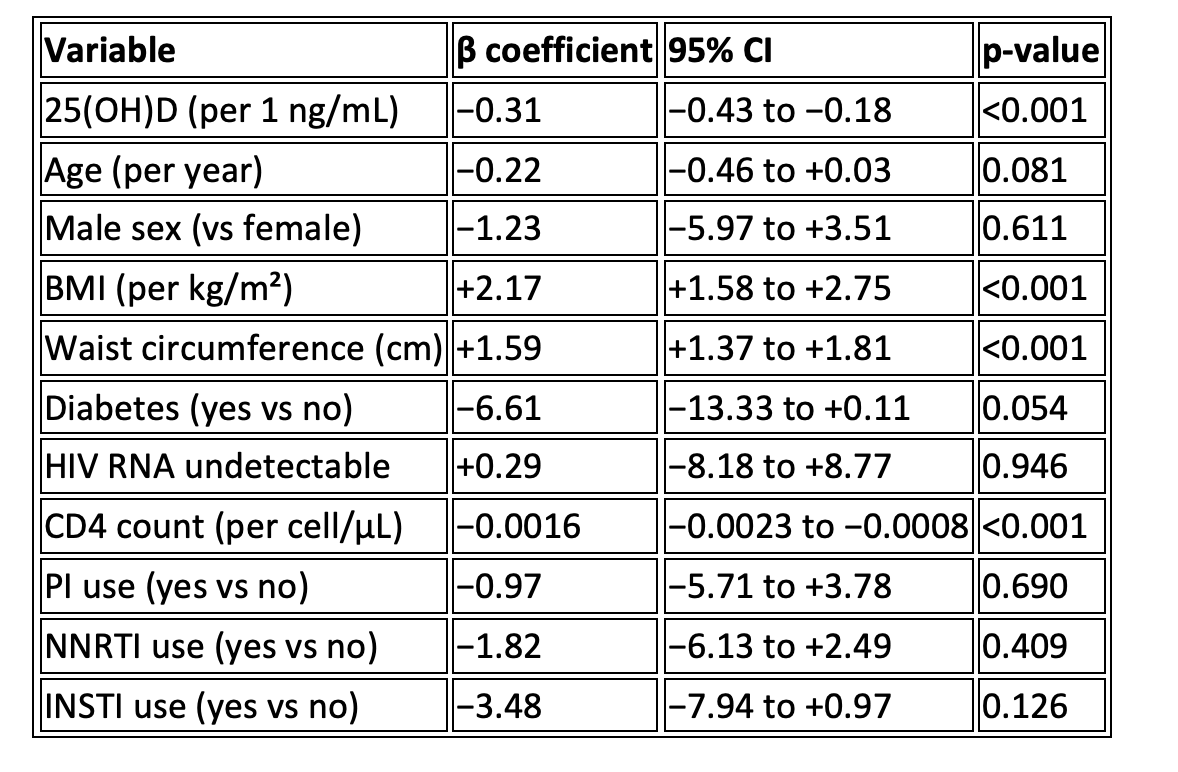
A total of 6579 observations from 1465 PWH were analyzed (mean age 56 years; 72% male). Steatosis distribution was: 60.9% S0, 12.2% S1, 6.1% S2, 20.8% S3. Compared with S0, PWH with S3 had higher BMI (28.3 vs 23.5 kg/m²), waist circumference (103 vs 88 cm), triglycerides (162 vs 110 mg/dL), fasting glucose (104 vs 90 mg/dL), and HOMA-IR (5.4 vs 2.1) and lower HDL (46 vs 54 mg/dL). Diabetes and hypertension were also more frequent (19% vs 7% and 33% vs 22%; all p<0.001). 25(OH)D declined with steatosis severity (34.1 ng/mL in S0 vs 29.1 ng/mL in S3; p<0.001). In multivariable models, higher 25(OH)D was associated with lower CAP (β = −0.31 dB/m per ng/mL; p<0.001, ~3 dB/m reduction per 10 ng/mL). BMI (+2.2 dB/m per kg/m²) and waist circumference (+1.6 dB/m per cm) were related to higher CAP (Table 1).
Conclusions
In this large prospective cohort of PWH, vitamin D deficiency was strongly and independently associated with hepatic steatosis severity, even in a setting where supplementation is systematically recommended. These findings support a potential protective role of vitamin D in liver health and underscore the importance of monitoring vitamin D as part of metabolic and hepatic risk assessment in HIV care. Longitudinal and interventional studies are needed to determine whether correcting deficiency can modify MASLD progression in this population.
Table or Figure