Background
In people with resolved hepatitis C (HCV), the presence of steatotic liver disease (SLD) is associated with adverse liver-related outcomes. However, data are limited in people with HIV (PWH). The aim of this study was to describe prevalence and severity of SLD in PWH who had prior HCV (PWH-HCV).
Methods
We examined participants from a prospective, cross-sectional study of SLD in PWH conducted by the NIDDK-funded HIV NASH CRN. Participants had suppressed HIV-1 RNA and underwent vibration controlled transient elastography. PWH-HCV had undetectable HCV RNA at least 3 years prior to enrollment either due to treatment or spontaneous clearance, and all participants had negative HCV RNA at enrollment. The primary outcome was SLD, defined as controlled attenuation parameter (CAP) ≥ 263 dB/m. MASLD was defined as SLD with at least one cardiometabolic risk factor without heavy alcohol use. Liver stiffness measurement (LSM) ≥ 8 kPa was considered clinically significant fibrosis (CSF).
Results
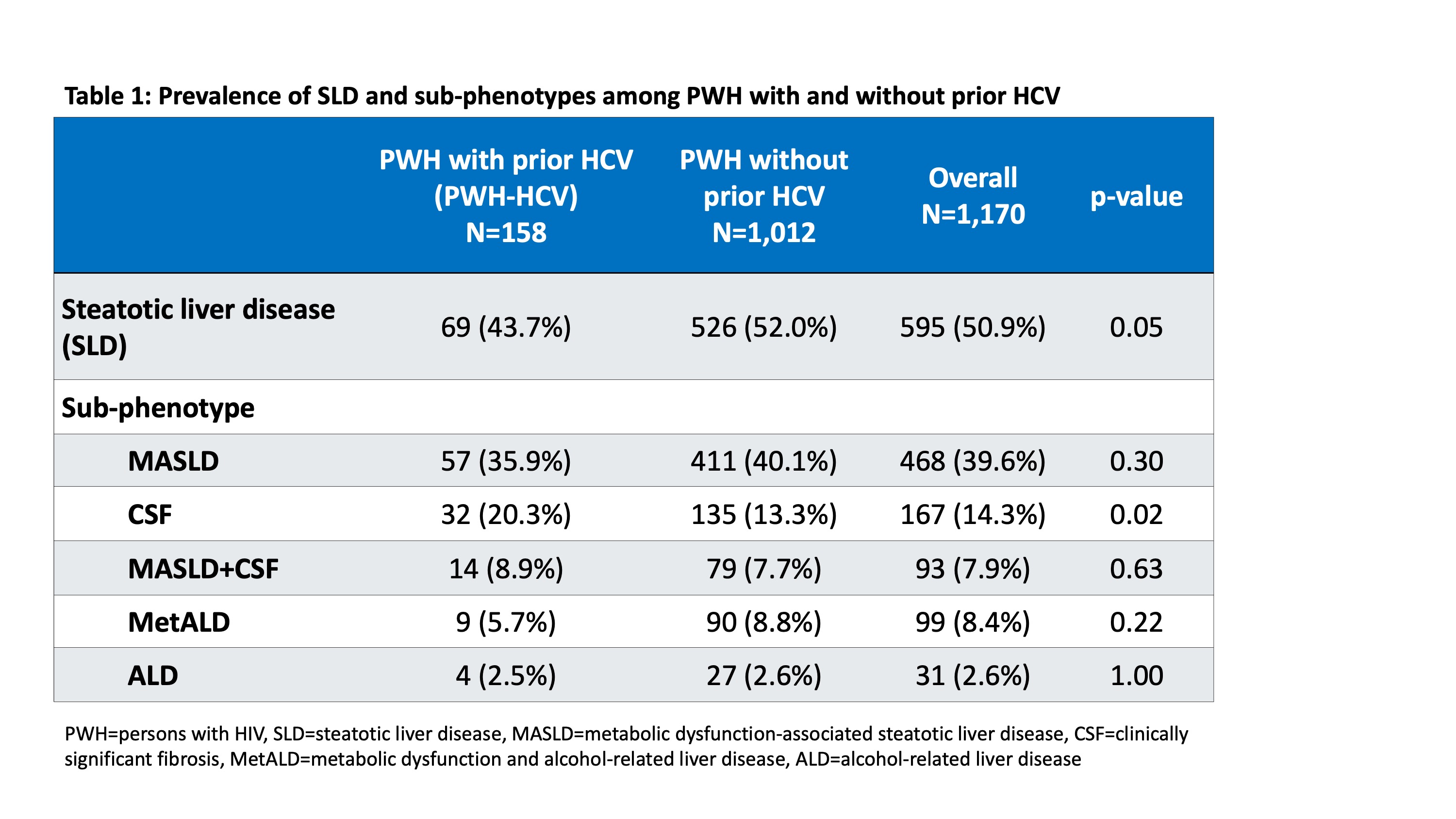
Among 1,170 PWH, 158 had prior HCV and 1,012 did not. PWH-HCV were older (60.8 vs 52.2 years, p<0.001), had lower body mass index (28.6 vs 30.5 kg/m2, p<0.001), smaller waist circumference (97.0 vs 101.2 cm, p=0.003), and higher prevalence of hyperlipidemia (69% vs 54%, p<0.001). PWH-HCV were more likely to be abstinent from alcohol (61% vs 44%, p<0.001) and to take mental health medications (49% vs 40%, p=0.02). SLD was present in 43.7% of PWH-HCV compared to 52.0% of PWH without prior HCV (p=0.052). There was no difference in prevalence of SLD subtypes (MASLD, MetALD, ALD) between groups. PWH-HCV were more likely to have CSF (20.3% vs 13.3%, p=0.02) (Table 1). In a multivariable logistic regression model, White (vs Black) race (OR 3.84, 95% CI 1.22-12.09, p=0.02) and higher BMI (1.24 [1.13-1.37], p<0.001) were associated with MASLD among PWH-HCV.
Conclusions
PWH-HCV had higher prevalence of CSF, likely reflecting HCV-related injury, and a distinct metabolic profile characterized by lower BMI and waist circumference but higher rates of hyperlipidemia. SLD was common after HCV resolution, suggesting that metabolic risk factors play an important role in SLD development among PWH after HCV resolution.
Table or Figure