Background
Steatotic liver disease (SLD) is common in PLWH and is associated with overweight and related metabolic disorders. Both INSTIs and TAF have been linked to weight gain in clinical trials and real-life studies. However, controversial results have been reported concerning their effect on SLD. In the PASO-DOBLE clinical trial, switching to DTG/3TC resulted in less weight gain than BIC/FTC/TAF. In this study, after 48 weeks, the frequency of SLD among PLWH who gained weight significantly increased over baseline in the BIC/FTC/TAF arm, but not in the DTG/3TC arm1. However, longer-term data are lacking. In this sub-study, we aimed to compare the effect of switching to DTG/3TC vs. BIC/FTC/TAF on SLD after 96 weeks of follow-up.
Methods
Patients from the open-label, randomized clinical trial PASODOBLE were analyzed if: 1) they were recruited at centers equipped with a vibration-controlled transient elastography device able to evaluate CAP, and 2) measurements fulfilling quality criteria were obtained at baseline and 96 weeks. SLD was defined as a CAP ≥248 dB/m. Continuous variables are presented as median (Q1-Q3).
Results
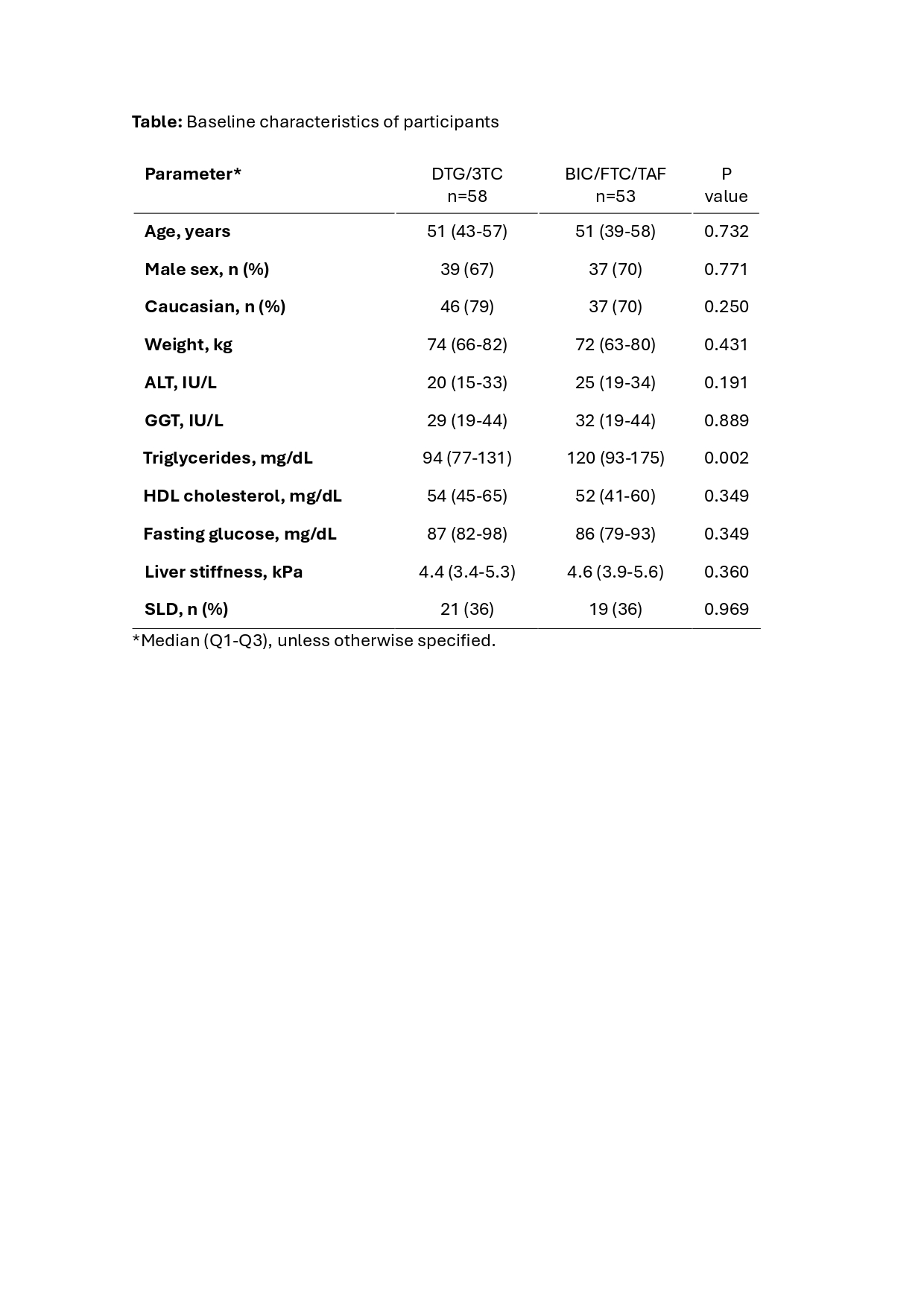
58 participants received DTG/3TC and 53 BIC/FTC/TAF. Baseline characteristics are shown in the table. At week 96, the CAP gain was 1 ([-39]-33) dB/m in PLWH on DTG/3TC vs. 10 ([-11]-52) dB/m (p=0.099) in those on BIC/FTC/TAF. SLD was present in 29% individuals on DTG/3TC and in 49% on BIC/FTC/TAF (p=0.033) at week 96. Weight gain ≥5% occurred in 12 (21%) individuals on DTG/3TC and in 17 (32%) on BIC/FTC/TAF (p=0.173). In the subset of participants who gained ≥5% weight, CAP change was -19 ([-53]-35) dB/m in those on DTG/3TC and 14 ([-9]-62) dB/m (p=0.027) in those on BIC/FTC/TAF, while no significant difference was observed among those who did not gain ≥5% weight. Among individuals with ≥5% weight gain, 17% on DTG/3TC vs. 76% on BIC/FTC/TAF (p=0.002) showed SLD and no difference was found among patients with <5% weight increase (Mantel-Haenszel test, p=0.081). In a multivariable linear regression analysis, adjusted for age, sex, treatment, triglycerides, weight gain and NRTIs in the prior regimen, CAP increase was independently associated with the assigned treatment (B [95%CI]=23.026 [-0.024,46.075], p=0.050).
Conclusions
Switching to BIC/FTC/TAF is associated with a higher frequency of SLD compared to DTG/3TC after 96 weeks of therapy. The differential impact of these regimens on SLD is more pronounced in PLWH who experience weight gain following therapy switch.
Table or Figure