Background
People living with HIV and active tuberculosis (PWH/TB) generate more broadly potent HIV-1 neutralizing antibodies as compared to those PWH/No TB (Bukola et al.). Enhanced neutralizing antibody responses, together with rapid viral diversification, can favor the emergence of neutralization resistant HIV-1 envelopes. We hypothesize that PWH/TB as compared to PWH/No TB harbor more broadly neutralizing antibody (bNAb) resistant variants.
Methods
We developed a novel digital droplet PCR method that amplifies 3,000 full-length HIV-1 envelope sequences per reaction with less than 2% recombination and less than 2 errors per sequence. Amplicons were sequenced using single molecule PacBio technology. We characterized 6,898 unique plasma derived envelopes from 7 PWH/TB. In addition, we examined 217 unique PBMC-derived envelopes from 21 PWH/TB and 13 PWH/No TB. Neutralization sensitivity of each envelope was computationally predicted using bNAb-ReP for VRC01, 3BNC117, 10-1074, PGT121, CAP256-VRC26.25, and PGDM1400. Cumulative resistance distributions among PWH/TB and PWH/No TB were compared using Kolmogorov-Smirnov tests.
Results
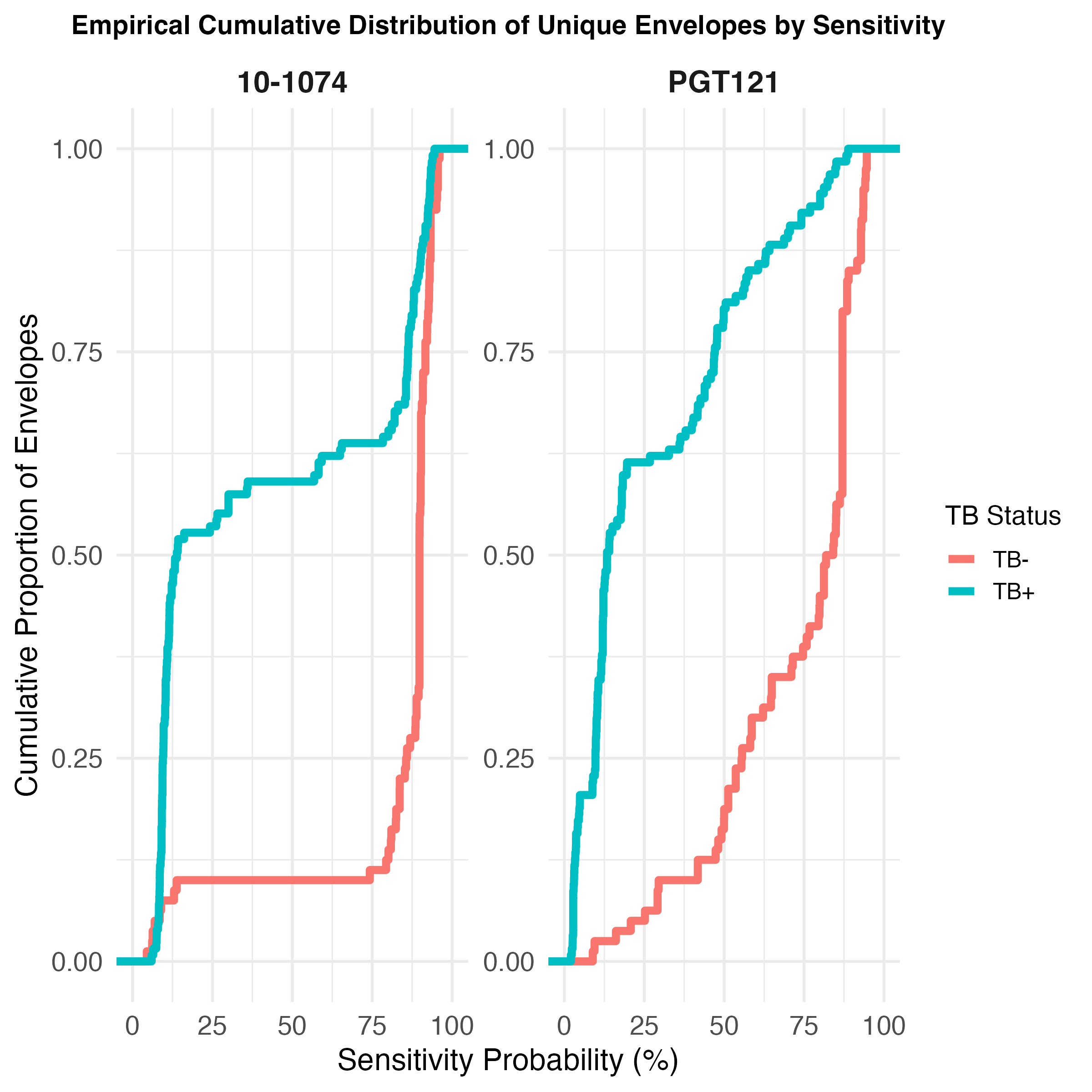
We examined an unprecedented number of unique full length envelope sequences from plasma (median = 1298/donor, range 296 – 1621) and PBMCs (median = 4/donor, range = 2-23). PBMC-derived HIV-1 envelopes from PWH/TB versus PWH/No TB had greater predicted resistance to V3-glycan antibodies 10-1074 (p<0.005) and PGT121 (p<0.005). In contrast, resistance patterns to CD4-binding bnAbs (VRC01 and 3BNC117), PGDM1400, or CAP256-VRC26.25 were not statistically different between groups. In plasma, rare resistant variants were detected across multiple donors. In 5 of 7 donors, at least one unique envelope predicted to be resistant to each bNAb was detected, with different envelopes conferring resistance to different antibodies. These envelopes were detected at a rate as low as 1 in 1298. One individual who had complete predicted sensitivity to CD4 binding antibodies had near complete predicted resistance to V3-glycan antibodies with 404 of 405 envelopes exhibiting less than 25% sensitivity.
Conclusions
Pre-existing bnAb predicted resistance is extremely common when assessed using unprecedented level of sequencing depth. PWH/TB as compared to PWH/No TB have greater predicted bnAb resistance to V3 glycan bNAbs. Our novel methodology and TB status will be important for future bnAb research aimed at prevention and inducing virus remission.
Table or Figure