Background
HIV proviral DNA drug resistance testing has not consistently predicted treatment outcomes, yet it may be valuable for regimen optimization during virologic suppression. Because only genome-intact proviruses drive viral rebound, resistance confined to defective, non-hypermutated genomes may have limited clinical relevance, but they remain included in commercial DNA drug resistance testing. We analyzed near-full-length HIV proviral genomes from multiple cohorts to test whether drug resistance mutations (DRMs) are differentially archived in intact versus defective genomes, informing whether proviral DRM testing should distinguish these compartments.
Methods
Blood-derived cells from four cohorts—FRESH (n=24, acute, subtype C), REACH (n=20, chronic, subtype B), RHSP (n=37, chronic, subtype A1/D), and UARTO (n=5, chronic, subtype C) were subjected to single-genome amplification (HXB2 638–9632). Proviruses were classified as intact or defective using HIVSeqinR. Hypermutated genomes were excluded. DRMs were identified according to the 2025 IAS-USA and Stanford HIVdb lists.
Results
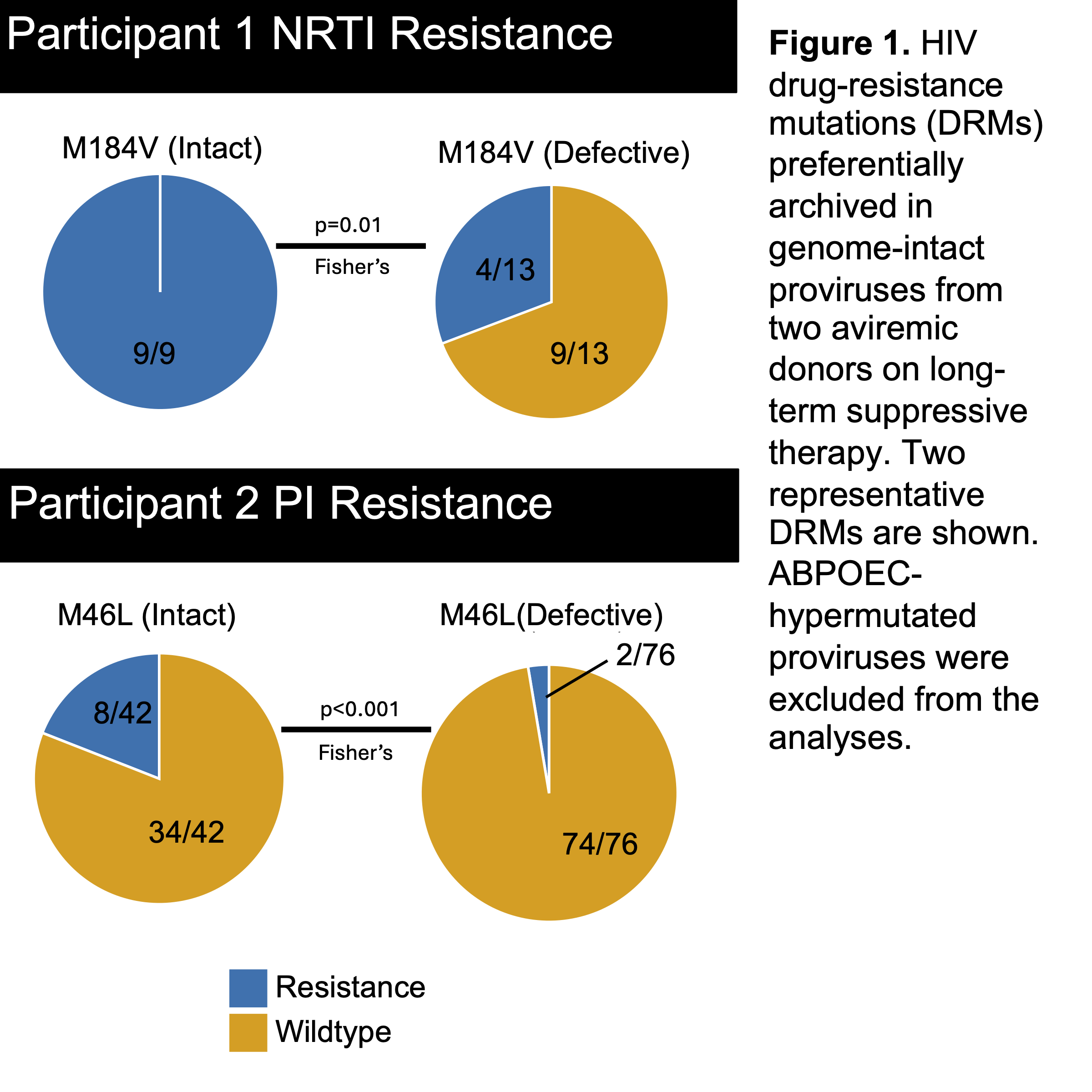
We analyzed 3273 HIV DNA genomes obtained from 86 participants. DRMs were detected in 9 (NRTI), 16 (NNRTI), 83 (PI), and 19 (INSTI) individuals (inclusive of major/minor/subtype-polymorphic DRMs). Fisher’s exact tests showed no differential archival in intact vs defective proviruses in FRESH, RHSP, or UARTO. In REACH, however, two participants had significant enrichment of DRMs in intact genomes. Participant 1, suppressed for 11 years, carried NRTI mutation M184V and PI mutations N88D, D30N, and V77I preferentially in intact genomes (all adjusted Fisher’s p≤0.03; Fig1), consistent with prior nelfinavir/lamivudine/stavudine failure. Participant 2, suppressed for 8 years, never on PI but had known transmitted PI DRMs, showed preferential intact-genome archival of PI mutation M46L (adjusted Fisher’s p=0.02; Fig1). Phylogenetic analysis revealed 100% nucleotide identity in 18/24 intact genomes carrying linked M184V (NRTI) and N88D/D30N/V77I (PI) in participant 1, and in 6/42 intact genomes M46L (PI) in participant 2, consistent with clonal expansion of infected cells propagating these DRMs in intact compartment.
Conclusions
Most participants showed no compartmentalization of DRMs, but selected individuals had significant enrichment in genome-intact proviruses. These findings support evaluating resistance testing strategies that specifically target intact proviral genomes and association with treatment response.
Table or Figure