Background
Although virological failure (VF) with Long-acting injectable (LAI) regimen with cabotegravir (CAB) and rilpivirine (RPV) is rare, it is frequently accompanied by integrase inhibitor (INI) and NNRTI resistance, potentially compromising future ART options. We aimed to characterize real-life CAB+RPV LAI failures, resistance and post-failure outcomes in Italy.
Methods
We conducted a retrospective observational cohort study including people with HIV (PWH) treated with CAB+RPV LAI followed in 20 Italian clinical centers over Mar 2022 – Febr 2025. VF was defined as 2 consecutive viremia ≥50 cps/mL, or one >50 cps/mL followed by therapy change, or as failure to achieve viral suppression (viremia <50 cps/mL). For individuals with a genotypic resistance test (GRT) after VF to CAB+RPV LAI, resistance and post-failure outcomes were evaluated.
Results
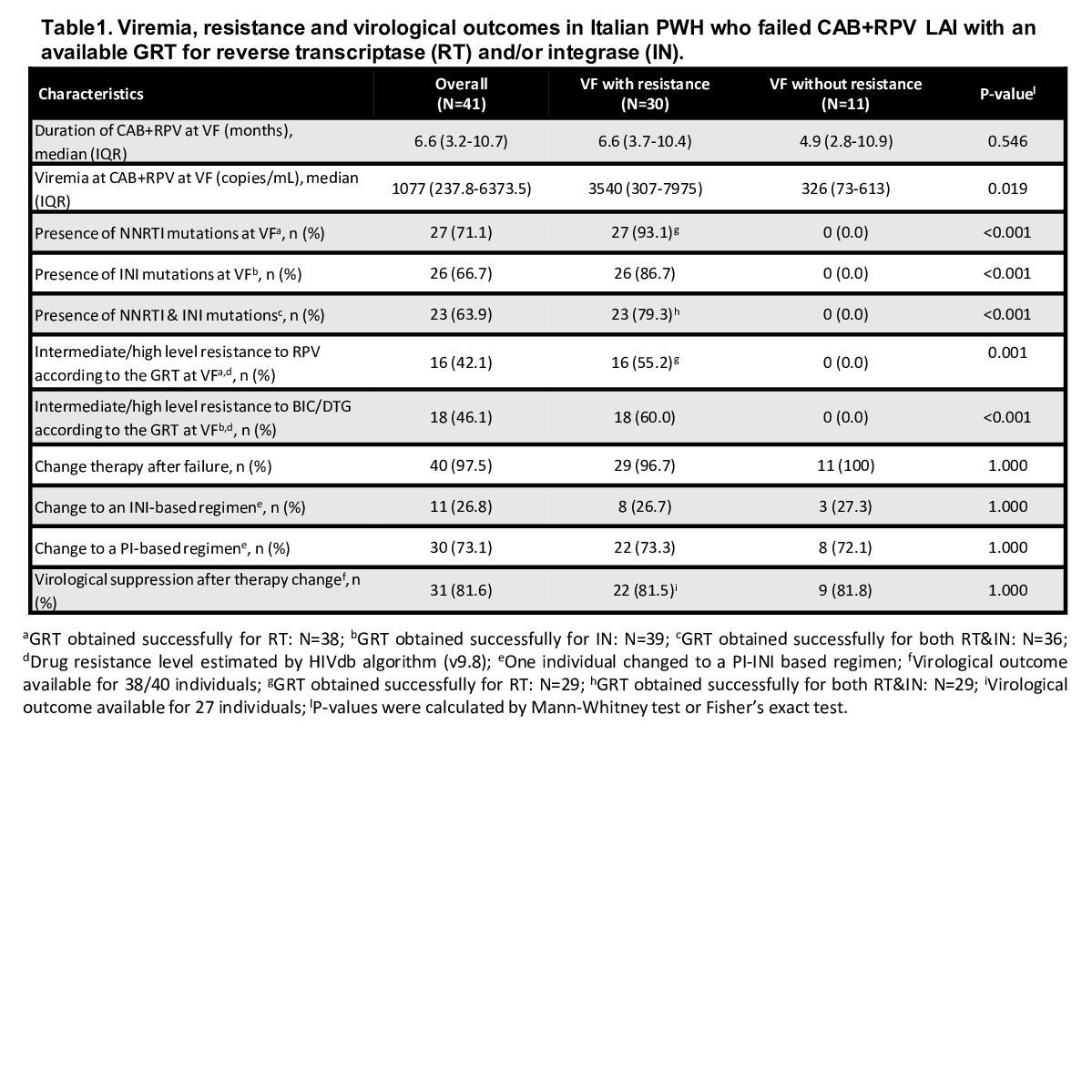
Among 2052 PWH who started CAB+RPV LAI, 43 (2.1%) experienced VF (median [IQR]: viremia, 1077 [238-6374] cps/mL; exposure time to CAB+RPV, 6.6 [3.2-10.7] months). For 41/43 individuals a GRT at VF was available; 33 (80.5%) were male. At CAB+RPV start, their median [IQR] age was 51 (46-58) years, ART duration was 12.9 (7.5-18.3) yrs, BMI was 25.2 (23.2-29.4) Kg/m2. Thirty-seven individuals were virologically suppressed since a median of 48 (6-119) months, 2 had low-level viremia (79 and 146 cps/mL), while 2 had very high viremia levels (1180000 and 154000 cps/mL). No individuals presented ≥1 of the known risk factors for VF (subtype A6, BMI ≥30 Kg/m2, pre-existing RPV resistance). At VF, 30/41 (73.2%) individuals harbored NNRTI and/or INI resistance, with viremia levels higher than those without resistance; 60% of them showed intermediate/high levels of bictegravir/dolutegravir cross resistance (Table1). After VF, 40 individuals changed therapy (PI-based, n=29; INI-based, n=10; PI-INI-based, n=1); considering a median (IQR) follow-up time of 2 (1-4) months, 81.6% of them achieved virological suppression, with a similar rate between groups with/without resistance.
Conclusions
In this large real-life Italian cohort, the rate of VF with CAB+RPV LAI was low (2%), with NNRTI and/or INI resistance detected in 73.2% of cases and higher viremia levels in PWH with drug resistance. Despite this, post-failure outcomes were generally successful, with a suppression rate of about 80% regardless of the presence of resistance. These findings support the importance of prompt management of PWH who failed CAB+RPV LAI to restore their virological control.
Table or Figure