Background
Persistent low-level viremia (LLV; 50-199 copies/mL) is generally considered to confer a modest risk of virological failure (VF; ≥200 copies/mL). Yet, data on LLV in people with HIV (PWH) with multidrug-resistant viruses, particularly those with four-class drug resistance (4DR), remains limited. We therefore aimed to compare the risk of LLV between 4DR- and non-4DR-PWH.
Methods
Matched cohort study of PWH who achieved stable virological suppression (VS; <50 copies/mL for ≥6 months) after VF [≥2 viral loads (VLs) ≥200 copies/mL or ≥1 VL ≥1000 copies/mL] from 2014 onward. Participants were classified as 4DR (PRESTIGIO Registry) or non-4DR (ARCA, ICONA, San Raffaele, Sacco) and matched up to 1:3, by sex assigned at birth, baseline (BL) age (±5 years), ART duration (±5 years), and calendar year (±2 years). Follow-up accrued from the first VL after 6 months of VS (BL) until LLV, VF, or last VL. The primary endpoint was a composite of VF and LLV (≥2 VLs 50-199 copies/mL); the secondary was LLV. Kaplan-Meier curves estimated cumulative probabilities of VF/LLV. The cumulative incidence function, with VF as competing risk, assessed LLV. Cox regression and Fine-Gray models adjusted for BL CD4+ and ART duration.
Results
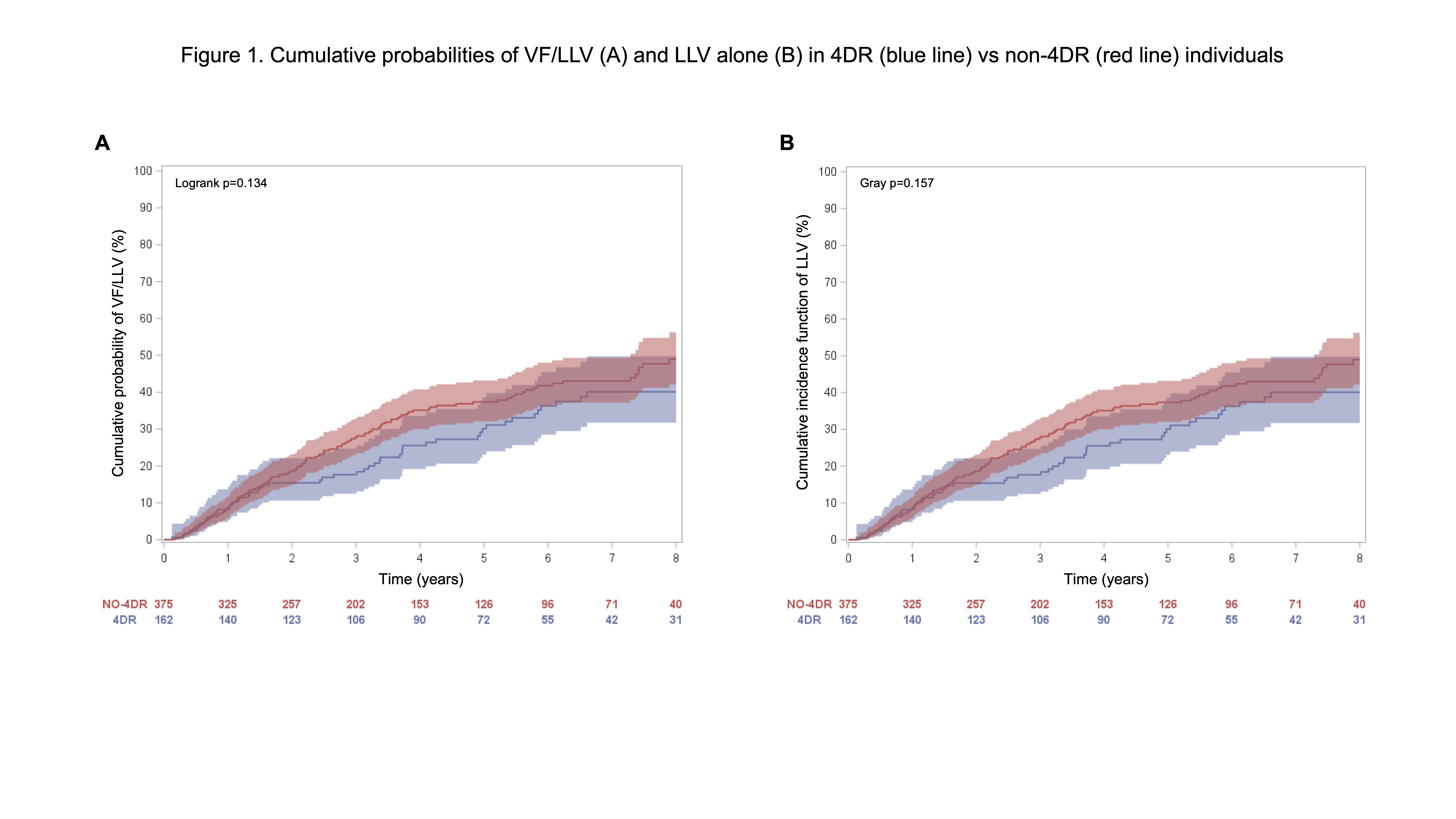
We included 162 4DR-PWH [median age 54.1 years (interquartile range 49.9-58.1), 71.6% male, ART exposure 22.0 (18.0-25.3) years, CD4+ 557 (376-790)] and 375 non-4DR-PWH [age 53.0 (48.7-57.6) years, 66.1% male, ART exposure 19.5 (16.1-23.0) years, CD4+ 481 (283-721); 34.2%, 22.2%, 30.0%, and 13.6% with 0-, 1-, 2-, and 3-class resistance, respectively]. After 3.6 (1.6-6.5) years of follow-up, 52/162 (32.1%) 4DR- and 133/375 (35.5%) non-4DR-PWH experienced VF/LLV (p=0.489). Specifically, 23/162 (14.2%) 4DR and 35/375 (9.3%) non-4DR developed LLV (p=0.098). At 3 years, the cumulative probability of VF/LLV was 17.7% in 4DR- vs 27.8% in non-4DR-PWH (p=0.134; Figure 1A); after adjustment, no significant difference remained [hazard ratio (HR)=0.85, 95% confidence interval (95%CI)=0.61-1.19, p=0.344]. The probability of LLV was 9.0% in 4DR and 7.5% in non-4DR (p=0.157; Figure 1B); this trend persisted after adjustment, though not significant (subdistribution HR=1.55, 95%CI=0.89-2.69, p=0.124).
Conclusions
In this multicohort matched analysis of suppressed PWH with long ART exposure and prior VF, 4DR did not affect the risk of VF/LLV. However, a trend toward more frequent LLV in 4DR-PWH was observed, possibly reflecting virological mechanisms that could interplay with multidrug resistance.
Table or Figure