Background
In this study, we investigated integrase strand transfer inhibitor drug resistance mutations (INSTI-DRMs) in HIV patients receiving antiretroviral (ARV) treatment in Rwanda.
Methods
A longitudinal cross-sectional survey used remnant viral load samples from 208 adults in Rwanda, stored at sixteen regional labs. Resistance was assessed by detecting specific drug resistance mutations (DRMs) in the HIV integrase gene. Each mutation was assigned a penalty score for individual drugs, and the total score was calculated by summing the relevant mutation scores. This total was used to classify resistance as susceptible, low, or intermediate, with scores of 30–59. High resistance was indicated by scores of 60 or more, following Stanford guidelines.
Results
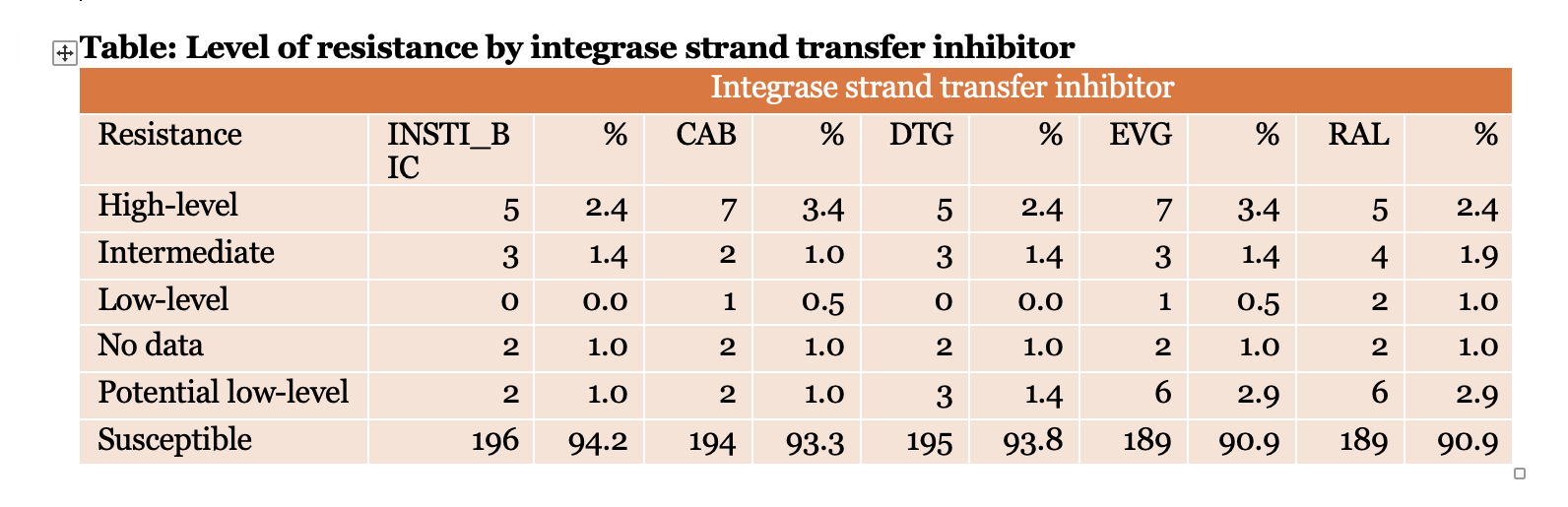
Based on the Cyclic Acquired Drug Resistance (CADRE) survey data collected, INSTI results were available for 208 adult participants tested between August 2022 and December 2023. The average age was 40.1 years, and the majority (58.2%) of participants were females. The estimated INSTI-DRMs for Bictegravir (BIC), Cabotegravir (CAB), Elvitegravir (EVG), and Raltegravir (RAL) ranged between 2.4% high-level to 9.1% any-level and 2.4% high-level to 6.2% any-level of resistance for INSTI Dolutegravir (DTG). INSTI-DRMs were detected in 83 (14%) individuals; 11 (5.3%) had more than one INSTI-DR mutation. Most participants (n=195, 93.8%) were susceptible to dolutegravir; three (1.4%) had potential low, two (1.0%) low, three (1.4%) intermediate, and five (2.4%) high-level dolutegravir resistance. In Rwanda, the ‘major’ INSTI-resistance mutations T66AIK, E92QV, G118R, F121Y, E138AT, G140ACS, Y143CHR, S147G, Q148HKR, or N155HS were rarely selected. The ‘accessory’ INSTI-DRMs included H51Y, L68IV, KL74ILM, T97TA, E138AK, G140ACS, G149A, S153F, E157EQ, G163AGKR, and R263K. In INSTI-treated patients, G118R was the most common major mutation selected.
Conclusions
Most participants are still susceptible to DTG, and major INSTI-DRM mutations were rarely selected. The Q148H and N155H mutations are believed to induce conformational changes within the catalytic pocket, leading to a reduced binding affinity of INSTIs to IN.
Table or Figure