Background
During HIV antiretroviral therapy scale-up there has been an increase in pre-treatment non-nucleoside reverse transcriptase inhibitor resistance observed among individuals initiating antiretroviral therapy. These data provide limited insights into how resistance spreads within communities. Population-level data of pre-treatment resistance are exceedingly rare, particularly from sub-Saharan Africa.
Methods
We analyzed data from the population-based Rakai Community Cohort Study collected between 2003 and 2021. Consenting people aged 15-49 years were interviewed and provided samples for HIV testing, viral load (VL) quantification, and sequencing. Major resistance mutations were identified in pre-treatment viral genomes. As viral load is correlated with transmission rate, the impact of resistance on pre-treatment VL was evaluated in a multivariate linear regression. Genetic distance (<0.025 substitutions/site) and Bayesian phylogenetic-based analyses were used to identify clusters of individuals linked by recent transmissions.
Results
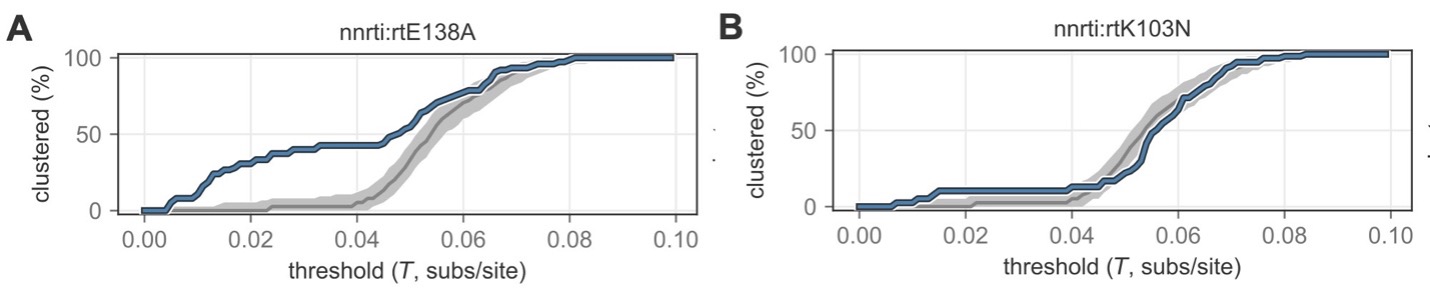
A total of 2,734 complete pre-treatment pol sequences were available. Out of 33 mutations observed in ≥2 pre-treatment individuals the most common were rtK103N (n=77), rtE138A (n=75), proL33F (n=32), and rtM41L (n=27). Within-individual co-occurrence of resistance mutations was uncommon (n=59/281). The only mutation with an effect on VL was rtM41L (-0.3 [95% HPD -0.6-0] log10 copies/mL). After accounting for multiple testing, 5 mutations (rtM41L, rtK101E, rtE138A, rtE138G, and proL33F) were significantly clustered compared to a null distribution accounting for prevalence (adj p-values <0.033). Despite high prevalence, rtK103N showed minimal evidence of clustering (adj. p-value = 0.33). These findings were corroborated by phylogenetic analyses of 634 A1 and 1,045 D viruses. While most sequences with rtK103N, rtE138A, and proL33F were not phylogenetically linked (76%, 95%HPD 77-79%), we do identify monophyletic subtrees of up to 5 pre-treatment individuals for rtE138A and up to 7 pre-treatment individuals for proL33F.
Conclusions
We observe divergent patterns of viral genetic clustering of resistance mutations among pre-treatment individuals. Limited rtK103N clustering suggests a predominance of acquisition from people failing therapy and limited sustained pre-treatment transmission. Our results suggest sustained pre-treatment transmission of rtE138A, which is concerning as rtE138A is associated with CAB/RPV regimen failure.
Table or Figure