Background
Dolutegravir (DTG)-based antiretroviral therapy (ART) covers most PLHIV in Zambia. Here we describe HIV drug resistance (HIVDR) to DTG and patterns of integrase (IN) drug resistance mutations (DRMs) in clients failing DTG-based regimens (DBRs) in Zambia.
Methods
Treatment failure was defined as a second viral load (VL) above 1000 copies/mL subsequent to a 3-months period of enhanced adherence counselling (EAC) to support ideal compliance to ART. ART clients with presumed treatment failure from facilities served by 21 randomly selected hub laboratories across the country were eligible to participate in this study. Remnant post EAC VL plasma from eligible clients was stored by provincial VL laboratories and referred to University Teaching Hospital laboratories in Lusaka for HIV genotyping. Before genotyping, VL testing was repeated and then Applied Biosystems HIV-1 genotyping kit with integrase (Thermo-Fisher Scientific, UK) was used to sequence suitable samples (repeat VL>1000 copies/mL). Sequence assembly and editing was done using RECall software (Centre for Disease Control, USA). DRMs and resistance profiles were generated using the Stanford HIVDR database, version 9.8 (Stanford University, USA). Clinical and demographic data of participants was obtained from the viral load laboratory requisition form.
Results
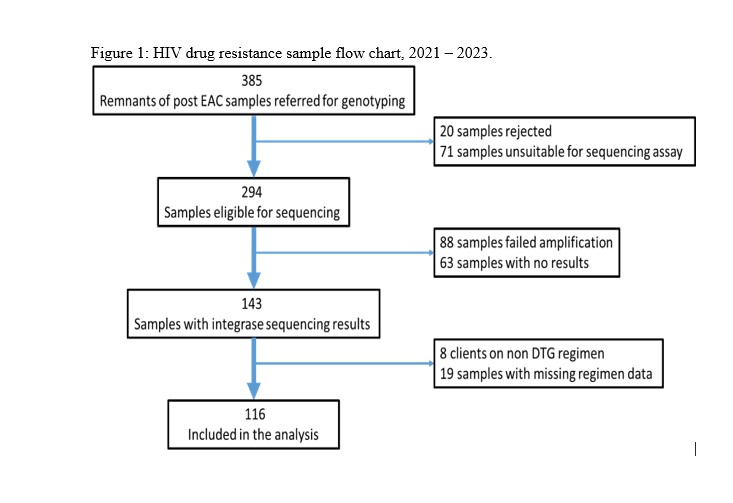
From October 2021 to September 2023, remnant post EAC plasma samples from 385 eligible ART clients with presumed treatment failure were referred for HIV genotyping. Only 143 of these clients had IN genotyping results, therefore eligible for inclusion in the study. Twenty-six (26) clients were excluded from the study because of current non-DBR (8) or missing regimen data (19). Of the remaining 116 clients included in the study (figure1), 45 (38.8%) were males while 96 (82.8%) were on 1st line HIV treatment. Study participants median age was 33.6 years (IQR: 20.6 – 43.1) while median VL was 35,931 copies/ml (IQR: 8,280 – 140,000) and median time on ART was 5 years (IQR: 2 – 9). Intermediate- to high-level DTG HIVDR was detected in 26.7% (95% CI: 19.5 – 35.4) participants. Major IN drug resistance mutations detected were E138AEK (19.0%), G118R (13.8%), T66AITV (10.3%), G140AGR (6.0%), Q148KR (6.0%), N155H (6.0%), R263K (5.2%) and E92Q (1.7%).
Conclusions
The high rate of DTG drug resistance observed in ART clients failing DBR may indicate a potential emerging challenge. Underlying selection bias and limited sample size may influence the generalizability of this finding.
Table or Figure